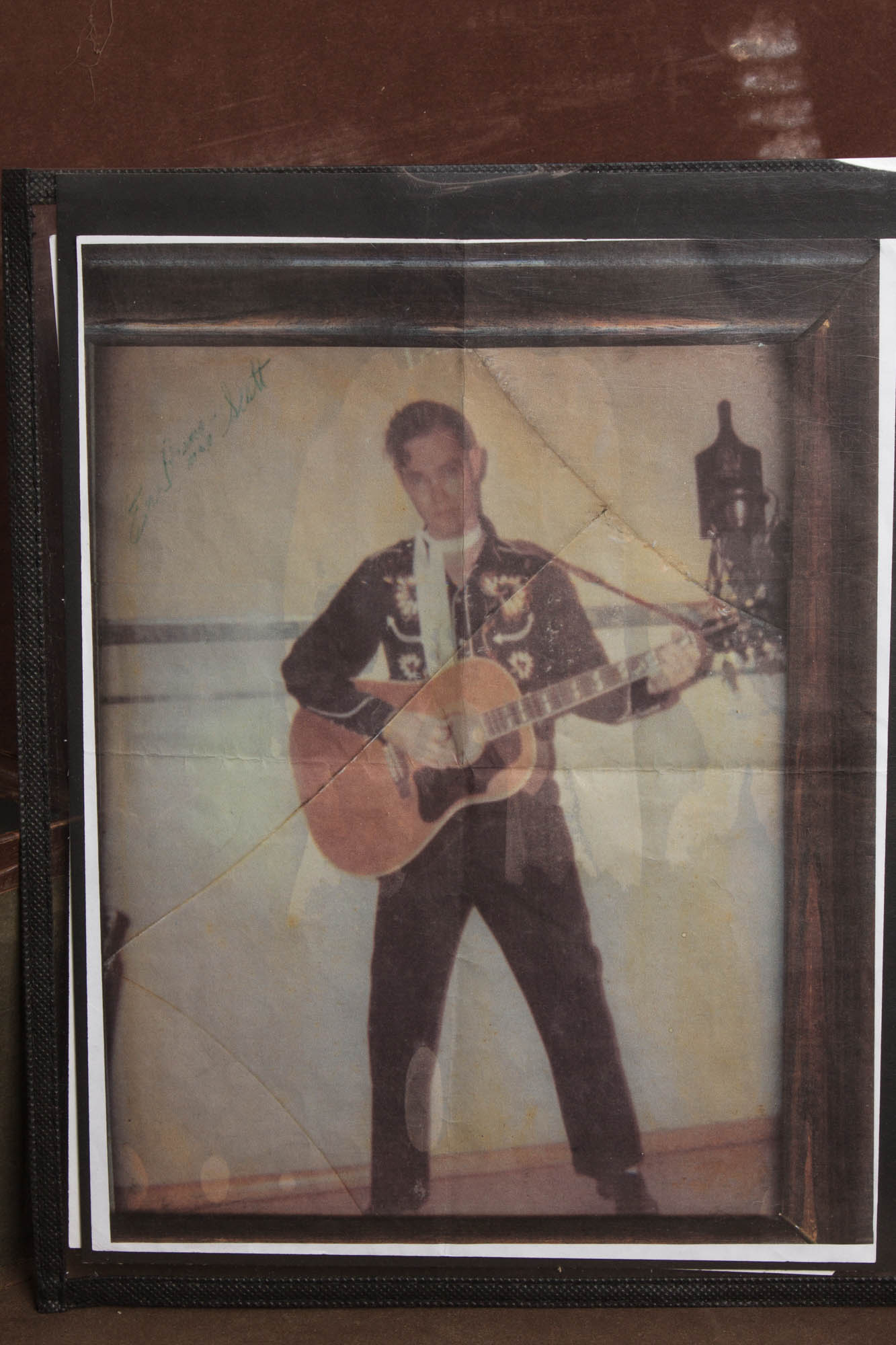
Gibson Country Western Owned and Played by Earl Scott Model Flat Top Acoustic Guitar (1956), made in Kalamazoo, Michigan, serial # V7389-29, natural lacquer finish, mahogany back and sides, spruce top; mahogany neck with rosewood fingerboard, original brown alligator chipboard case.
The Gibson Country-Western model is essentially a re-named SJN, the Southern Jumbo in a natural finish. When the model was officially renamed in 1955 it was given a special lariat-bordered label. In either guise it sat at the top of the company's 1950's slope-shoulder Jumbo line over the SJ, J-50, and J-45. The SJ itself had become a somewhat fancier guitar by the mid-1950's, gaining a pearl logo and crown headstock ornament, while at the same time a natural top option was added soon before the natural SJN was renamed the Country-Western Model as a tip of the hat to the many Gibson pickers of that genre.
This guitar has a really cool provenance as it did in fact belong to a professional Country singer/picker, albeit one who is not well remembered today. Earl Scott began recording in the late '50s; in the early '60 he had a couple of minor hits the biggest being "Then a Tear Fell" in 1962 on Kapp Records. He later recorded for Mercury and Decca Records without much success, but made a few guest appearances on the Grand Ole Opry and Ernest Tubb's record shop Midnight Jamboree. His stage wear was apparently flashy enough to once merit a special magazine article! He appears to have played this Gibson early in his career; it arrived in the original brown alligator chipboard case with a printout of a photo of him in full regalia playing the guitar, and a copy of his 1961 HAP 45 "You're That Certain Someone/"Opal Lee".
This C&W was made in 1956, the first year after the model's renaming. it features a multi-bound top and back, bound fingerboard with pearloid double parallelogram inlay and the new larger tortoise celluloid pickguard used after 1955. It remains in nice original condition with one small addition; an second plastic endpin added over the heel, set into the upper end of the neck block. Earl's old C&W shows signs of use but remains an effortless player with a warm, sweet but still powerful tone, still a hillbilly strummer's delight and an excellent all around guitar.
Overall length is 40 3/4 in. (103.5 cm.), 16 1/4 in. (41.3 cm.) wide at lower bout, and 5 in. (12.7 cm.) in depth at side, taken at the end block. Scale length is 24 3/4 in. (629 mm.). Width of nut is 1 11/16 in. (43 mm.).
This is played-in guitar that remains largely original with some cosmetic wear but no major damage or repair. There is moderately heavy checking overall; the top has dings and scrapes with pickwear into the wood around the lower soundhole edge and just off the back edge of the pickguard, with a few case lid dings by the upper edge. The back and sides show checking and wear spots with some "belt buckling" into but not through the back finish; Earl definitely wore a cowboy buckle! The back of the neck has some feelable dings and chips but no heavy capo wear, the headstock shows some chips and dings as well.
There are no cracks or structural repairs detectable on the instrument. The original celluloid pickguard was replaced with a correct tortoise replica but it is included in the case; likely it has shrunken up somewhat. The rosewood top-belly bridge is original and appears to have been taken down just a hair long ago and possibly reglued although if so it was a clean job. Internally all bracing and the maple bridgeplate are original and undisturbed, the bridge retaining bolts are still in place. The only modification is the added endpin/strap button over the neck heel (secured into the upper end of the neck block) which is odd but solid.
The frets appear original, crowned down somewhat in the lower positions but still fully playable; the fingerboard shows some divoting in the first position (where we'd guess Earl mostly played). The neck has never been reset and the angle is good and the guitar plays very nicely with a great chunky Honky-Tonk sound. If not the cleanest C&W this one sounds and plays great with a killer story and vibe about it; We don't know how long Earl played the guitar (he had a J-200 later in the 1960s) but is seems to have been part of his story. It still lives in the original brown alligator chipboard, solid but worn with some ephemera related to Earl Scott included. Very Good + Condition.