


Gibson Byrdland N (Pre-Production) Thinline Hollow Body Electric Guitar (1955)


1
/
of
18
Couldn't load pickup availability
Item #13860
Gibson Byrdland N (Pre-Production) Model Thinline Hollow Body Electric Guitar (1955), made in Kalamazoo, Michigan, serial # A-20986, natural lacquer finish, maple back and sides with spruce top; laminated maple neck with ebony fingerboard, original brown hard shell case.
This is a truly historic instrument, one of three known production samples (NOT prototypes) if the Byrdland, a pivotal guitar in Gibson history. This is documented in Andre Duchossoir's book "Gibson Electrics: The Classic Years: "According to factory records the earliest production samples were registered on 30 June 1955 (#A-20985/A-20986/A-20987) but the model was not shipped in quantity until 1956. For the record, four original prototypes were built as modified L-5CES with a special thin body and registered on 4th April 1955. Two of them were sent to Billy Byrd and Hank Garland and the remaining pair kept by CMI/Gibson". What Andre did NOT mention (or may not have known at the time) is that these three pre-production guitar are *significantly* different from all subsequent production models, in a way that makes them both unique and arguably superior instruments. Two of these were natural finish and one sunburst; this beautiful guitar is one of those natural Blonde twins. (Twins, Max...imagine the possibilities...)
At Nashville's 1955 disc jockey convention Gibson sales manager Clarence Havenga asked if top Nashville session player Hank Garland and his friend Billy Byrd, Ernest Tubb's lead guitarist would like to see anything not already in the company line. They suggested an L-5CES electric with a thinner body to make it easier to handle and reduce feedback. Back in Kalamazoo Havenga had four thinline L-5 prototypes built, logged on April 4 1955; Garland and Byrd each received one. Garland then asked for another feature; his Stromberg Model G-5 arch top featured a 23 1/2" scale neck making extended chords easier to reach. The short-scale neck Garland specified would have 22 frets instead of 20 and a narrow a 1 5/8" nut.
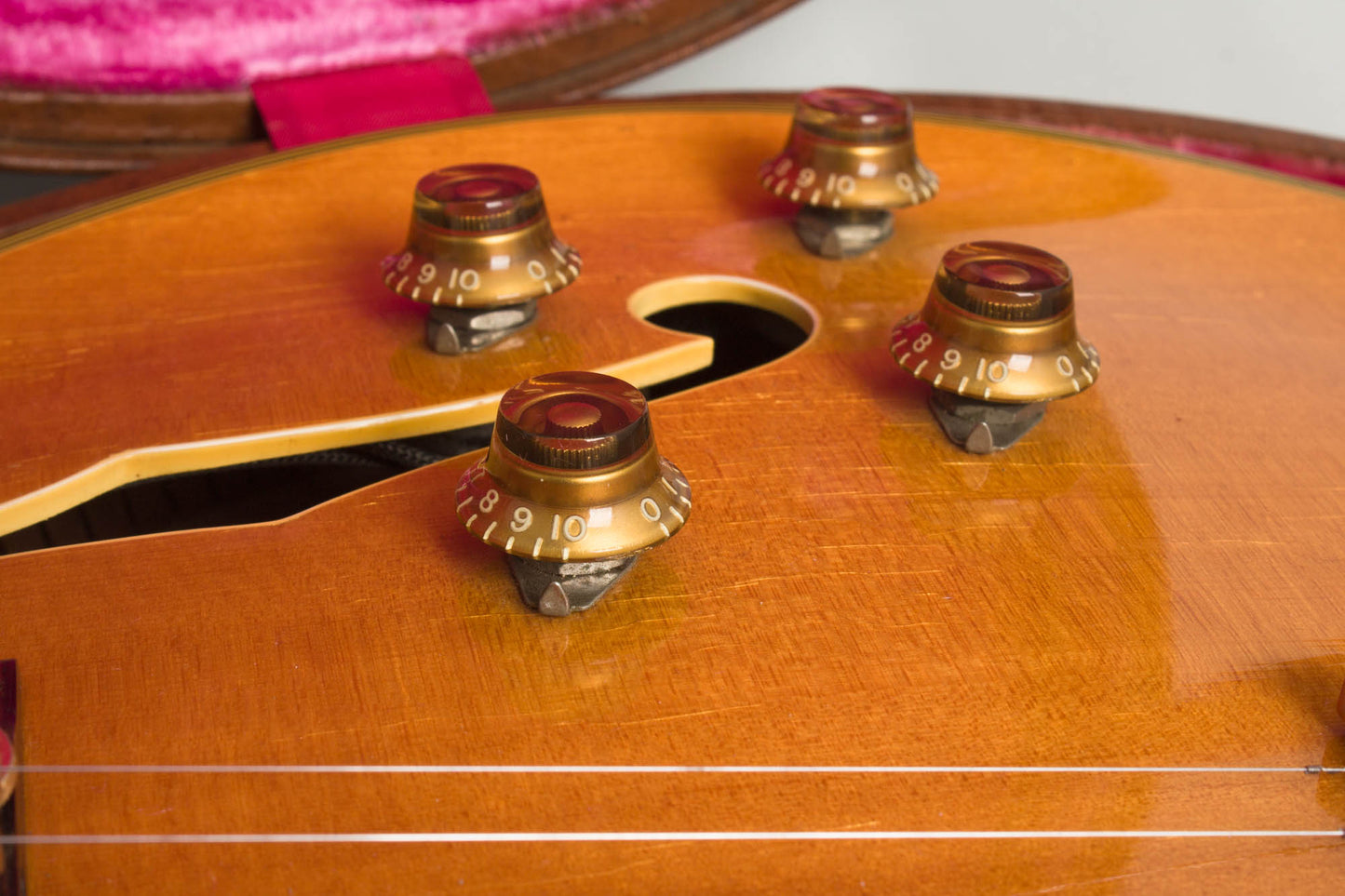
Three production samples incorporating all these ideas (S/N A-20985/6/7) were then run up and named for the two men as the "Byrdland", touted by Gibson as "designed for the fast action needed in modern playing". This Byrdland is one of them, carrying Factory Order Number W1926-3, #3 of that initial batch. Things at Gibson rarely staying neatly in sequence, the serial number on its orange label is A-20986, the middle of the 3 used. Features carried over from the L-5CES including the fully carved spruce top and maple back, L-5 trim and inlay patterns, Kluson Sealfast tuners, two "staple pole" Alnico magnet pickups and 4-knob, one switch wiring rig. New additions included the short scale neck, shallow 2 1/4" rim and a special looped tailpiece. This actual guitar was displayed at the NAMM show in 1955, one of two "Byrdland Nat." listed in Gibson's shipping records as sent to CMI as "Convention Samples" on July 11.
Production models were not shipped to Gibson dealers until 1956, By which time there had been a fairly major change to the design. Shortening the scale length led to an unanticipated issue; the bridge and pickups were mounted far up on the guitar's face. The large lead pickup rout was right alongside the upper ball of the soundhole, resulting in a very small area of top at that junction. Perhaps this was felt to look odd; more likely someone pointed out that this could be a potential weak spot in the top. Even with two long parallel braces underneath this may have been judged prone to failure, which could cause the top to sink.
This guitar has the neck joint between the 15th and 16th fret, while all production guitars have it at the 14th. The scale is the same, this earlier neck is longer and mounts farther forward on the body, making more frets accessible and creating a notable difference in how the guitar handles. Gibson's initial dealer one-sheet dated January 1956 shows the longer-neck Byrdland but production models had already been redesigned, showing Gibson thought this important enough to alter right away. Upper fret access on production models is noticeably more limited and trying both versions side-by-side this original feels MUCH more player friendly. By the next catalog the artwork had been redone to reflect the re-design, something Gibson often did not bother to do!
While considered a classic over the years one of the Byrdland's main selling points has proved a practical drawback. The 23 1/2" scale never caught on with most pro users; jazz players in particular often find it cramped in higher positions. The upscale Byrdland was popular enough to survive as a low-production instrument, with the additions of humbucking pickups in 1957 and a sharp cutaway in 1961. The thinline design it pioneered was hugely popular with Gibson bringing out many more thinner-rim instruments leading to the slim semi-solid ES-335 series. THIS guitar was there when it all began.
This exceptionally rare, nearly unique Byrdland #A-20986 is a truly beautiful blonde, crafted by Gibson's top artisans in 1955 with sinuous lines and the company's finest workmanship. Added to that it remains in stunning original condition having survived the years incredibly well with only minimal wear. It apparently has been little use since sitting on a stand at NAMM in 1955. Even if not the absolute first of its kind, this is one of the primal thinline electrics, a herald of the "modern" electric guitar and a splendid piece of Gibson history.
Overall length is 41 in. (104.1 cm.), 16 15/16 in. (43 cm.) wide at lower bout, and 2 1/8 in. (5.4 cm.) in depth, measured at side of rim. Scale length is 23 3/8 in. (594 mm.). Width of nut is 1 11/16 in. (43 mm.).
This is a superbly clean and original guitar, looking only very lightly used at most since its star appearance in the CMI/Gibson booth at the 1955 NAMM show. The all-original natural finish shows only very light handling wear; it has ambered somewhat over the decades with some light checking and very small dings and scuffs.
Everything on the guitar remains as built except for a Gibson-style strap button mounted to the side above the heel and a *Perfect* custom repro pickguard (using the original bracket) by Paul Fox, who really outdid himself this time. Thanks Paul! There is a tiny hole in the top of the neck heel presumably from another strap button mounting. The gold plating has some light wear, heaviest on the pickup, poles. The top bar of the special tailpiece is not gold plated, but shows the underlying nickel; this looks like a deliberate choice but as there are no comps it's hard to say for sure!
This exceptional guitar plays and sounds divine and is simply a special find in every way, a very different handling instrument from the production Byrdland with the more set-in-to-the-body neck design. This amazing and truly historic guitar resides in the original brown HSC which has some external wear but is also completely solid and original. An antique handwritten setlist card resides in the case pocket. Overall Excellent Condition.
View full details
This is a truly historic instrument, one of three known production samples (NOT prototypes) if the Byrdland, a pivotal guitar in Gibson history. This is documented in Andre Duchossoir's book "Gibson Electrics: The Classic Years: "According to factory records the earliest production samples were registered on 30 June 1955 (#A-20985/A-20986/A-20987) but the model was not shipped in quantity until 1956. For the record, four original prototypes were built as modified L-5CES with a special thin body and registered on 4th April 1955. Two of them were sent to Billy Byrd and Hank Garland and the remaining pair kept by CMI/Gibson". What Andre did NOT mention (or may not have known at the time) is that these three pre-production guitar are *significantly* different from all subsequent production models, in a way that makes them both unique and arguably superior instruments. Two of these were natural finish and one sunburst; this beautiful guitar is one of those natural Blonde twins. (Twins, Max...imagine the possibilities...)
At Nashville's 1955 disc jockey convention Gibson sales manager Clarence Havenga asked if top Nashville session player Hank Garland and his friend Billy Byrd, Ernest Tubb's lead guitarist would like to see anything not already in the company line. They suggested an L-5CES electric with a thinner body to make it easier to handle and reduce feedback. Back in Kalamazoo Havenga had four thinline L-5 prototypes built, logged on April 4 1955; Garland and Byrd each received one. Garland then asked for another feature; his Stromberg Model G-5 arch top featured a 23 1/2" scale neck making extended chords easier to reach. The short-scale neck Garland specified would have 22 frets instead of 20 and a narrow a 1 5/8" nut.
Three production samples incorporating all these ideas (S/N A-20985/6/7) were then run up and named for the two men as the "Byrdland", touted by Gibson as "designed for the fast action needed in modern playing". This Byrdland is one of them, carrying Factory Order Number W1926-3, #3 of that initial batch. Things at Gibson rarely staying neatly in sequence, the serial number on its orange label is A-20986, the middle of the 3 used. Features carried over from the L-5CES including the fully carved spruce top and maple back, L-5 trim and inlay patterns, Kluson Sealfast tuners, two "staple pole" Alnico magnet pickups and 4-knob, one switch wiring rig. New additions included the short scale neck, shallow 2 1/4" rim and a special looped tailpiece. This actual guitar was displayed at the NAMM show in 1955, one of two "Byrdland Nat." listed in Gibson's shipping records as sent to CMI as "Convention Samples" on July 11.
Production models were not shipped to Gibson dealers until 1956, By which time there had been a fairly major change to the design. Shortening the scale length led to an unanticipated issue; the bridge and pickups were mounted far up on the guitar's face. The large lead pickup rout was right alongside the upper ball of the soundhole, resulting in a very small area of top at that junction. Perhaps this was felt to look odd; more likely someone pointed out that this could be a potential weak spot in the top. Even with two long parallel braces underneath this may have been judged prone to failure, which could cause the top to sink.
This guitar has the neck joint between the 15th and 16th fret, while all production guitars have it at the 14th. The scale is the same, this earlier neck is longer and mounts farther forward on the body, making more frets accessible and creating a notable difference in how the guitar handles. Gibson's initial dealer one-sheet dated January 1956 shows the longer-neck Byrdland but production models had already been redesigned, showing Gibson thought this important enough to alter right away. Upper fret access on production models is noticeably more limited and trying both versions side-by-side this original feels MUCH more player friendly. By the next catalog the artwork had been redone to reflect the re-design, something Gibson often did not bother to do!
While considered a classic over the years one of the Byrdland's main selling points has proved a practical drawback. The 23 1/2" scale never caught on with most pro users; jazz players in particular often find it cramped in higher positions. The upscale Byrdland was popular enough to survive as a low-production instrument, with the additions of humbucking pickups in 1957 and a sharp cutaway in 1961. The thinline design it pioneered was hugely popular with Gibson bringing out many more thinner-rim instruments leading to the slim semi-solid ES-335 series. THIS guitar was there when it all began.
This exceptionally rare, nearly unique Byrdland #A-20986 is a truly beautiful blonde, crafted by Gibson's top artisans in 1955 with sinuous lines and the company's finest workmanship. Added to that it remains in stunning original condition having survived the years incredibly well with only minimal wear. It apparently has been little use since sitting on a stand at NAMM in 1955. Even if not the absolute first of its kind, this is one of the primal thinline electrics, a herald of the "modern" electric guitar and a splendid piece of Gibson history.
Overall length is 41 in. (104.1 cm.), 16 15/16 in. (43 cm.) wide at lower bout, and 2 1/8 in. (5.4 cm.) in depth, measured at side of rim. Scale length is 23 3/8 in. (594 mm.). Width of nut is 1 11/16 in. (43 mm.).
This is a superbly clean and original guitar, looking only very lightly used at most since its star appearance in the CMI/Gibson booth at the 1955 NAMM show. The all-original natural finish shows only very light handling wear; it has ambered somewhat over the decades with some light checking and very small dings and scuffs.
Everything on the guitar remains as built except for a Gibson-style strap button mounted to the side above the heel and a *Perfect* custom repro pickguard (using the original bracket) by Paul Fox, who really outdid himself this time. Thanks Paul! There is a tiny hole in the top of the neck heel presumably from another strap button mounting. The gold plating has some light wear, heaviest on the pickup, poles. The top bar of the special tailpiece is not gold plated, but shows the underlying nickel; this looks like a deliberate choice but as there are no comps it's hard to say for sure!
This exceptional guitar plays and sounds divine and is simply a special find in every way, a very different handling instrument from the production Byrdland with the more set-in-to-the-body neck design. This amazing and truly historic guitar resides in the original brown HSC which has some external wear but is also completely solid and original. An antique handwritten setlist card resides in the case pocket. Overall Excellent Condition.


Loading...
Just arrived!
Item #