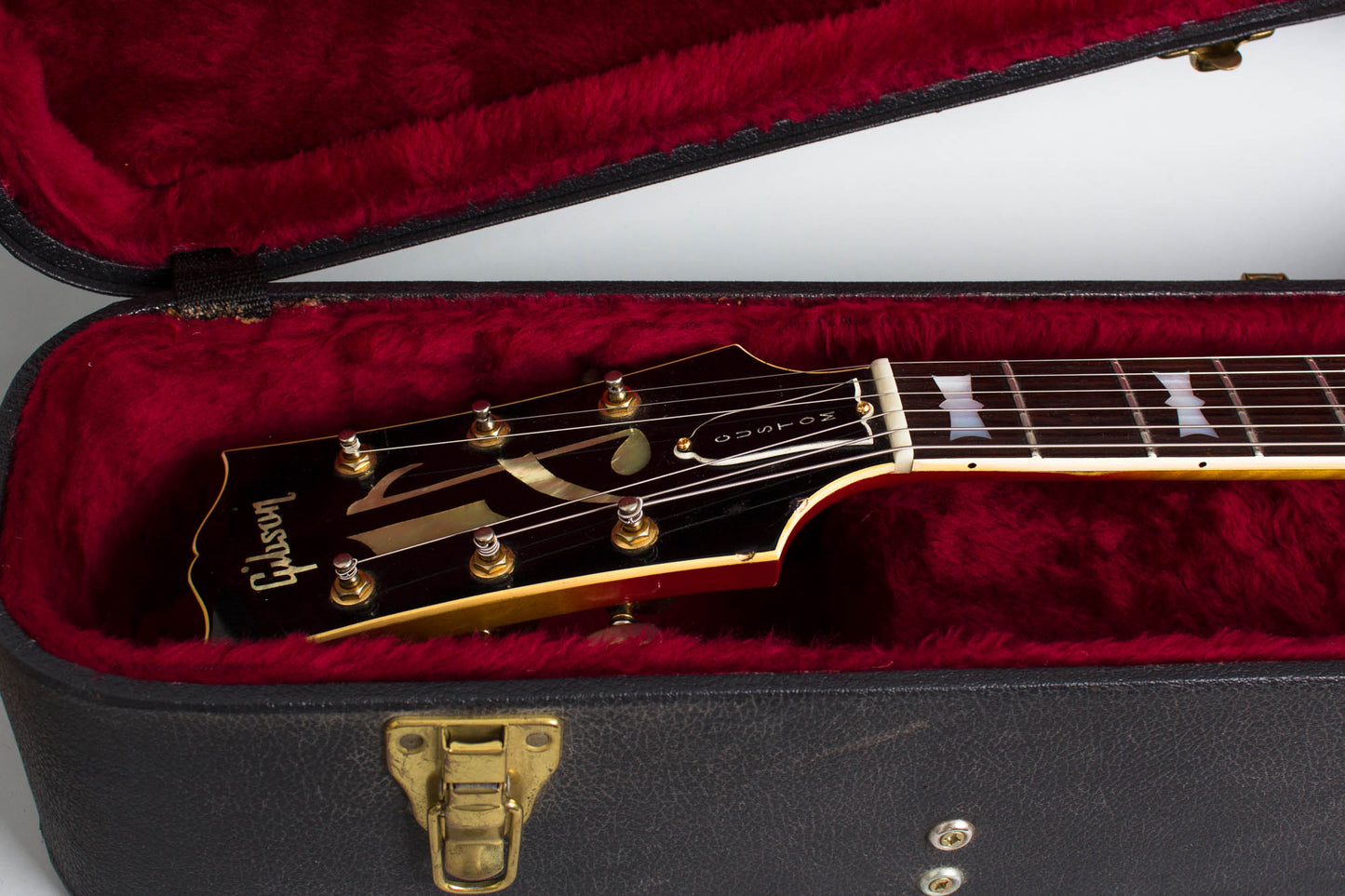
Gibson Barney Kessel Custom Model Arch Top Hollow Body Electric Guitar (1965), made in Kalamazoo, Michigan, cherry sunburst finish, laminated maple body and neck with rosewood fingerboard, black tolex hard shell case.
This is a cool example of one our favorite if somewhat eccentric 1960's Gibsons, the relatively rare Barney Kessel Custom. In the early '60s star jazz guitarist Barney Kessel was on a hot streak, having just won the DOWN BEAT poll 3 years running. Around 1960 he was induced to abandon a prior endorsement deal with Kay (whose guitars he called "terrible") to go with officially endorsing Gibson, whose guitars he played anyway. How much input Kessel himself had in this subsequent design can be debated, but the result was certainly a distinctive instrument then and now.
The Kessel Signature model's most notable feature is a 17" wide, full depth body with a double sharp "Florentine" cutaway, a new idea at Gibson at the time. The model was offered in "Custom" or "Regular" format built on this body, differing mostly in cosmetic details. This is a 1965 Custom model, the more deluxe of the two with gold-plated hardware on the bright cherry sunburst finished body and special "Bowtie" and "Musical note" motifs to the fingerboard and headstock inlay, respectively. The neck is the 5-piece laminate maple used on higher-grade Gibsons at the time; the nut width lands squarely between the older 1 11/16" and post-'65 1 5/8" specs; call it 1 21/32"! Overall the neck has a wider, chunkier feel than many 1965 Gibsons which can get quite thin.
This guitar has Patent # pickups as is typical for 1965 with the standard Gibson one switch, four pot wiring rig, topped off with gold-tinted clear plastic metal-capped knobs. Other hardware includes Grover Rotomatic tuners, an bound celluoiod floating pickguard and a standard gold tailpiece with an engraved "Barney Kessel" plaque inserted in the middle. By 1965 the model had a few notable differences from the earliest versions; the originally specified laminated spruce top had been replaced by laminated maple and large heel joint was shortened somewhat to improve high-fret access.
This is a somewhat rare guitar, with only 42 shipped in 1965, the peak year of the guitar boom. The Kessel models were not a huge hit when new but were featured by a few notable 1960s players including Trini Lopez, who based his subsequent signature model on it, Bryan Maclean of Love (who played a nearly identical custom) and most notably Gene Cornish of the Rascals, who played several versions of the BK regular. Cornish was the model's most dedicated user, playing one through much of his career with the band and having several custom black-finished models made. This fancier BK Custom is still an unusual and visually striking guitar as well as a high grade, fine playing instrument.
Overall length is 43 3/4 in. (111.1 cm.), 16 7/8 in. (42.9 cm.) wide at lower bout, and 2 7/8 in. (7.3 cm.) in depth, measured at side of rim. Scale length is 25 1/2 in. (648 mm.). Width of nut is 1 5/8 in. (41 mm.).
Cosmetically this nearly 60-year-old guitar shows only light general wear and remains in fine condition overall. There have been a few hardware substitutions over the decades, but everything is in the correct style. The all-original finish has very little fade, retaining a strong red hue to the bright cherry sunburst finish. There is some fine checking and mostly just some scattered very minor dings and dents. There a couple of deeper dinks into the upper side at the turn above the tailpiece and the face of the headstock has several cigarette marks below the low E tuner. The back of the neck has a couple of feelable dings around the 5th fret area. There are no cracks or structural repairs.
As noted a few pieces of hardware has been replaced with correct style later reproductions. Fortunately the Patent number pickups remain original; the covers have been on and off, looking visibly resoldered at some point. The stickers are intact on the baseplates. The gold covers show some heavier plating wear. Internally the "can" pots and braided wiring are original but a later switch has been fitted in the original rubber surround. Currently the guitar appears to be lightly out-of-phase in the middle position, a possible result of this work but not a displeasing sound. The gold-plated tailpiece is the correct style but is from a thinline instrument; the Kessel signature block is original. It appears that a couple of different tailpieces have been on and off the guitar.
The Grover tuners, gold knobs and tortoise celluloid pickguard remain original, some of the various mounting screws are more recent. The bridge is a correct style Gibson rosewood piece but also of more recent vintage. The original frets and fingerboard are in excellent condition and this is an excellent player's guitar, a wonderful gigging or recording example of Barney's namesake showpiece. It resides in a correct Gibson case from a few years later, with the red plush lining instead of yellow. Overall Excellent - Condition.