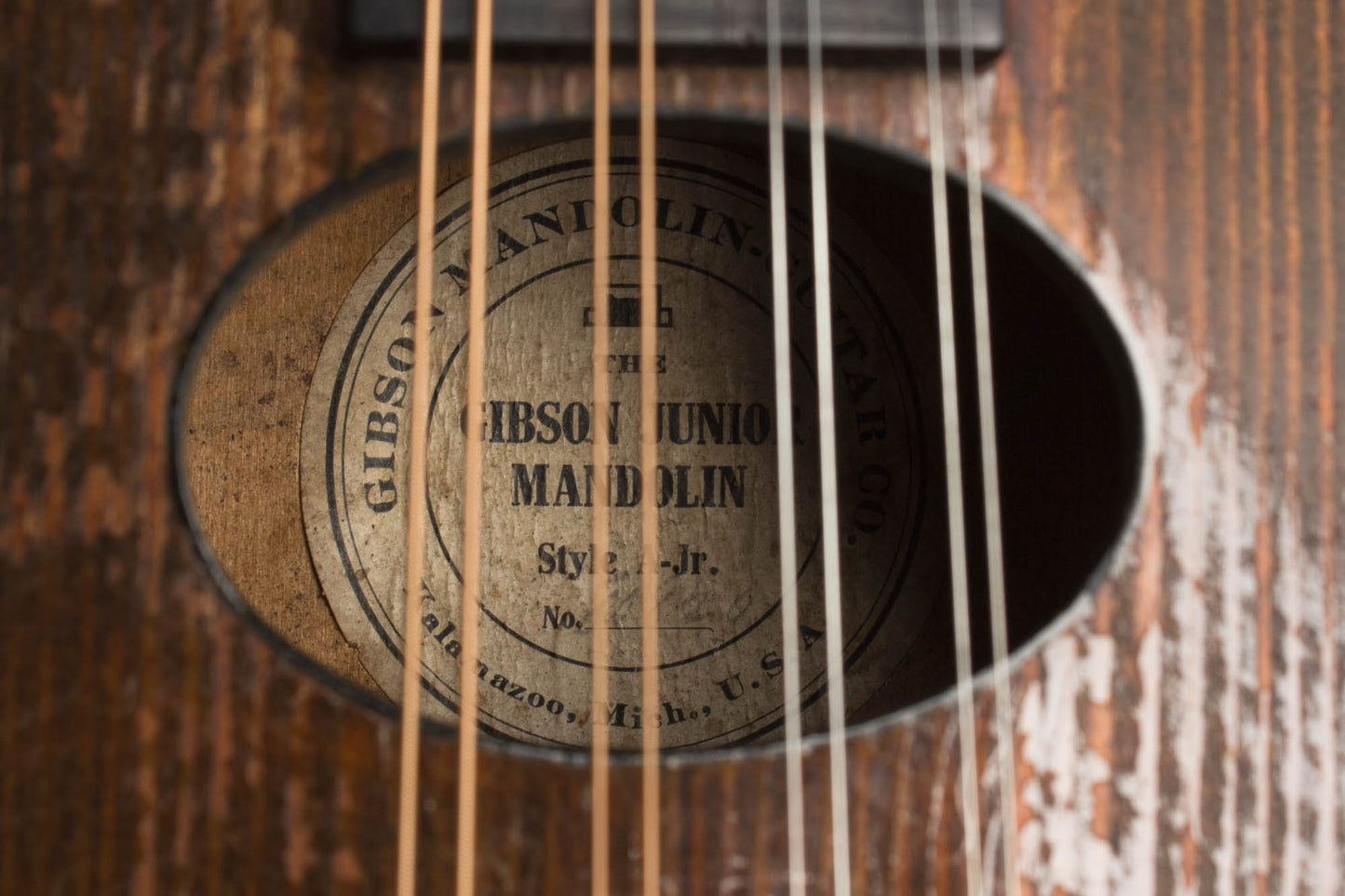
Gibson A-Junior Snakehead Model Carved Top Mandolin (1927), made in Kalamazoo, Michigan, serial # 80820, brown stain finish, birch back and sides, spruce top; mahogany neck with ebony fingrboard, period black hard shell case.
This is a VERY well played but lovely sounding original A-Junior mandolin from the mid-1920s, made after the end of the "Loar Era" at Gibson but still embodying many of the "Masters" ideas. This well-loved example of Gibson's mandolin craftsmanship was built and shipped in early 1927 based on both the factory order and serial numbers; Master Loar had left the building in late 1924 but the "snakehead" mandolins were still carrying his design touches up into this period. By this time the company's focus had shifted primarily to banjos and interest in the mandolin was noticeably slowing down.
Original "Snakeheads" are generally considered the best-sounding vintage oval hole "A" style mandolins made, revered for their unmatched tone and projection compared to both earlier and later A-models. They are so nicknamed for their Loar-designed peghead that angles inward towards the tip, a feature inexplicably abandoned by Gibson not long after this one was made.
The A-Junior was Gibson's lowest priced arched top mandolin in the 1920's designed primarily for sale to students. The solid wood top and back are fully carved like the higher priced models, as the instrument was designed to still sound "Gibsonic" at the lowest price point. To this end it has no ornament at all but is built to the same standards as the company's higher end instruments.
While this basic A-Junior lacks some of the other advanced features of the era (it does not have an adjustable truss rod or height-adjustable bridge) it does sport Loar's slimmer neck profile and sleeker peghead shape. The finish is a clear lacquer coat over an overall plain dark brown stain.
There is no binding at all; the pickguard is long gone. The tailpiece has a simple "clamshell" cover plate and the tuners are plain openback strips. Even this most basic "A" model is a very fine instrument, with sonic and playing improvements carrying over from "Master Loar's" tenure still evident. Nearly 100 years on this still makes for a very fine sounding if modest looking mandolin.
Overall length is 25 3/4 in. (65.4 cm.), 10 1/4 in. (26 cm.) wide, and 1 7/8 in. (4.8 cm.) in depth, measured at side of rim. Scale length is 14 in. (356 mm.). Width of nut is 1 1/8 in. (29 mm.).
This 99 year old mandolin has seen a LOT of use along the way but remains original and an excellent player with a sweet and resonant sound. The finish is VERY worn with checking, dings, scrapes and heavy pick wear to the top, including areas worn completely through to the wood from hard strumming and rough handling. There are dings, dents, and scrapes overall, with a noticeable wear spot in the center of the back and wear-through to the usual spots like the unbound body edges and the back of the neck. There are no visible cracks or repairs, a few back/side seams have been reglued but are fully are solid.
All hardware remains original including the tuners, tailpiece and bridge all showing notable wear; the pickguard/clamp assembly is long gone. Even without a truss rod the neck has remained true for nearly a century and the original frets have been crowned down showing only minor wear. While not the prettiest (although beautiful in its own way) this an excellent player's example of Gibson's plainest 1920s A Model, still a fine instrument with a sweeter, rounder sound than some. It is housed in a modern hardshell case; these usually originally came swathed in chipboard. Overall Very Good Condition.