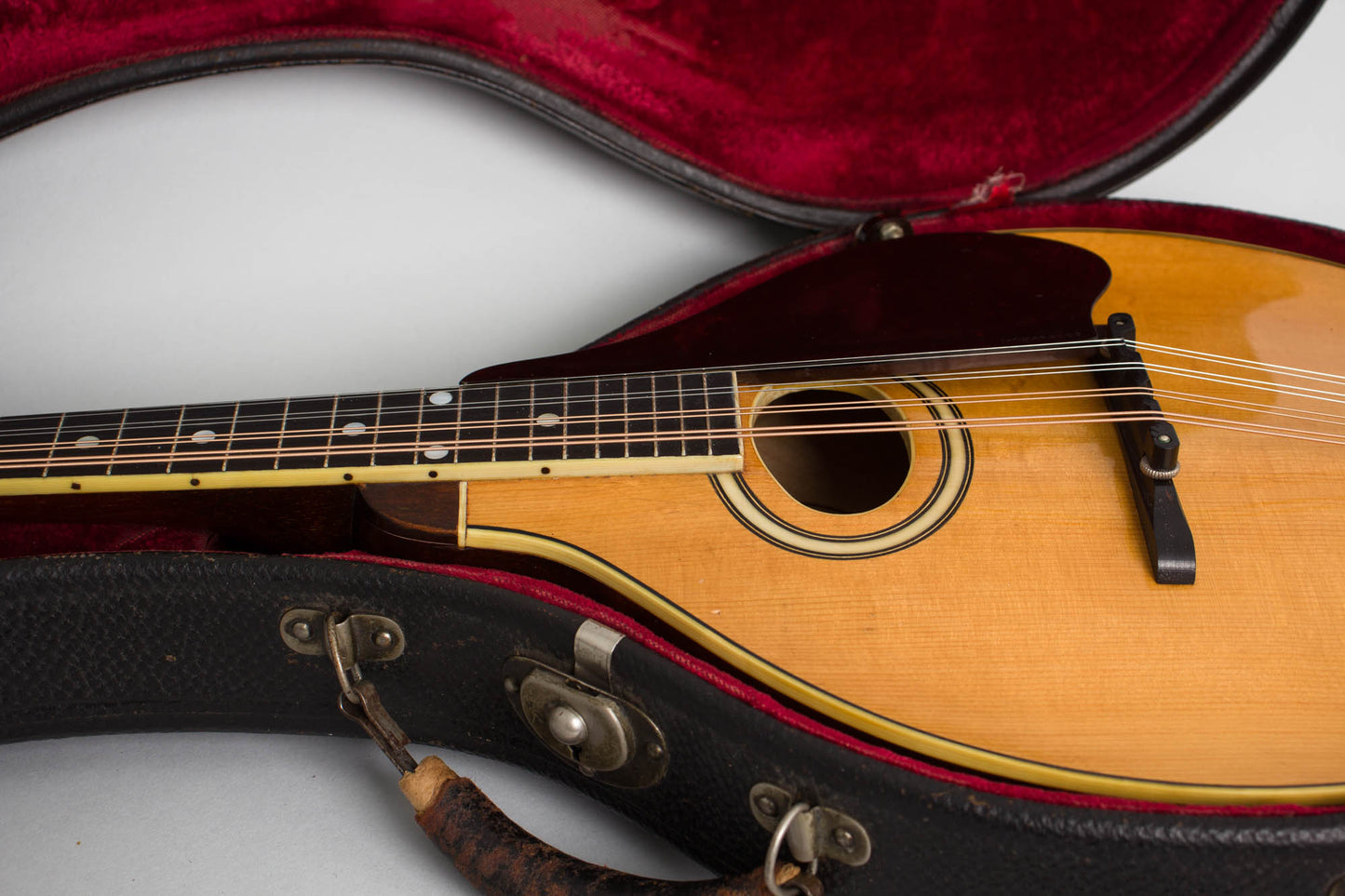
Gibson A-2Z Snakehead Model Carved Top Mandolin (1923), made in Kalamazoo, Michigan, serial # 79177, natural top, dark back and sides finish, birch back and sides, spruce top; mahogany neck with ebony fingerboard, original black hard shell case.
This is a truly great playing and sounding original Style A-2Z mandolin built around the peak of the "Loar Era" at Gibson. These 1923-5 instruments are generally considered the best-sounding round hole "A"-style mandolins ever made, and this one certainly bears this out. This is a fine example of Gibson's craftsmanship at the apex of the mandolin era, just before the company's focus shifted to banjos and then guitars. "Snakehead" A-style mandolins are revered for their unmatched tone and projection and have all the advanced features of the era including the adjustable truss rod, raised adjustable bridge, and slim neck profile.
The A-2Z was the midline model in the mandolin line, rare compared to the less expensive Style A and A-Junior models. The top has a clear, natural lacquer finish, double bound while the back and fingerboard are single-bound. The thin, double-inlaid wood soundhole ring has a prominent thick celluloid center, the unbound headstock has a pearl "The Gibson" logo in sharply angled script. The tortoise celluloid pickguard is held with the hybrid earlier-style clamp attached to the then-new screw bracket. The whimsical name "A-2Z" seems to have been a Gibson joke that made it into the catalog; earlier versions were simply the A-2.
This A-2Z was fabricated right at the very end of 1923, but not labelled and sold until 1925. Such dating discrepancies are not uncommon for this period, when Gibson was experiencing a drastic drop in mandolin sales. The Factory Order Number (11999) stamped on the neck block belongs to one of several batches of A-2Z mandolins started right at the end of 1923; this was actually the last batch number in a continuous series going back to 1917. The serial number on the label dates to mid/late 1925; this was affixed when the instrument was ready to be shipped out and suggests it sat unfinished at the Gibson factory for nearly 2 years! By the time it was sold, Master Loar was no longer in the building!
Lloyd Loar's tenure as acoustic engineer at Gibson has become mythical. Mandolin family instruments made during his employment are the most perfectly realized in Gibson's history, templates for most similar instruments since. The mandolins of the "Loar Era" show the influence of a master player on both design and execution, although other Gibson employees (especially Thaddeus McHugh and Lewis A. Williams) engineered many of the early 1920s technical improvements. Loar was primarily concerned with "voicing" the instruments properly; all Gibson mandolin family instruments were refined and improved under his supervision. These distinctive Loar-era A mandolins have become ever more sought-after by discerning players, and this is a superb example.
Overall length is 25 7/8 in. (65.7 cm.), 10 1/16 in. (25.6 cm.) width, and 1 13/16 in. (4.6 cm.) in depth, measured at side of rim. Scale length is 13 7/8 in. (352 mm.). Width of nut is 1 1/8 in. (29 mm.).
This is a superb example of this rare Gibson "A" model; a resealed back center seam is the only visible repair. For being almost 100 years old there is very little wear; there are a few pick scratches, finish rubs and dings overall, but really this mandolin shows very little evidence for its time on Earth. The tuners are the only changed hardware; they are original correct period machines but not the exact correct style. Overall this is a simply wonderful instrument; an extremely fine player with a very powerfully bright but well-modulated sound. It includes a nice OHSC. Overall Excellent Condition.