Galiano Grand Concert Flat Top Acoustic Guitar (1925)


1
/
of
4
Couldn't load pickup availability
Item #6848
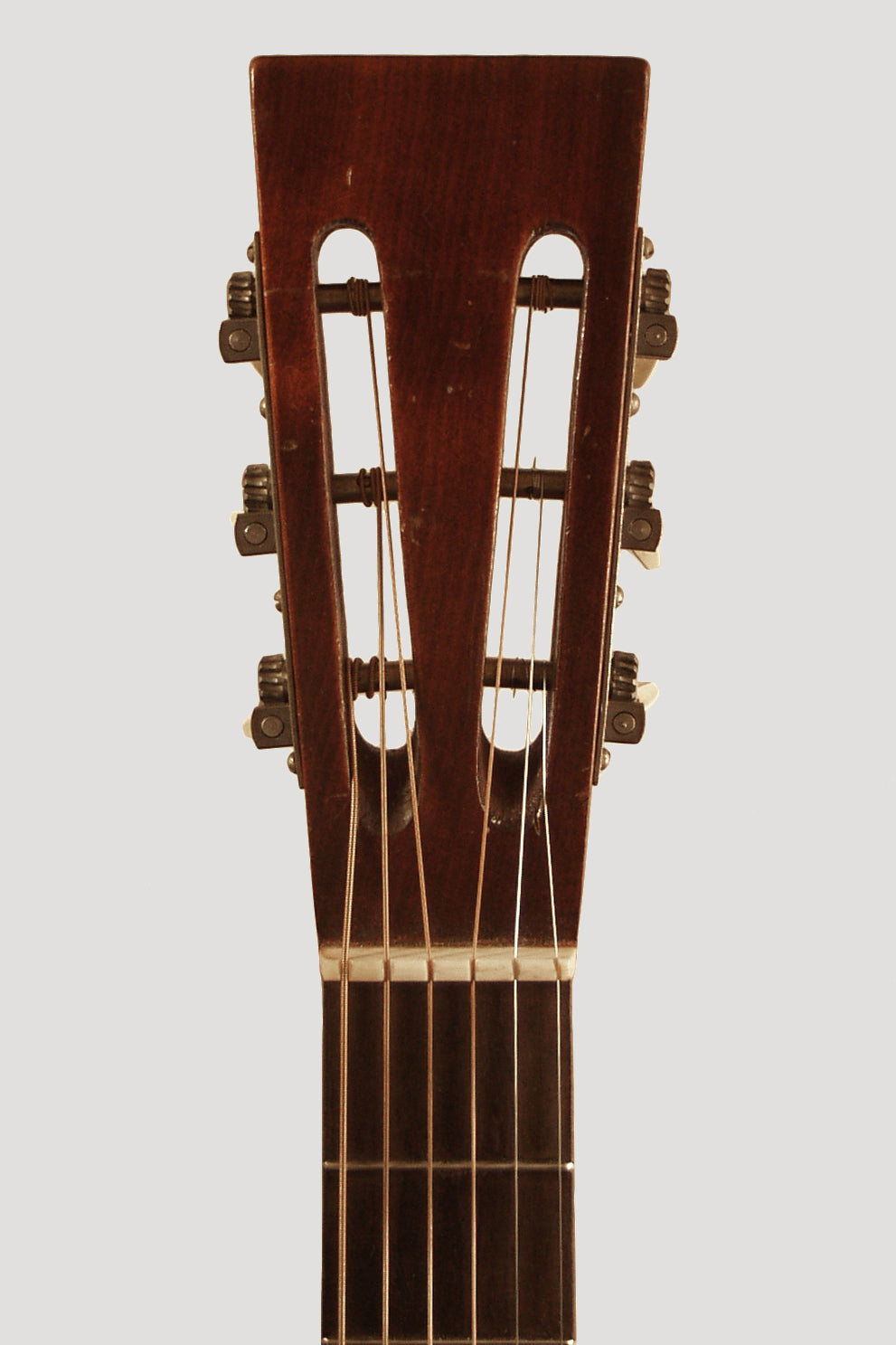
Grand Concert Model Flat Top Acoustic Guitar, labeled Galiano, c. 1925, made in New York City, natural varnish finish, mahogany body, spruce top; mahogany neck with ebonized fingerboard, black hard shell case.
This is a fascinating and historically important guitar, and extraordinarily well preserved for an instrument from this time and place. New York City of the 1910's and 1920's was teeming with immigrants, including large numbers from Italy. The first quarter of the 20th Century saw the establishment of what has become referred to recently as "The Italian Guild" a set of affiliated small retail stores and instrument workshops operated by Italian immigrant luthiers including Antonio Cerrito, Raphael Ciani, J. Nettuno, Nicolai Turturro and others. Some of these craftsmen also appear to have had ties to the Oscar Schmidt Company's instrument factory in nearby Jersey City, NJ, builders of the iconic "Stella" guitars.
While often similar in design, the instruments produced in the small Little Italy shops exhibit a much higher level of craftsmanship and original details than Schmidt factory products. Bowlback mandolins were predictably the most popular offering, but the guitars are the prizes today. Many of these instruments were labeled "Galiano", a non-specific brand name that appears to have been shared by several of the shops on both hand-made and re-labeled factory product.
This large "Galiano" brand grand concert flat top guitar is from the 1915-25 period, and current scholarship identifies it as most likely made in the shop of Antonio Cerrito. The body is high grade mahogany with a one-piece back showing visible saw marks on the inside. The top is straight-grained spruce with fairly wide growth rings along the outside edge, narrowing towards the center. The top and sound hole are bound in holly and ebony-there is no plastic used on this guitar! The bridge is the original wide 'pyramid' style with a brass fret-wire saddle and original dotted ebony bridge pins, also common on Schmidt guitars. The fingerboard is 'ebonized' wood, and the neck is carved to a comfortable 'C' profile as is common on these instruments-Schmidt used a more typical hard "V". The fingerboard is inlaid with only two large position dots, and is mounted with a mortised heel joint as opposed to the dovetail used at the Schmidt factory. Internally, the rather refined ladder braces are very neatly shaped to a peak, but the kerfing is cut square, as sometimes seen on lower-end Schmidts.
The label under the soundhole reads 'A. Galiano, fabricante di Chitarre e Mandolini' with no other information.
This Grand Concert-size guitar is quite large for its day, and measures 14 7/8" across the lower bout. The scale length is also quite long at 26 1/8", typical of these larger Italian instruments but rarely seen on most other period guitars. These were not made for dainty classicists, like period Martins-they were designed for volume and projection, and intended for steel strings from the start. The itinerant players who would have ordered a guitar like this were employed in cafes, restaurants and on the vaudeville stage and required a powerful tone to cut through the din. This is a relatively plain example of this type of guitar, but an exceptionally well-made and good sounding instrument. We've examined a number of these New York-made guitars over the years and this one is simply one of the very finest in both condition and sound. The tone is clear, powerful and rich, with very pleasing bass and ringing treble. Simply a joy to play and a time capsule example of a rich if nearly forgotten American guitar tradition.
Overall length is 40 1/4 in. (102.2 cm.), 14 7/8 in. (37.8 cm.) wide at lower bout, and 4 in. (10.2 cm.) in depth at side, taken at the end block. Scale length is 26 1/8 in. (664 mm.). Width of nut is 1 3/4 in. (44 mm.). The guitar appears all original down to the nut and saddle and even bridgepins, and the only evidence of any work ever being done is a small clean back crack repair. There are small checks and scrapes to the finish but no major wear. The guitar plays beautifully and is a delight for the country blues fingerpicker-ironically perhaps for a guitar with such urban origins! This instrument offers all the best-loved points of a factory made Stella in a handmade period package- if that style of guitar is your bag we can't think of a better combination than that! Excellent Condition.
View full details
This is a fascinating and historically important guitar, and extraordinarily well preserved for an instrument from this time and place. New York City of the 1910's and 1920's was teeming with immigrants, including large numbers from Italy. The first quarter of the 20th Century saw the establishment of what has become referred to recently as "The Italian Guild" a set of affiliated small retail stores and instrument workshops operated by Italian immigrant luthiers including Antonio Cerrito, Raphael Ciani, J. Nettuno, Nicolai Turturro and others. Some of these craftsmen also appear to have had ties to the Oscar Schmidt Company's instrument factory in nearby Jersey City, NJ, builders of the iconic "Stella" guitars.
While often similar in design, the instruments produced in the small Little Italy shops exhibit a much higher level of craftsmanship and original details than Schmidt factory products. Bowlback mandolins were predictably the most popular offering, but the guitars are the prizes today. Many of these instruments were labeled "Galiano", a non-specific brand name that appears to have been shared by several of the shops on both hand-made and re-labeled factory product.
This large "Galiano" brand grand concert flat top guitar is from the 1915-25 period, and current scholarship identifies it as most likely made in the shop of Antonio Cerrito. The body is high grade mahogany with a one-piece back showing visible saw marks on the inside. The top is straight-grained spruce with fairly wide growth rings along the outside edge, narrowing towards the center. The top and sound hole are bound in holly and ebony-there is no plastic used on this guitar! The bridge is the original wide 'pyramid' style with a brass fret-wire saddle and original dotted ebony bridge pins, also common on Schmidt guitars. The fingerboard is 'ebonized' wood, and the neck is carved to a comfortable 'C' profile as is common on these instruments-Schmidt used a more typical hard "V". The fingerboard is inlaid with only two large position dots, and is mounted with a mortised heel joint as opposed to the dovetail used at the Schmidt factory. Internally, the rather refined ladder braces are very neatly shaped to a peak, but the kerfing is cut square, as sometimes seen on lower-end Schmidts.
The label under the soundhole reads 'A. Galiano, fabricante di Chitarre e Mandolini' with no other information.
This Grand Concert-size guitar is quite large for its day, and measures 14 7/8" across the lower bout. The scale length is also quite long at 26 1/8", typical of these larger Italian instruments but rarely seen on most other period guitars. These were not made for dainty classicists, like period Martins-they were designed for volume and projection, and intended for steel strings from the start. The itinerant players who would have ordered a guitar like this were employed in cafes, restaurants and on the vaudeville stage and required a powerful tone to cut through the din. This is a relatively plain example of this type of guitar, but an exceptionally well-made and good sounding instrument. We've examined a number of these New York-made guitars over the years and this one is simply one of the very finest in both condition and sound. The tone is clear, powerful and rich, with very pleasing bass and ringing treble. Simply a joy to play and a time capsule example of a rich if nearly forgotten American guitar tradition.
Overall length is 40 1/4 in. (102.2 cm.), 14 7/8 in. (37.8 cm.) wide at lower bout, and 4 in. (10.2 cm.) in depth at side, taken at the end block. Scale length is 26 1/8 in. (664 mm.). Width of nut is 1 3/4 in. (44 mm.). The guitar appears all original down to the nut and saddle and even bridgepins, and the only evidence of any work ever being done is a small clean back crack repair. There are small checks and scrapes to the finish but no major wear. The guitar plays beautifully and is a delight for the country blues fingerpicker-ironically perhaps for a guitar with such urban origins! This instrument offers all the best-loved points of a factory made Stella in a handmade period package- if that style of guitar is your bag we can't think of a better combination than that! Excellent Condition.