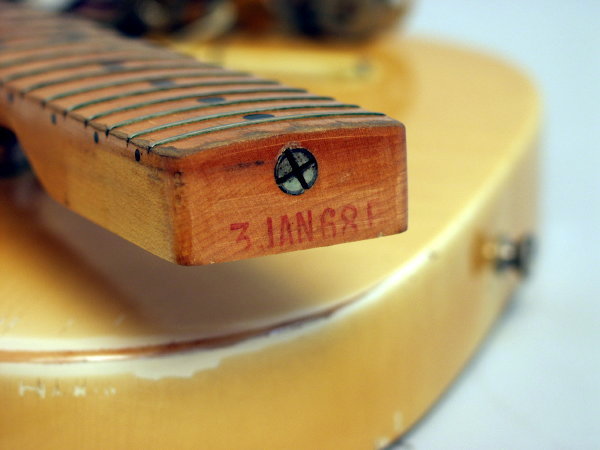
Fender Telecaster Model Solid Body Electric Guitar (1968), made in Fullerton, California, blonde finish, ash body, maple cap neck, original black hard shell case.
A nice example of the relatively rare late-'60s Telecaster with the laid-on maple board neck, as built prior to Fender's re-introduction of the original-style one-piece maple neck in 1969.
This guitar's body has yellowed to a darker creamy butterscotch. The neck has the transitional finish and is not yet covered in heavy polyester. All hardware and components are original; even the "ashtray" bridge cover is included.
Overall length is 38 3/4 in. (98.4 cm.), 12 3/4 in. (32.4 cm.) wide at lower bout, and 1 3/4 in. (4.4 cm.) deep. Scale length is 25 1/2 in. (648 mm.).
Light average playwear overall, most noticeable on fingerboard and armwear area of upper bout. Very little wear on back of neck; back has almost no belt buckle wear.
The only alterations are to the headstock, where a second string tree has been added and, for some inexplicable reason, the patent number has been forcibly removed from the decal, digging slightly into the wood�the rest of the decal is fully intact and original.