


Fender Telecaster Solid Body Electric Guitar (1953)


1
/
of
7
Couldn't load pickup availability
Item #7916
Fender Telecaster Model Solid Body Electric Guitar (1953), made in Fullerton, California, Blonde lacquer finish, ash body, maple neck, original shaped hard shell case.
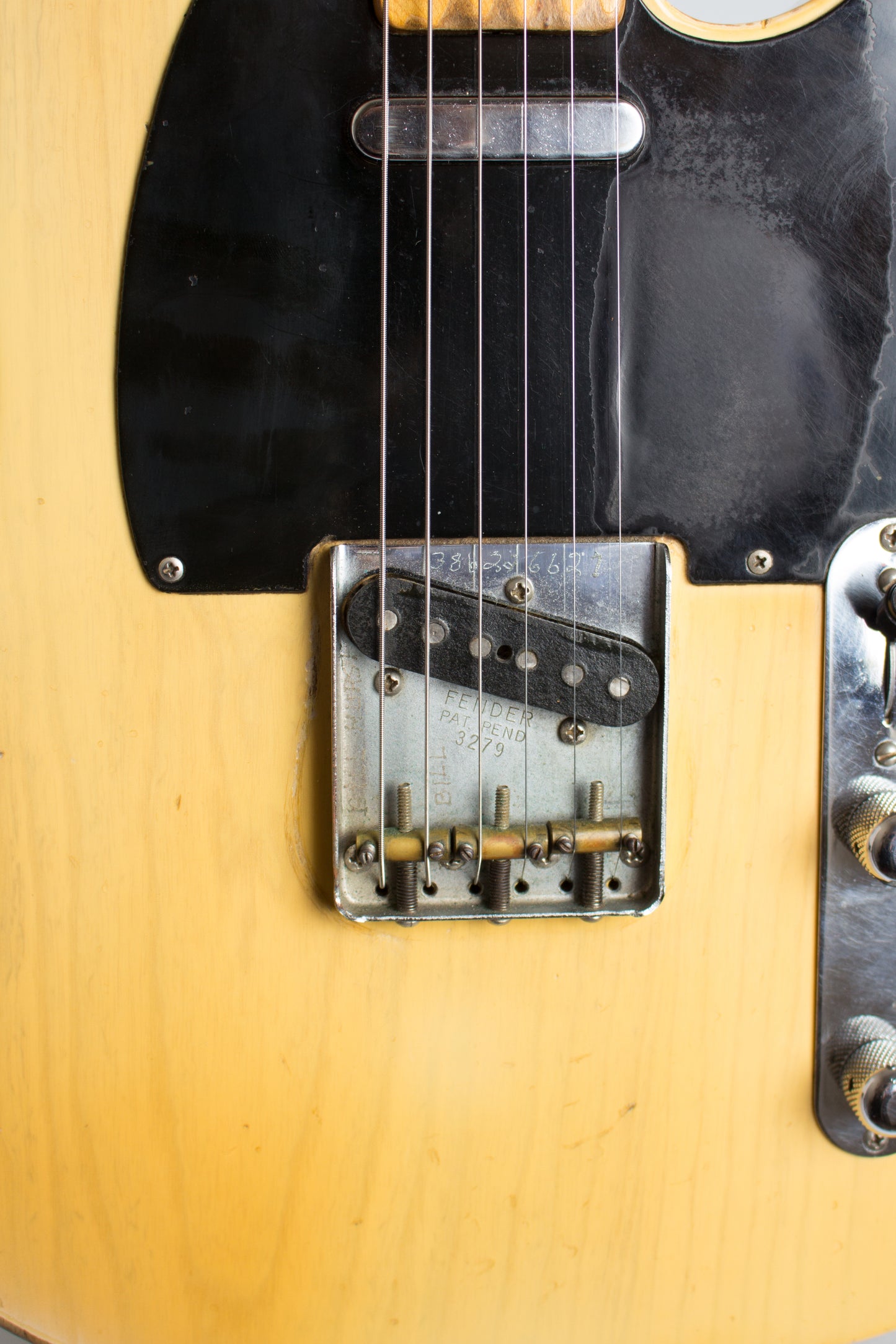
This beautiful "Blackguard" Fender Telecaster was assembled at the company's original factory in Fullerton, California right at the end of 1953. It carries the serial number 3279 stamped on the bridgeplate, while the neck is dated 12-53 in pencil on the heel and the body carries a red-penciled date mark of 11-53 in the neck cavity. The visible potentiometer date is somewhat older, with a stamped code peeking out from under the solder joint of xxx-218 indicating the piece was made the 21th week of 1952. This dating anomaly is not unusual in older Fender instruments, where stocks of parts were not always assembled in strict order. Gloria wired this guitar up on 12-18-53 and left her masking-tape signature in the control cavity, as she did on many other original Telecasters.
This guitar has been played but has seen relatively limited circulation since 1953, and was used for some years primarily in the Detroit area. The only alteration is the original electronics rig has been re-wired to the "modern" Telecaster switching scheme to allow for more playing flexibility; this is very common in Telecasters of this period, as they were originally wired with a bass capacitor in position #1 and no available pickup blend setting.
This exceptionally fine instrument is otherwise all original. The neck is fairly chunky and round, with just the tiniest hint of the "V" profile to come in the shoulder carving. All screws are of the Phillips-head type as is customary for 1953. The 1953 Telecaster still has the same look and feel of the earliest Fender guitars from 1950-51, although many of the fine details gradually evolved as the decade went along. This particular year is considered by many Fender aficionados as the peak of the company's early period and the apex of quality and consistency for their first Spanish guitar, before the introduction of the second Fender solidbody: the Stratocaster.
Many of the artists most associated with "blackguard" Teles have used guitars from this year including Roy Buchanan, Danny Gatton, James Burton, Keith Richards, Albert Lee, and Red Volkaert. The "butterscotch" blonde ash body and maple neck are subtly changed from the earlier examples, with the neck profile being slightly sleeker than "Broadcaster" standards and the finish having a slight halo effect around the edges.
Many players and collectors consider the 1953 Telecaster the most desirable example of the model. In his authoritative and beautiful book "The Blackguard" author Nachos Banos references this and states "There is something really magical about these mid-'53 butterscotch finishes". Early Fender Telecasters of this period are considered one of the most collectable and historic of all electric guitars, and this is a very fine example.
Overall length is 38 3/4 in. (98.4 cm.), 12 5/8 in. (32.1 cm.) wide at lower bout, and 1 3/4 in. (4.4 cm.) in depth, measured at side of rim. Scale length is 25 1/2 in. (648 mm.). Width of nut is 1 5/8 in. (41 mm.).
The instrument remains completely authentic and in very finely preserved condition with some typical play wear but no irreversible alterations from its original state. The guitar shows signs of use in the past, but the finish is unaltered and not heavily worn. There are a number of small dings and chips overall (mostly to the body edges) but it is not heavily discolored, worn away, or abused. There is only minimal "smoke" darkening of the lacquer finish overall, with some typical worn-away areas on the neck.
There is visible play wear through the finish on much of the lacquered maple fingerboard; again, typical of Fenders from this early period. There was a cigarette burn on the headstock edge by the low "E" tuner and the lacquer has been chipped off a bit there. The pickguard shows some wear through the lacquer where the strumming hand impacted over the years.
All parts including pickups, bridge components, Kluson Deluxe tuners, lacquered fiber pickguard, strap buttons, and all screws and other hardware are completely original. The original owner etched his license number into the front flange of the bridgeplate and the name "Bill Hurst" and "Bill" into the area of the metal between the saddles and pickup. There are also numbers etched under the original "ashtray" bridge cover.
The original frets still have plenty of life in them, and this guitar is just heaven to play. The instrument is accompanied by its original shaped case but that is in a fairly sad state so it may also be housed in a reproduction Fender tweed hard case. We love blackguard Teles more than just about anything and this is a spectacular example, used but not abused and with vibe for days. Excellent - Condition.
View full details
This beautiful "Blackguard" Fender Telecaster was assembled at the company's original factory in Fullerton, California right at the end of 1953. It carries the serial number 3279 stamped on the bridgeplate, while the neck is dated 12-53 in pencil on the heel and the body carries a red-penciled date mark of 11-53 in the neck cavity. The visible potentiometer date is somewhat older, with a stamped code peeking out from under the solder joint of xxx-218 indicating the piece was made the 21th week of 1952. This dating anomaly is not unusual in older Fender instruments, where stocks of parts were not always assembled in strict order. Gloria wired this guitar up on 12-18-53 and left her masking-tape signature in the control cavity, as she did on many other original Telecasters.
This guitar has been played but has seen relatively limited circulation since 1953, and was used for some years primarily in the Detroit area. The only alteration is the original electronics rig has been re-wired to the "modern" Telecaster switching scheme to allow for more playing flexibility; this is very common in Telecasters of this period, as they were originally wired with a bass capacitor in position #1 and no available pickup blend setting.
This exceptionally fine instrument is otherwise all original. The neck is fairly chunky and round, with just the tiniest hint of the "V" profile to come in the shoulder carving. All screws are of the Phillips-head type as is customary for 1953. The 1953 Telecaster still has the same look and feel of the earliest Fender guitars from 1950-51, although many of the fine details gradually evolved as the decade went along. This particular year is considered by many Fender aficionados as the peak of the company's early period and the apex of quality and consistency for their first Spanish guitar, before the introduction of the second Fender solidbody: the Stratocaster.
Many of the artists most associated with "blackguard" Teles have used guitars from this year including Roy Buchanan, Danny Gatton, James Burton, Keith Richards, Albert Lee, and Red Volkaert. The "butterscotch" blonde ash body and maple neck are subtly changed from the earlier examples, with the neck profile being slightly sleeker than "Broadcaster" standards and the finish having a slight halo effect around the edges.
Many players and collectors consider the 1953 Telecaster the most desirable example of the model. In his authoritative and beautiful book "The Blackguard" author Nachos Banos references this and states "There is something really magical about these mid-'53 butterscotch finishes". Early Fender Telecasters of this period are considered one of the most collectable and historic of all electric guitars, and this is a very fine example.
Overall length is 38 3/4 in. (98.4 cm.), 12 5/8 in. (32.1 cm.) wide at lower bout, and 1 3/4 in. (4.4 cm.) in depth, measured at side of rim. Scale length is 25 1/2 in. (648 mm.). Width of nut is 1 5/8 in. (41 mm.).
The instrument remains completely authentic and in very finely preserved condition with some typical play wear but no irreversible alterations from its original state. The guitar shows signs of use in the past, but the finish is unaltered and not heavily worn. There are a number of small dings and chips overall (mostly to the body edges) but it is not heavily discolored, worn away, or abused. There is only minimal "smoke" darkening of the lacquer finish overall, with some typical worn-away areas on the neck.
There is visible play wear through the finish on much of the lacquered maple fingerboard; again, typical of Fenders from this early period. There was a cigarette burn on the headstock edge by the low "E" tuner and the lacquer has been chipped off a bit there. The pickguard shows some wear through the lacquer where the strumming hand impacted over the years.
All parts including pickups, bridge components, Kluson Deluxe tuners, lacquered fiber pickguard, strap buttons, and all screws and other hardware are completely original. The original owner etched his license number into the front flange of the bridgeplate and the name "Bill Hurst" and "Bill" into the area of the metal between the saddles and pickup. There are also numbers etched under the original "ashtray" bridge cover.
The original frets still have plenty of life in them, and this guitar is just heaven to play. The instrument is accompanied by its original shaped case but that is in a fairly sad state so it may also be housed in a reproduction Fender tweed hard case. We love blackguard Teles more than just about anything and this is a spectacular example, used but not abused and with vibe for days. Excellent - Condition.


Loading...
Just arrived!
Item #