Fender Precision Bass Owned by Ian McDonald of King Crimson and Foreigner Model Solid Body Electric Bass Guitar (1964), made in Fullerton, California, serial # L31355, Blonde lacquer with white overspray finish, ash body, maple neck with rosewood fingerboard, black rigid foam case.
This super well-worn but great sounding 1964 Precision bass has seen a lot of use over 60+ years, most notably by protean English musician Ian McDonald, founding member of both King Crimson and Foreigner. While McDonald is not known as a bassist per se, he played a wide range of instruments throughout his long career and was a highly accomplished songwriter; this was his studio bass for that work. It comes directly from his family with two letters of provenance written by his son Maxwell McDonald and former Wife Laura McDonald, to whom he gifted the instrument some time ago.
Ian McDonald may be best remembered as the co-founder of King Crimson, playing keyboards, clarinet, zither, flute, and most strikingly Mellotron on their groundbreaking 1969 debut album "In the Court of the Crimson King", still considered by many as the most influential progressive rock album ever. McDonald and drummer Michael Giles then split and recorded their "McDonald and Giles" duo LP, now considered a lost prog-rock classic. He reappeared with King Crimson in 1974, contributing to the album "Red". In the mid-1970s he moved to New York City and co-founded the multi-platinum Foreigner, appearing on the group's first three albums and hit singles before leaving the band in 1980. McDonald contributed to many classic recordings as a session player as well; his full discography is most impressive. He also toured with the "21St Century Schizoid Band" playing the original King Crimson classics for new generations.
McDonald purchased this 1964 Precision Bass in 1980 while on tour in Texas, according to his family. The bass is as real as relics get, with a LOT of wear and some changes but nothing that diminishes its musical character. This is a lovely feeling and sounding pre-CBS Precision, superbly resonant even not plugged in and one of the lightest and handiest we have had. We can only imagine that master musician Ian McDonald felt this immediately when he first encountered the bass in 1980; according to his family it has not been altered since then except for a newer jack installed recently.
This Precision is a rare variation, originally finished in Blonde over an ash, not alder body. This was a catalog option but rarely ordered in 1964; all other Precision finish variations were sprayed over alder bodies, only the blonde used ash. Some of the original lacquer has been lost and much of it finished over, but the sound is undiminished. It has a powerfully upfront take on the classic Precision bright midrange growl, warming up nicely when the tone knob is rolled off.
The bass was originally assembled in summer 1964, just months before the CBS takeover; the neck heel is stamped 5 JUN 64C. Features particular to the period include a thin-lam rosewood fingerboard with clay dot inlay, "Transition" silver Fender logo decal, "L" serial number plate and "backwards" Kluson bass tuners. At just over 8 lbs. this is light for a Precision Bass from ANY era, a lovely "real relic" example of the world's premier electric bass, still ruler of the roost 60+ years on. It is scarred by decades of use, not hammers and sandpaper and remains a wonderful instrument for any style of music, a joy to play carrying the legacy of a master musician.
Overall length is 45 3/4 in. (116.2 cm.), 13 in. (33 cm.) wide at lower bout, and 1 5/8 in. (4.1 cm.) in depth, measured at side of rim. Scale length is 34 in. (864 mm.). Width of nut is 1 3/4 in. (44 mm.)., 8.1 lbs.
This bass is VERY well-worn, and the original blonde lacquer finish only partly survives intact under a later (but pre-1980) thin white overspray. The original heavily yellowed lacquer is visible mostly on the sides, especially in the areas around the neck heel. The face looks to have been at least partially sanded down before the entire body was overfinished long ago in white. This shows heavy play wear everywhere with dings, scrapes, chips and numerous areas worn through, some to the bare wood and some to the original blonde.
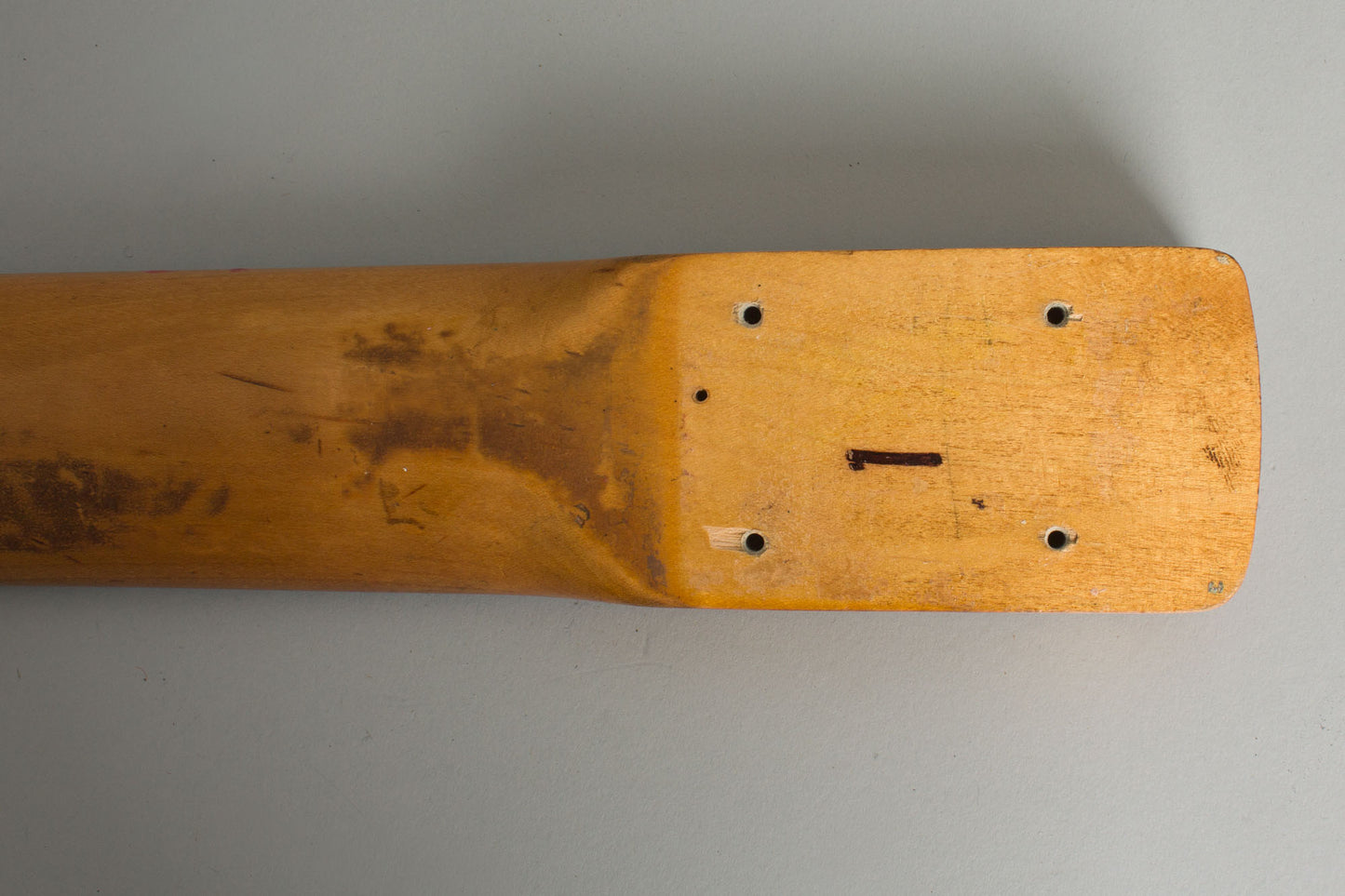
The neck is almost completely down to the bare wood with the classic "old Fender" feel; what finish remains is original with no overspray. Small red dots were painted along the edge for on-stage visibility, and there is some old funk present we chose not to remove! The headstock finish and decal are original, a small spot was scraped off the lower corner of the face by the E tuner. The Kluson tuners are original, the "Hootnanny" strap button is missing from the back of the headstock. Pieces of a business card from an old guitar shop are present in the neck cavity as shims.
The tortoise pattern pickguard is an old Fender part but is not original to the bass, dating to the late '60s/early '70s with the original 1964 grounding plate still underneath it. It has a few extra holes drilled but not used, while the body has a couple of extra holes in different places underneath, indicating another guard was fitted at some point. The rearmost corner is cracked off, but the screw still secures it.
The great sounding pickup is original with some later foam added underneath for adjustability. The original 1964 volume pot is intact, the tone pot dates to 1973 (the cap is original) and the jack is newer; the original jack is in the case. The knobs are the correct style but later; they are secured by Allen screws. The original neckplate, strap buttons and bridge are intact; all parts have some wear and corrosion but everything works as intended.
Both before and after Ian McDonald's purchase this bass has been played a LOT. The frets are the original thin-style wire but look to be a very old refret, there is some pull marking to the rosewood fingerboard in spots. They have been crowned down over the decades but remain playable; for heavy use a modern player might prefer a refret with larger wire. In honor of its English rock heritage we put on a vintage set of Rotosound RS66 "Swing Bass; the McDonald family strings are pretty worn but still in the case pocket. "Bassically" This lovely veteran Fender "took a lickin' and kept on tickin", providing generations with great sound. It comes in a heavy duty hard foam carry case, inside are lovely heartfelt letters of provenance From Ian McDonald's former wife and son attesting to the importance this bass has had to their family over 45+ years. Overall Very Good + Condition.