


Fender Maverick (Custom) Owned by Jeff Tweedy of Wilco Solid Body Electric Guitar (1969)


1
/
of
15
Couldn't load pickup availability
Item #13122
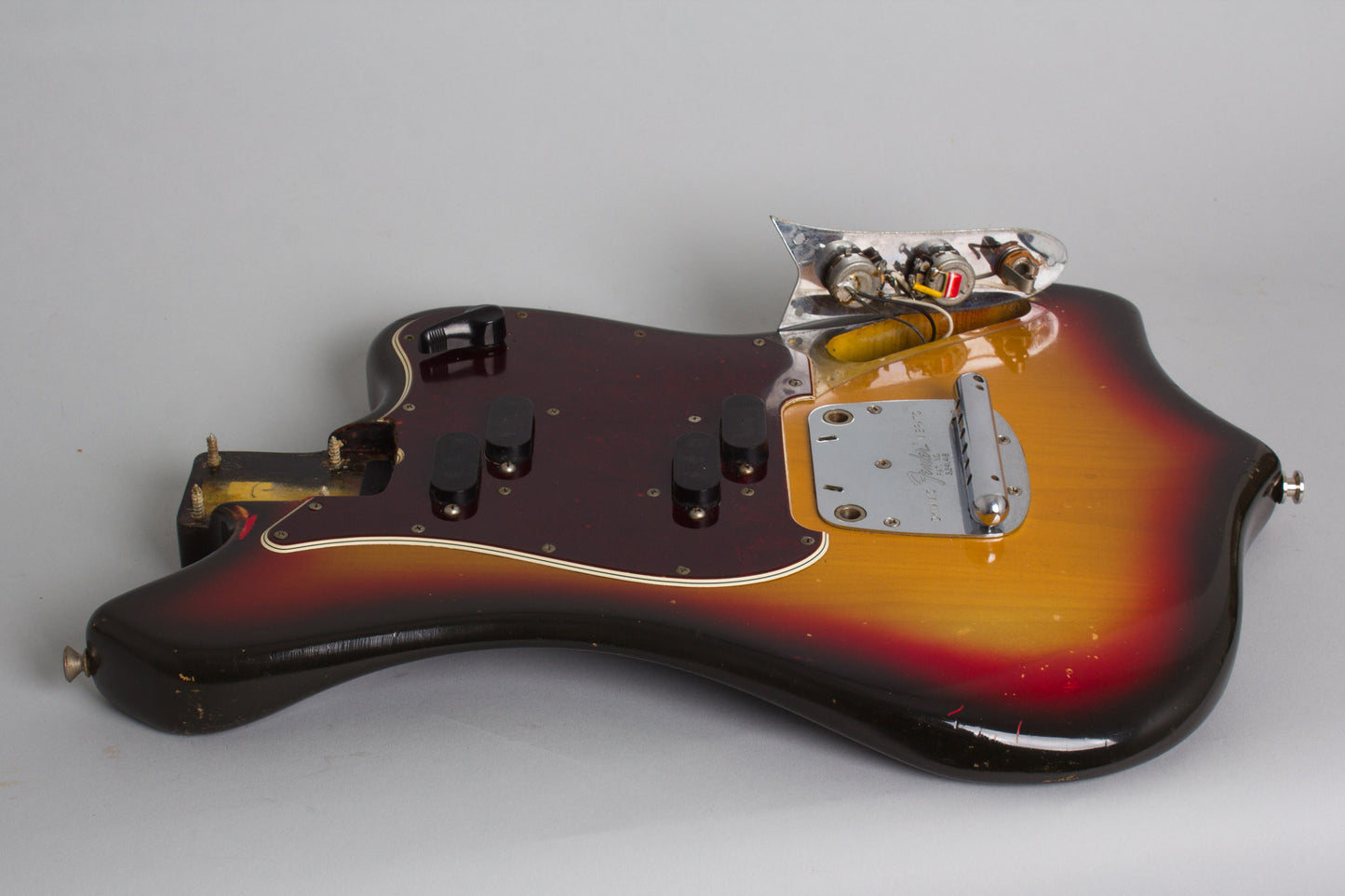
Fender Maverick (Custom) Owned by Jeff Tweedy of Wilco Model Solid Body Electric Guitar (1969), made in Fullerton, California, serial # 258875, sunburst top, dark back and sides finish, alder body, maple neck with rosewood fingerboard, black tolex hard shell case.
This interesting if slightly ungainly instrument represents one of the odder Fender Follies of the late 1960s, a guitar born not out of Leo's imagination, but from racks of leftover parts. There were few things the "bean counters" from CBS found more objectionable than unsellable stock sitting around taking up space and getting taxed at the end of the year. Long time Fender employee Virgil "Babe" Simoni was more than once tasked with finding creative ways to use overstock up; this "Maverick" (better known as the "Custom" model) is only the most obvious example.
The Maverick/Custom story starts with the Fender Electric XII, not one of Leo Fender's best-remembered creations but a superbly engineered solidbody 12-string. Introduced at the July 1965 NAMM Show it married the Jaguar/Jazzmaster style offset body to the 12-string neck with a distinctive extended "hockey stick" headstock. The electronics rig was unique with two pickups each with two separately adjustable 3-string coils, as later used on the Mustang Bass. A 4-way lever switch selects each pickup individually as well as the two together in or out of phase.
Unfortunately for CBS Fender somewhat missed the boat on the electric 12-string fad and by late 1965 when the Electric XII was shipping in quantity Rickenbacker had already reaped the bulk of benefit. By mid-late 1966 the Fender factory was still churning out Electric XII parts when the word filtered back that dealers were not re-ordering them, resulting in the large backlog sitting around unassembled well into 1969.
Enter re-purposing magician Babe Simoni. Instructed to clear out the redundant stock but facing a dead market for 12-strings he simply re-engineered the XII into a 6-string guitar. The bodies received a few calculated chops to the base and upper horn on the band saw resulting in a slightly oddball but distinctive pointed-tail look. The rout in the back of the body for the 12's string through-bridge was plugged; this meant that while the top was finished in sunburst the back was shot in black to cover the paste-up. It seems odd that Custom Color Mavericks apparently weren't assembled, but by 1969 the California hot rod aesthetic was seen as fading, the "Competition" Mustangs notwithstanding.
Electric XII Necks already drilled for 12 machines were given an artful maple laminate on both sides of the headstock and redrilled for three widely-spaced tuners per side; less completed blanks could skip this step. The entire pickguard and split-coil pickup rig from the XII was retained including the 4 position rotary "klunk" switch and master tone and volume knobs. The standard Mustang bridge/vibrato unit was used but looks obviously ill-fitted to the larger cutout in the pickguard intended for the 12-string baseplate.
The resulting guitar was marketed as both the Fender Custom and Maverick. It appeared just once as the Custom in the 1970 Fender catalog at the list price of $289.50, $40 cheaper than the final discounted 1968 price for the Electric XII. A 1969 Fender brochure promoted the Custom as "New in shape and sound" but likely didn't fool anybody; even the most undiscerning Fender dealer would have recognized where the parts came from. Why the name "Maverick" appears on a limited number of these is lost; most are labeled "Fender Custom" and that is how the model is usually referred to, if it is referenced at all. Still, we really like the jauntily-lettered "MAVERICK" decal Fender on the headstock of this guitar and it is a cooler name more in keeping with the Mustang's western-horsey vibe.
This Maverick has all the expected quirks of a converted XII. The neck is date stamped 12 AUG ? (1966 or 67, it is pretty much illegible), the pots are 304-6617. The long "hockey Stick" headstock with only 6 tuners is the veneered version and looks rather silly (some find it endearing) but the neck plays as well as any late '60s Fender. The re-sculpted body retains the full electronics rig from the XII, which can sound lush or shimmery but does not easily overdrive the amplifier line the Stratocaster does, making it about the worst possible layout for 1969. The Mustang bridge/vibrato unit works as well as it ever does; arguably better on this long scale guitar than its short-scale point of origin.
The Custom/Maverick model disappeared as quickly as it appeared, gone from Fender's catalog after 1970 presumably as the backstock of 12-string parts was used up. While often derided as an example of how far Leo's company had drifted under the CBS regime taken on its own merits this is a pretty cool guitar, certainly unique and very playable with an interesting range of sounds. Although this one has been let go from the Wilco Loft collection we happen to know there is at least one more still there; perhaps someday some player will take this "Gets No Respect" model and make it their own; hey, that has happened to less interesting guitars!
Overall length is 42 in. (106.7 cm.), 13 1/2 in. (34.3 cm.) wide at lower bout, and 1 1/2 in. (3.8 cm.) in depth, measured at side of rim. Scale length is 25 1/2 in. (648 mm.). Width of nut is 1 5/8 in. (41 mm.).
This rare and obscure Fender oddity shows some general wear but remains all original except for a repro trem arm and a more modern lower strap button. The original finish has dings, dents and scrapes overall, and one oddly worn away spot on top of the body above the neck joint. The back of the body has an area of deep belt buckle scratches and a lot of wear around the heel. The back of the neck some wear to the wood just along the edges and at the heel, with a couple of tiny dinks through the finish. There is scuffing and general wear to the metal hardware but no major corrosion.
The rosewood fingerboard has some surprisingly deep divots in the lower positions and wear continues further up the neck�somebody actually played this one! Despite this, the frets appear original, crowned down somewhat with minor subsequent wear. The guitar shows no other repairs or major alterations, just honest wear. It lives in a period Fender bass case that once held a bass, with the Wilco Loft identification along the bottom edge as usual with a tag reading "Sunburst with black guard". The pickguard on the guitar is actually tortoise celluloid, but the serial number also recorded on the case tag does match the instrument. Overall Very Good + Condition.
View full details
This interesting if slightly ungainly instrument represents one of the odder Fender Follies of the late 1960s, a guitar born not out of Leo's imagination, but from racks of leftover parts. There were few things the "bean counters" from CBS found more objectionable than unsellable stock sitting around taking up space and getting taxed at the end of the year. Long time Fender employee Virgil "Babe" Simoni was more than once tasked with finding creative ways to use overstock up; this "Maverick" (better known as the "Custom" model) is only the most obvious example.
The Maverick/Custom story starts with the Fender Electric XII, not one of Leo Fender's best-remembered creations but a superbly engineered solidbody 12-string. Introduced at the July 1965 NAMM Show it married the Jaguar/Jazzmaster style offset body to the 12-string neck with a distinctive extended "hockey stick" headstock. The electronics rig was unique with two pickups each with two separately adjustable 3-string coils, as later used on the Mustang Bass. A 4-way lever switch selects each pickup individually as well as the two together in or out of phase.
Unfortunately for CBS Fender somewhat missed the boat on the electric 12-string fad and by late 1965 when the Electric XII was shipping in quantity Rickenbacker had already reaped the bulk of benefit. By mid-late 1966 the Fender factory was still churning out Electric XII parts when the word filtered back that dealers were not re-ordering them, resulting in the large backlog sitting around unassembled well into 1969.
Enter re-purposing magician Babe Simoni. Instructed to clear out the redundant stock but facing a dead market for 12-strings he simply re-engineered the XII into a 6-string guitar. The bodies received a few calculated chops to the base and upper horn on the band saw resulting in a slightly oddball but distinctive pointed-tail look. The rout in the back of the body for the 12's string through-bridge was plugged; this meant that while the top was finished in sunburst the back was shot in black to cover the paste-up. It seems odd that Custom Color Mavericks apparently weren't assembled, but by 1969 the California hot rod aesthetic was seen as fading, the "Competition" Mustangs notwithstanding.
Electric XII Necks already drilled for 12 machines were given an artful maple laminate on both sides of the headstock and redrilled for three widely-spaced tuners per side; less completed blanks could skip this step. The entire pickguard and split-coil pickup rig from the XII was retained including the 4 position rotary "klunk" switch and master tone and volume knobs. The standard Mustang bridge/vibrato unit was used but looks obviously ill-fitted to the larger cutout in the pickguard intended for the 12-string baseplate.
The resulting guitar was marketed as both the Fender Custom and Maverick. It appeared just once as the Custom in the 1970 Fender catalog at the list price of $289.50, $40 cheaper than the final discounted 1968 price for the Electric XII. A 1969 Fender brochure promoted the Custom as "New in shape and sound" but likely didn't fool anybody; even the most undiscerning Fender dealer would have recognized where the parts came from. Why the name "Maverick" appears on a limited number of these is lost; most are labeled "Fender Custom" and that is how the model is usually referred to, if it is referenced at all. Still, we really like the jauntily-lettered "MAVERICK" decal Fender on the headstock of this guitar and it is a cooler name more in keeping with the Mustang's western-horsey vibe.
This Maverick has all the expected quirks of a converted XII. The neck is date stamped 12 AUG ? (1966 or 67, it is pretty much illegible), the pots are 304-6617. The long "hockey Stick" headstock with only 6 tuners is the veneered version and looks rather silly (some find it endearing) but the neck plays as well as any late '60s Fender. The re-sculpted body retains the full electronics rig from the XII, which can sound lush or shimmery but does not easily overdrive the amplifier line the Stratocaster does, making it about the worst possible layout for 1969. The Mustang bridge/vibrato unit works as well as it ever does; arguably better on this long scale guitar than its short-scale point of origin.
The Custom/Maverick model disappeared as quickly as it appeared, gone from Fender's catalog after 1970 presumably as the backstock of 12-string parts was used up. While often derided as an example of how far Leo's company had drifted under the CBS regime taken on its own merits this is a pretty cool guitar, certainly unique and very playable with an interesting range of sounds. Although this one has been let go from the Wilco Loft collection we happen to know there is at least one more still there; perhaps someday some player will take this "Gets No Respect" model and make it their own; hey, that has happened to less interesting guitars!
Overall length is 42 in. (106.7 cm.), 13 1/2 in. (34.3 cm.) wide at lower bout, and 1 1/2 in. (3.8 cm.) in depth, measured at side of rim. Scale length is 25 1/2 in. (648 mm.). Width of nut is 1 5/8 in. (41 mm.).
This rare and obscure Fender oddity shows some general wear but remains all original except for a repro trem arm and a more modern lower strap button. The original finish has dings, dents and scrapes overall, and one oddly worn away spot on top of the body above the neck joint. The back of the body has an area of deep belt buckle scratches and a lot of wear around the heel. The back of the neck some wear to the wood just along the edges and at the heel, with a couple of tiny dinks through the finish. There is scuffing and general wear to the metal hardware but no major corrosion.
The rosewood fingerboard has some surprisingly deep divots in the lower positions and wear continues further up the neck�somebody actually played this one! Despite this, the frets appear original, crowned down somewhat with minor subsequent wear. The guitar shows no other repairs or major alterations, just honest wear. It lives in a period Fender bass case that once held a bass, with the Wilco Loft identification along the bottom edge as usual with a tag reading "Sunburst with black guard". The pickguard on the guitar is actually tortoise celluloid, but the serial number also recorded on the case tag does match the instrument. Overall Very Good + Condition.


Loading...
Just arrived!
Item #