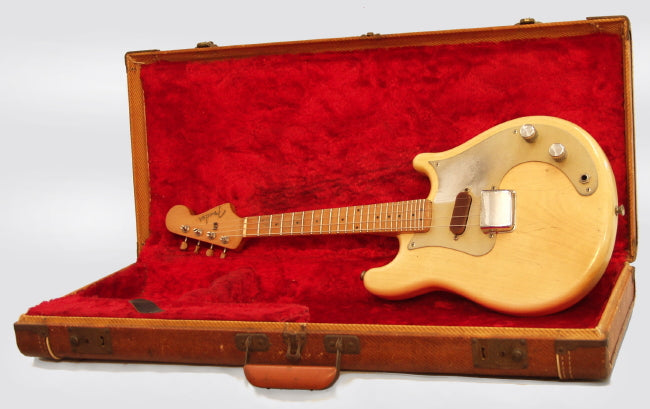
Fender "Mandocaster" Model Solid Body Electric Mandolin (1956), made in Fullerton, California, blonde lacquer finish, ash body, maple neck, original tweed hard shell case.
One of the Fender company's more obscure but entertaining creations, the Electric Mandolin was in production for over 15 years but remains a relatively rare item. This example is from 1956, the first production year. The Fender mandolin differs from most electrics (and nearly all acoustic mandolins) in having only four strings instead of the usual doubled courses. This follows the ideas of the western swing players who were instrumental in helping develop Fender instruments, and is also seen in Bigsby electric mandolins. This results in a clearer, more brilliant electric sound without the natural "chorusing" effect of doubled strings, albeit one that sounds as much like an octave guitar as a mandolin.
This instrument is also just ridiculously cute, resembling more than anything else a "just hatched" baby Precision Bass. All the coolest mid-1950's Fender features are there in miniature, including a one-piece maple neck with a sharp "V" contour, beautiful blonde finish on a heavily-grained ash body, gold anodized aluminum pickguard, and reddish plastic-covered single coil pickup with chrome knurled tone and volume knobs.
This very early example also has some period-specific features: a body without a rear 'scoop' contour and solid (non-ridged) plated bridge saddles. Tuners are single line plastic-button strip Kluson Deluxes. The gold Fender logo decal has no model designation ("Mandocaster" is a collectors' slang term, but so well known as to be the semi-official model name!). The red-lined tweed case is also a miniature version of the standard guitar case. A really neat early example of an unsung Fender classic.
Overall length is 25 7/8 in. (65.7 cm.), 10 in. (25.4 cm.) wide at lower bout, and 1 1/2 in. (3.8 cm.) in depth, measured at side of rim. Scale length is 13 3/4 in. (349 mm.). Width of nut is 1 1/8 in. (29 mm.).
All original, and very clean overall -- the only major wear is typical loss of the gold anodised surface to the pickguard where the player's fingers have rested. There is some typical fingrboard wear below the 5th fret, and the bridge cover has some corrosion. The original tuner buttons have shrunken somewhat but are still functional; all other hardware intact and original. An excellent player and very early example complete with a nice original tweed HSC. Overall Excellent - Condition.