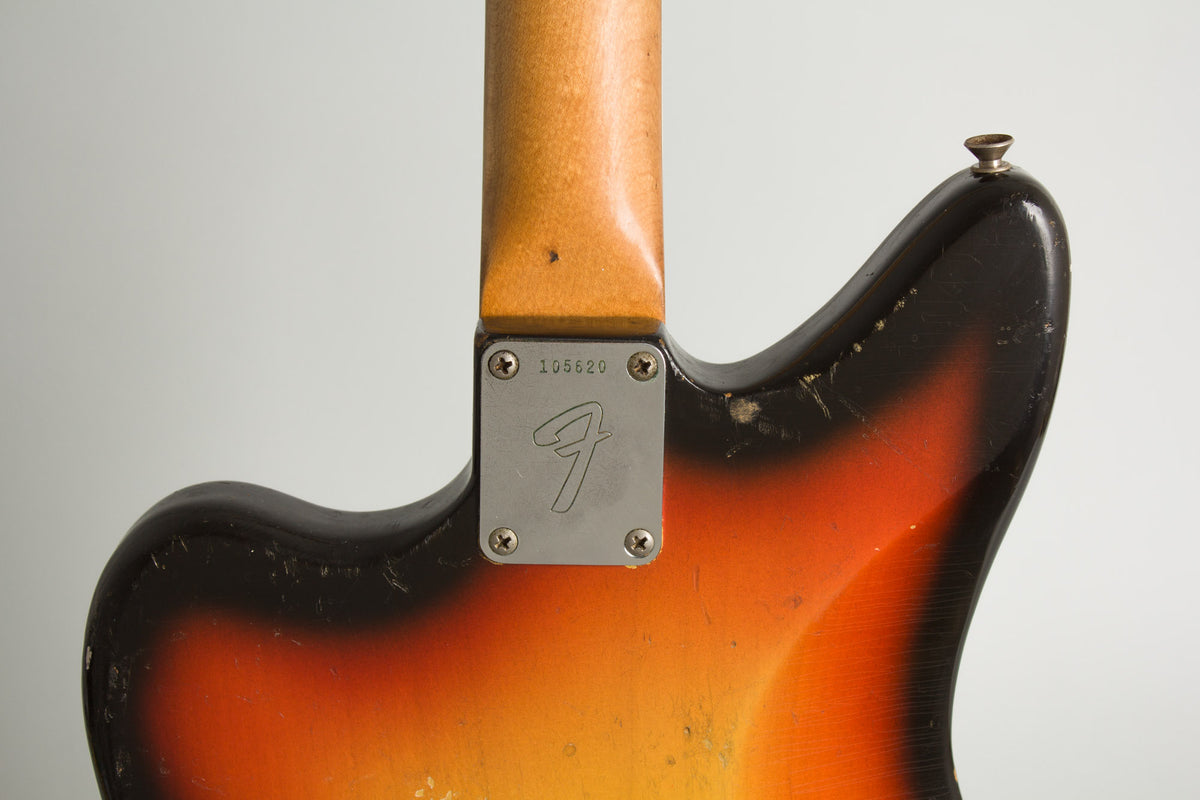
Fender Jaguar Model Solid Body Electric Guitar (1965), made in Fullerton, California, serial # 105620, sunburst lacquer finish, alder body, maple neck with rosewood fingerboard, tweed hard shell case.
This is a played-in but solid early CBS-era Jaguar, showing some noticeable wear but in fine playing condition. It was built just months after the Fender sell-out to CBS in January 1965; the stamped neck date is September '65, and the pots date to the 16th and 30th week of that year. Typical late-1965 features include a bound fingerboard with pearloid dot inlay, bright "target" 3-color sunburst lacquer finish on the body, an F-stamped neck plate with a 6-digit serial number and the gold transition logo headstock decal. The pickguard is the new-for-65 ABS laminated tortoise pattern plastic that had just replaced the older Nitrocellulose piece. This is an early example of the bound Fender fingerboard; it feels more comfortable than many later ones, rolled on the edges more carefully.
The Jaguar debuted in spring 1962 as Fender's new top-of-the line guitar, supplanting the Jazzmaster. The sleek offset body and flashy chrome-accented look quickly made it a status symbol for many combos in the early '60s, not only California teen bands but also country players and even many Chitlin' Circuit R&B acts.
The Jaguar was long one of the more under-appreciated of vintage guitars with several interesting features. The scale length is shorter than other professional-grade Fender guitars at 24", designed to enhance playability. The two-circuit wiring and floating vibrato are shared with the Jaguar's ancestor, the Jazzmaster, but the guitar feels quite different. While the tremolo unit itself is the same as the Jazzmaster, the lower string tension of the shorter scale gives it even more flexibility.
Pickup selection is controlled by a bank of slide switches on the treble side; each pickup has an on/off switch, while the third is a "strangle" switch that cuts lower frequencies. The rhythm circuit works as on the Jazzmaster, giving a quickly selectable deeper toned neck pickup sound. This all combines to make the "Jag" a very flexible guitar with a lot of sonic options.
The unique Jaguar pickups with the chrome-plated "claw" baseplate are optimized for punch, clarity and crispness, factors along with the floating trem that led to the model losing popularity in the late '60s as twang went out and super light strings, crunch and heavy distortion came in! The once-ignored Jag has found a super appreciative new audience over the last couple of decades, and the Twang of the ages lives on! These top-of-the line '60s Jaguars are very high quality guitars, and still represent a relative bargain in an authentic 1960s Fender instrument.
Overall length is 40 in. (101.6 cm.), 14 in. (35.6 cm.) wide at lower bout, and 1 5/8 in. (4.1 cm.) in depth, measured at side of rim. Scale length is 24 in. (610 mm.). Width of nut is 1 5/8 in. (41 mm.).
This is a solid playing example overall, nearly all original showing some moderately heavy finish wear but with a good vibe. The body lacquer has light checking and a decent amount of general wear and tear overall. There are dings, dents and scratches, most heavily on the body edges and a few larger and quite deep dings into the top. The back has some buckle wear into the wood a d a spot of finish removed where it looks like perhaps a sticker once sat. There is wear along much of the back of the neck, and what is either a deep scratch or a small grain split just under the binding line on the bass side in the first fret area. The headstock decal is original and intact, but it is mounted a bit farther down on the face than most.
All hardware is original except for the bridge, which is a period original Fender Mustang unit. This was a common substitution back in the day among hard-strumming players. The original trem arm is intact; the mute is missing which is quite common with Jaguars as it was never particularly useful to most players anyway. The original frets show some wear but still play well, and this Jag sounds as it should and has a cool broken-in vibe. A later tweed hard shell case is included. Overall Very Good + Condition.