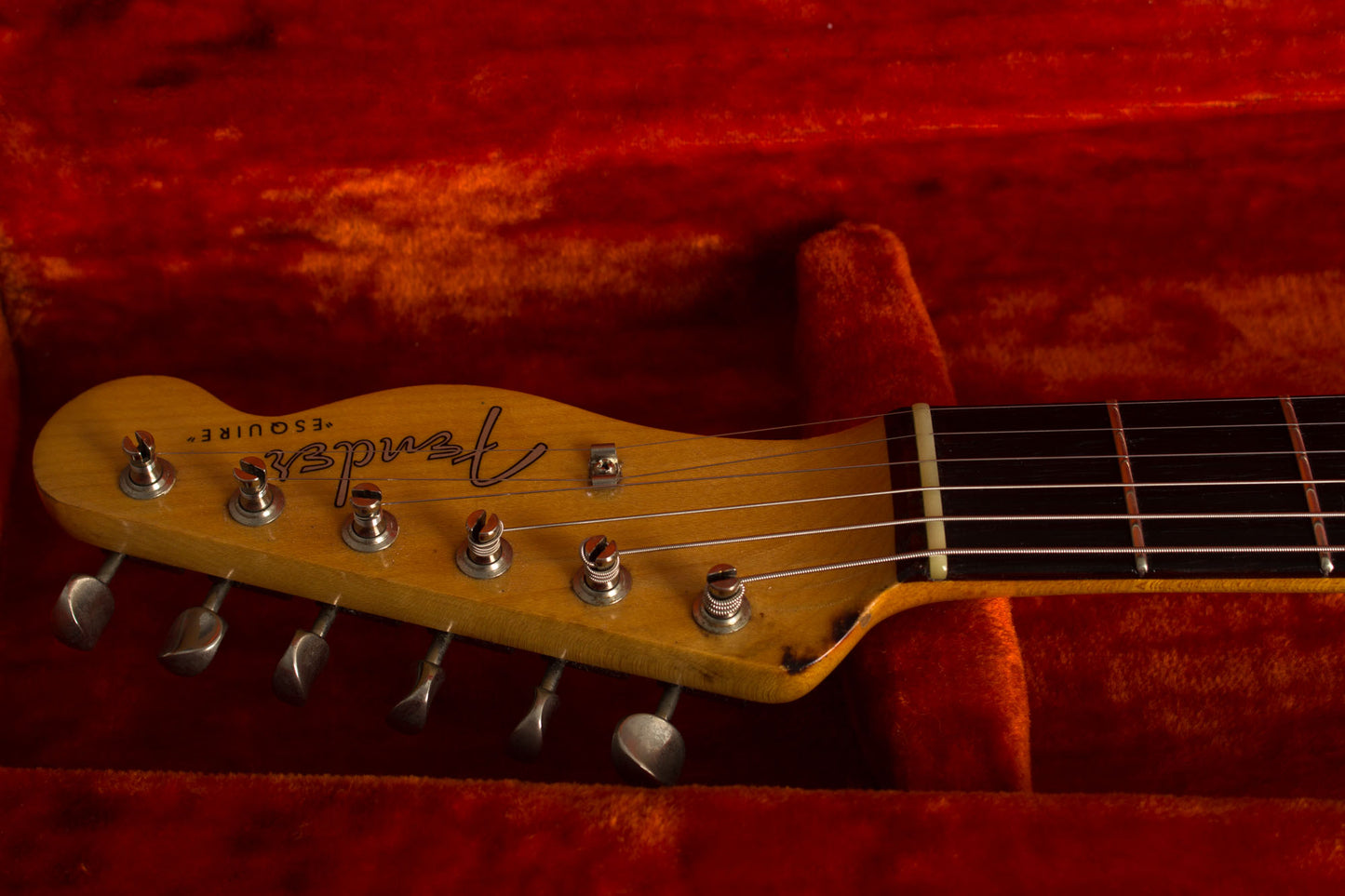
Fender Esquire Model Solid Body Electric Guitar (1963), made in Fullerton, California, Blonde lacquer finish, ash body, maple neck with rosewood fingerboard, original brown tolex hard shell case.
We've handled quite a few vintage Telecaster family instruments over the years but here's one we rarely see -- a 1963 Fender Esquire. The "Esquire" name had been around since 1950, applied to this variation of the two-pickup Broadcaster/Telecaster. By the early '60s its popularity was in a steep decline. While classed as a separate model, the Esquire was just a single-pickup Telecaster built from all the same parts. This meant Fender sales could offer a slightly cheaper alternative for the buyer who couldn't quite spring for the Tele's $189.50 pricetag. By 1963 the "plain Jane" Esquire was lost among the myriad of newer Fullerton models both more and less expensive and was only ordered in miniscule numbers.
This guitar is one of those, and a very well-preserved one at that. The features are mostly identical to a period Telecaster, but of course with only that blank spot on the empty-looking pickguard where the neck pickup usually sits. The neck on this guitar is date stamped April 1963, but the pots carry codes from the 7th and 35th weeks of 1961, indicating the wiring assembly probably sat in stock for a while before being assembled into a guitar.
The guitar shows a typical mix features for this period. The old single ply white plastic pickguard (used since 1955) is still present with several more mounting screws around the rim than in the '50s. The old script "Fender Esquire" logo decal on the headstock would be used well up into 1968, an indicator of the backlog of older parts in stock for this scarcely ordered model. The grainy ash body has a slightly yellowed coat of the typical 1960s "white-blonde", which is still semi-transparent. The neck features the clay-dot inlaid rosewood fingerboard and the standard round/flat 1960s Fender profile.
The "Fender Patent" bridge unit carries three serrated saddle assemblies and a single staggered pole piece pickup. This is controlled by the standard Telecaster volume and tone knobs and 3-way switch with a "top hat" tip. Esquire wiring is unique in offering three tonal options on this one-pickup guitar: the #1 bass-heavy setting, the #2 with a normal tone control function, and the #3 "bypass" sending the signal straight to the jack. This last setting is the Esquire's secret bonus, offering some of the finest, snarliest tones ever to emerge from Fullerton.
The serial number stamped on the neck plate is a very early "L-Series" for 1963, a golden year at Fullerton. This is a fantastic sounding guitar, especially for having just one pickup -- bright but not thin, twangy with bite and body. A super Fender rarity that's also fun to play...and even to just hold! This no-frills Esquire remains a fantastic example of stark Fender minimalism, and in that light one of the coolest of Leo's 1960s children we have seen in a while!
Height is 38 3/4 in. (98.4 cm.), 12 3/4 in. (32.4 cm.) width, and 1 3/4 in. (4.4 cm.) in depth, measured at side of rim. Scale length is 25 1/2 in. (648 mm.). Width of nut is 1 5/8 in. (41 mm.).
This Esquire shows some typical light wear but overall is very nicely preserved. There are small dings and dents to the thin Fender blonde finish (mostly on the edges -- the Telecaster syndrome) with one larger bash mark on the lower back edge near the jack. There are belt buckle marks into and through the finish on the back, but nothing too serious. The plating shows light wear as well, most notably to the "ashtray" bridge cover that must have been fitted for some time while the guitar was in use.
The neck has been neatly refretted with appropriate wire and has a replaced nut to go with it. The headstock face bears a "classic" cigarette burn near the low E string tuner, practically a right of passage scar on many old Fenders. Other than that, this Esquire remains all original, a fine example of bona-fide Fender goodness from the days before the company was sold into the corporate clutches of CBS.
The original grey Fender cord is in the very solid original brown Tolex case, along with a beat up copy of the super rare original hangtag/instruction manual. There is also a period plastic Western-buckle strap and a 2004 letter signed by VINTAGE GUITAR writer Willie Moseley stating that this guitar is pictured on page 19 of his book "VINTAGE ELECTRIC GUITARS: In Praise Of Fretted Americana". All-in-all this is simply a wonderful Esqiore -- the sound, the feel, and the vibe are all the most basic and pure form of Fender nirvana. Twang it and be blessed! Excellent + Condition.