


Fender Esquire Solid Body Electric Guitar (1959)


1
/
of
15
Couldn't load pickup availability
Item #10565
Fender Esquire Model Solid Body Electric Guitar (1959), made in Fullerton, California, serial # 37139, Blonde lacquer finish, ash body, maple neck, original tweed hard shell case.
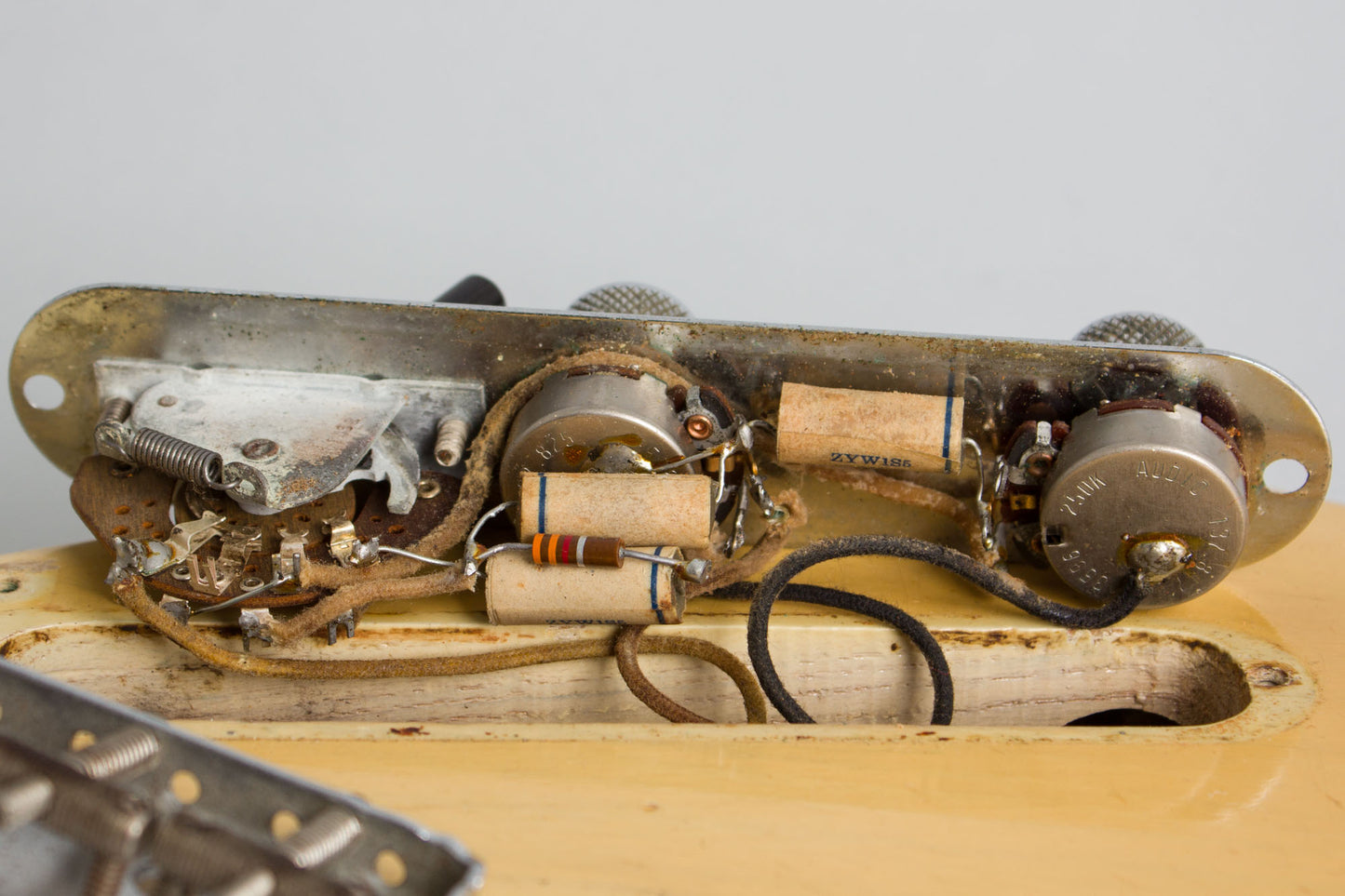
This is a very nice original early/mid 1959 Fender Esquire, one of the last of the original maple fingerboard examples. The neck is not dated (which is correct for this year) but the features are a specific combination found only in this period. The body is dated 2-59 in the pickup rout and the pots are coded to the 25th and 47th weeks of 1958.
The "Esquire" name had been in use at Fender since 1950 designating the single pickup variation of the Broadcaster/Telecaster. By the end of the 1950s the Fender line had grown considerably, and the Esquire seemingly got lost in the shuffle. While classed as a separate model, it was assembled from all the same parts as the Telecaster, allowing Fender sales to offer a slightly cheaper alternative for the buyer who couldn't quite spring for the Tele's $189.50 price tag. It seems most Fender customers considered the versatility of a second pickup worth the $35 premium, and Esquires were always made in smaller numbers.
By the time this one was made in early/mid-1959, sales of the Esquire were in deep decline, outpaced by newer Fullerton models both more expensive, like the Stratocaster and brand-new Jazzmaster, and the lower-priced Duo-Sonic and Musicmaster. Fender's introduction of these budget-priced student guitars in 1956 cut into the Esquire's territory somewhat, and the model began to languish.
This guitar's blonde 1959-era finish is somewhat thicker and more translucent than earlier '50s Fender blonde guitars, with a more "white-blonde' hue. Like most this one has yellowed somewhat over time. The single layer white pickguard is secured by five screws; this was increased to eight by late 1959. This "blank" pickguard conceals the factory rout for the neck pickup, as the bodies used were exactly the same as for the Telecaster.
Starting later in 1959 the one-piece maple neck fitted to this Esquire would shortly be discontinued in favor of the new "slab" rosewood fingerboard across the fender line. This neck profile is round-backed, quite unlike the "V" pattern of 1957-8. It is fairly flat and slim in cross section rather more like the early rosewood board necks in feel. The 5-digit serial number is stamped on the neck plate, and is typical for early-mid 1959.
This Esquire is what Fender aficionados call a "top loader", because the strings feed through the back end of the bridge instead of through the body. This was a short-lived production change that lasted only from late 1958 to early 1960; apparently Fender's customers preferred the original design and the company responded to their wishes and changed the guitars back to the original pattern.
The Esquire control rig is unique, although visually the same as the Telecaster with standard knurled metal volume and tone knobs and 3-way switch with a "top hat" tip. The wiring is cleverly designed to offer three tonal options on a one-pickup guitar: #1 is a bass-heavy setting, #2 engages a normal tone control function, and #3 is a "bypass" setting sending the signal straight to the jack. This last notch is the Esquire's secret bonus, offering some of the finest, snarliest tones ever to emerge from Fullerton.
As the 1950s progressed, the Esquire was ordered in ever-shrinking numbers, making it generally rarer than the same year Telecasters. This 1959 example has seen some use but remains unaltered in excellent playing and sounding condition. For years many Tele fans discounted these fairly rare "Top loaders" as categorically inferior to their earlier sisters. It took NY guitar maven Jim Campilongo to demonstrate to fans worldwide that they have a distinctive character unique to themselves, and now "Top Loaders" are sought after in their own right.
Overall length is 38 3/4 in. (98.4 cm.), 12 3/4 in. (32.4 cm.) wide at lower bout, and 1 3/4 in. (4.4 cm.) in depth, measured at side of rim. Scale length is 25 1/2 in. (648 mm.). Width of nut is 1 5/8 in. (41 mm.).
This 60+ year old Esquire shows some general wear but remains beautifully original internally and externally. The all-original body finish has numerous smaller dings, dents and chips, mostly along the edges as is typical for slab-sided Teles and some random dings into the face. There is some not-too-heavy belt buckle wear on the back somewhat farther aft on the body than usual. The hardware shows some light wear and scuffing overall, with minor corrosion on the steel saddles, string retainer, knob sides and tuner shells.
The neck finish shows some of the usual fingerboard wear in the lower positions and some lacquer rubbed down to the wood on the back along much of its length. The frets are original with probably one G&P in the past, showing some wear in the lower positions but still quite playable. Everything else is original down to the screws except the snap-on bridge cover, which appears to be a more recent piece, perhaps "reliced" a bit with some scuffing on the top.
The guitar remains completely original internally, having never had a neck pickup fitted as was once a common "upgrade" on old Esquires. The single staggered-pole pickup and complex multi-capacitor Esquire wiring rig are original and untouched. The Fender Esquire decal on the headstock is perfectly preserved.
This old Esquire has survived just the way we love 'em; played in but well cared for, unaltered and ready for the next 60+ years. The sound is simply glorious, hotter than some with that bright and snarly edge when cranked but still sweet and bell-like when the amp is backed down. This is one pure, 7.31 LB. package of real, genuine unadulterated vintage 1950's Fender goodness in its simplest form. It resides in the original red plush-lined tweed Fender case, which has some wear but is still quite functional. Overall Excellent - Condition.
View full details
This is a very nice original early/mid 1959 Fender Esquire, one of the last of the original maple fingerboard examples. The neck is not dated (which is correct for this year) but the features are a specific combination found only in this period. The body is dated 2-59 in the pickup rout and the pots are coded to the 25th and 47th weeks of 1958.
The "Esquire" name had been in use at Fender since 1950 designating the single pickup variation of the Broadcaster/Telecaster. By the end of the 1950s the Fender line had grown considerably, and the Esquire seemingly got lost in the shuffle. While classed as a separate model, it was assembled from all the same parts as the Telecaster, allowing Fender sales to offer a slightly cheaper alternative for the buyer who couldn't quite spring for the Tele's $189.50 price tag. It seems most Fender customers considered the versatility of a second pickup worth the $35 premium, and Esquires were always made in smaller numbers.
By the time this one was made in early/mid-1959, sales of the Esquire were in deep decline, outpaced by newer Fullerton models both more expensive, like the Stratocaster and brand-new Jazzmaster, and the lower-priced Duo-Sonic and Musicmaster. Fender's introduction of these budget-priced student guitars in 1956 cut into the Esquire's territory somewhat, and the model began to languish.
This guitar's blonde 1959-era finish is somewhat thicker and more translucent than earlier '50s Fender blonde guitars, with a more "white-blonde' hue. Like most this one has yellowed somewhat over time. The single layer white pickguard is secured by five screws; this was increased to eight by late 1959. This "blank" pickguard conceals the factory rout for the neck pickup, as the bodies used were exactly the same as for the Telecaster.
Starting later in 1959 the one-piece maple neck fitted to this Esquire would shortly be discontinued in favor of the new "slab" rosewood fingerboard across the fender line. This neck profile is round-backed, quite unlike the "V" pattern of 1957-8. It is fairly flat and slim in cross section rather more like the early rosewood board necks in feel. The 5-digit serial number is stamped on the neck plate, and is typical for early-mid 1959.
This Esquire is what Fender aficionados call a "top loader", because the strings feed through the back end of the bridge instead of through the body. This was a short-lived production change that lasted only from late 1958 to early 1960; apparently Fender's customers preferred the original design and the company responded to their wishes and changed the guitars back to the original pattern.
The Esquire control rig is unique, although visually the same as the Telecaster with standard knurled metal volume and tone knobs and 3-way switch with a "top hat" tip. The wiring is cleverly designed to offer three tonal options on a one-pickup guitar: #1 is a bass-heavy setting, #2 engages a normal tone control function, and #3 is a "bypass" setting sending the signal straight to the jack. This last notch is the Esquire's secret bonus, offering some of the finest, snarliest tones ever to emerge from Fullerton.
As the 1950s progressed, the Esquire was ordered in ever-shrinking numbers, making it generally rarer than the same year Telecasters. This 1959 example has seen some use but remains unaltered in excellent playing and sounding condition. For years many Tele fans discounted these fairly rare "Top loaders" as categorically inferior to their earlier sisters. It took NY guitar maven Jim Campilongo to demonstrate to fans worldwide that they have a distinctive character unique to themselves, and now "Top Loaders" are sought after in their own right.
Overall length is 38 3/4 in. (98.4 cm.), 12 3/4 in. (32.4 cm.) wide at lower bout, and 1 3/4 in. (4.4 cm.) in depth, measured at side of rim. Scale length is 25 1/2 in. (648 mm.). Width of nut is 1 5/8 in. (41 mm.).
This 60+ year old Esquire shows some general wear but remains beautifully original internally and externally. The all-original body finish has numerous smaller dings, dents and chips, mostly along the edges as is typical for slab-sided Teles and some random dings into the face. There is some not-too-heavy belt buckle wear on the back somewhat farther aft on the body than usual. The hardware shows some light wear and scuffing overall, with minor corrosion on the steel saddles, string retainer, knob sides and tuner shells.
The neck finish shows some of the usual fingerboard wear in the lower positions and some lacquer rubbed down to the wood on the back along much of its length. The frets are original with probably one G&P in the past, showing some wear in the lower positions but still quite playable. Everything else is original down to the screws except the snap-on bridge cover, which appears to be a more recent piece, perhaps "reliced" a bit with some scuffing on the top.
The guitar remains completely original internally, having never had a neck pickup fitted as was once a common "upgrade" on old Esquires. The single staggered-pole pickup and complex multi-capacitor Esquire wiring rig are original and untouched. The Fender Esquire decal on the headstock is perfectly preserved.
This old Esquire has survived just the way we love 'em; played in but well cared for, unaltered and ready for the next 60+ years. The sound is simply glorious, hotter than some with that bright and snarly edge when cranked but still sweet and bell-like when the amp is backed down. This is one pure, 7.31 LB. package of real, genuine unadulterated vintage 1950's Fender goodness in its simplest form. It resides in the original red plush-lined tweed Fender case, which has some wear but is still quite functional. Overall Excellent - Condition.


Loading...
Just arrived!
Item #