Fairbanks Whyte Laydie # 7 Model 5 String Banjo (1906), made in Boston, Mass., serial # 23847, natural varnish finish, laminated maple rim and neck, ebony fingerboard, period black hard shell case.
This is simply one of the most beautiful banjos we have ever had, a splendid 120-year-old original example of one of the most desired of all openback 5-strings: the Fairbanks Whyte Laydie #7. This instrument is simply a standard by which all openback banjos are judged, not only a visual marvel but producing a sound that few other banjos, new or old, can match. It is a feast for the eyes as well as the ears!
This particular #7 is an exceptionally beautiful banjo with elaborate early-style hand-engraved pearl inlay on the peghead and fingerboard including the famous "gryphon" design on the headstock rear. According to recent scholarship master engraver Icilio Consalvi (the originator of the fantastic engraved pearl inlays on this banjo) stopped working for the Fairbanks company later in 1906 when the instruments were running around serial number 239XX. This banjo (#23847) would be a very late example of his work when his talents were in full flower. Subsequent banjos bear the work of other engravers and although beautiful never quite match the artistry of Consalvi himself. The deeply incised pearl inlays on the fingerboard, headstock and pearl-inlaid ebony cap on the elaborately carved heel are as finely wrought as we have ever seen, truly a master's showcase.
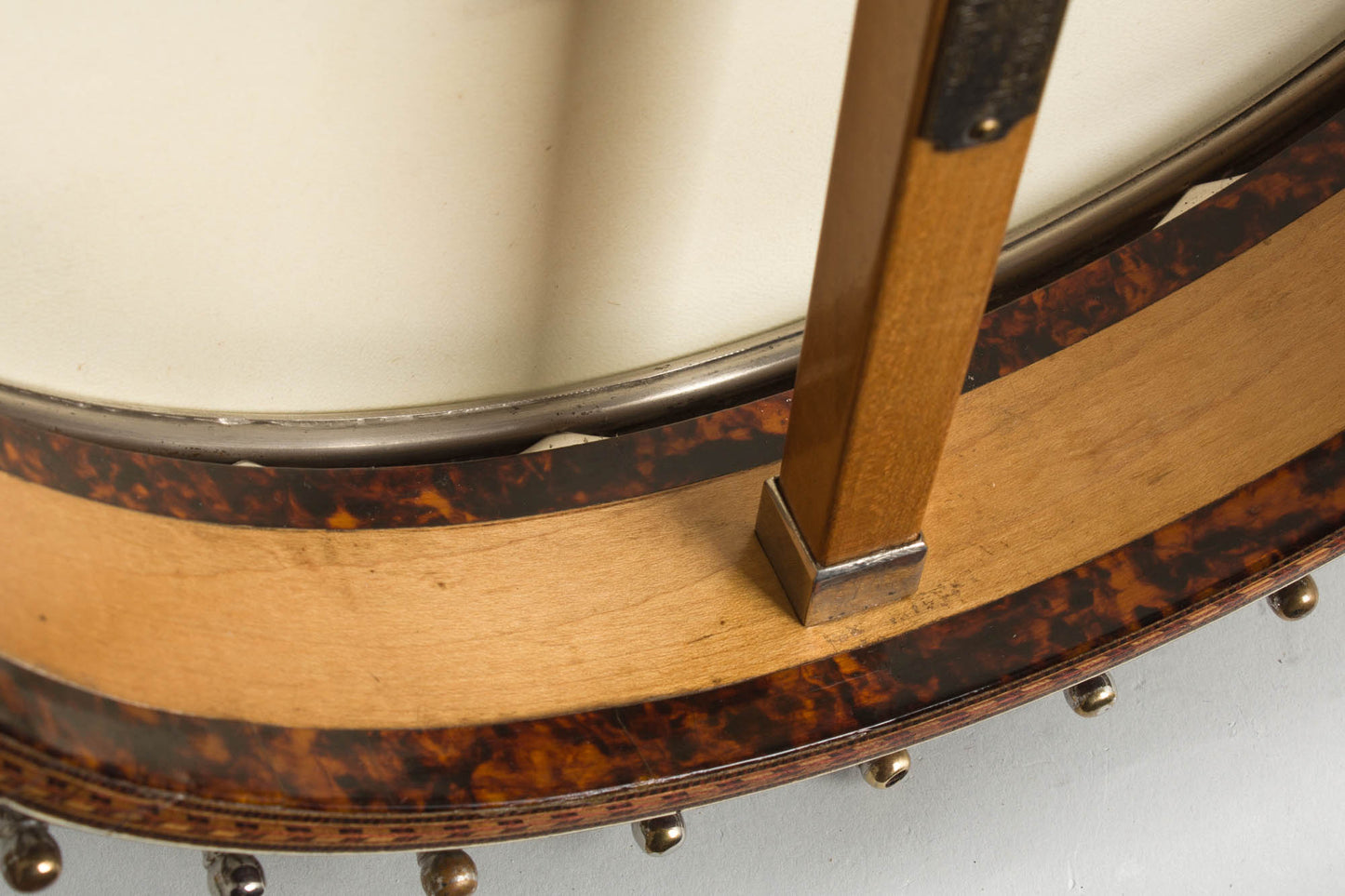
The rim is also a work of the banjo maker's art, the finest Fairbanks built at the time (The Tu-Ba-Phone was still several years away at this point). It is equipped with Fairbanks' patented bracket band with the shoes are mounted to that, not drilled through the rim. The rim is topped by the "Electric" tone ring on a scalloped base that was revolutionary at the time and still a standard today. The bottom of the rim is capped with tortoise celluloid on both edges and has elaborate herringbone marquetry along the bottom. The dowel has the "Whyte Laydie" and "#7" stamps on the sides and the Fairbanks nameplate pinned on. The deeply stamped serial numbers match on the stick and rim.
The Whyte Laydie model was largely the brainchild of David Day, chief engineer at Fairbanks and arguably the single most important if relatively unsung banjo designer of all time. His technical and aesthetic innovations have been widely copied for many decades, yet few banjo players even know his name. 120 years on this Whyte Laydie #7 remains a testament to his dedication to the banjo and a tribute to the original crew that built it, especially master pearl worker Icilio Consalvi. This is one vintage instrument that instantly justifies its stellar reputation as one of the finest of "old school" banjos ever made.
Overall length is 37 in. (94 cm.), 11 in. (27.9 cm.) diameter head, and 2 5/8 in. (6.7 cm.) in depth, measured at side of rim. Scale length is 27 in. (686 mm.). Width of nut is 1 1/4 in. (32 mm.).
This 120 year old banjo remains in splendid nearly all original condition showing only light wear and tear, having been far less re-worked than many. There appears to be an ancient and very light overfinish on the neck only which shows some minor wear overall both under and over this, but no large areas down to the wood. The dyed wood headstock veneers are very prone to cracking and chipping but these show only a few minor touched up spots where old splits have been sealed. The 5th string peg has been visibly re-seated but remains original; it leans slightly down towards the rim but still functions fine. The rim has some light typical wear but nothing too heavy.
The hardware is nearly all original and correct; just one of the original and superbly elegant cobra hooks was replaced with a slightly later period Fairbanks/Vega hook. The plating is relatively well preserved overall with the most loss on the tips of the shoes and nuts and the tailpiece, which is an original No-Knot. The original pearl-button friction pegs are fully intact and functioning, although as always must be handled with care.
The frets are original with virtually no wear, the fretboard has never been planed so the inlay is beautifully undisturbed. The banjo is set up with a genuine calf skin head and later bridge, making for a truly excellent player with the spectacular warm and rich traditional sound these are renowned for. The banjo rests in a nice period HSC, which appears to be of just slightly later vintage than the instrument itself and still has a set of period used gut strings in the pocket. Overall Excellent Condition.