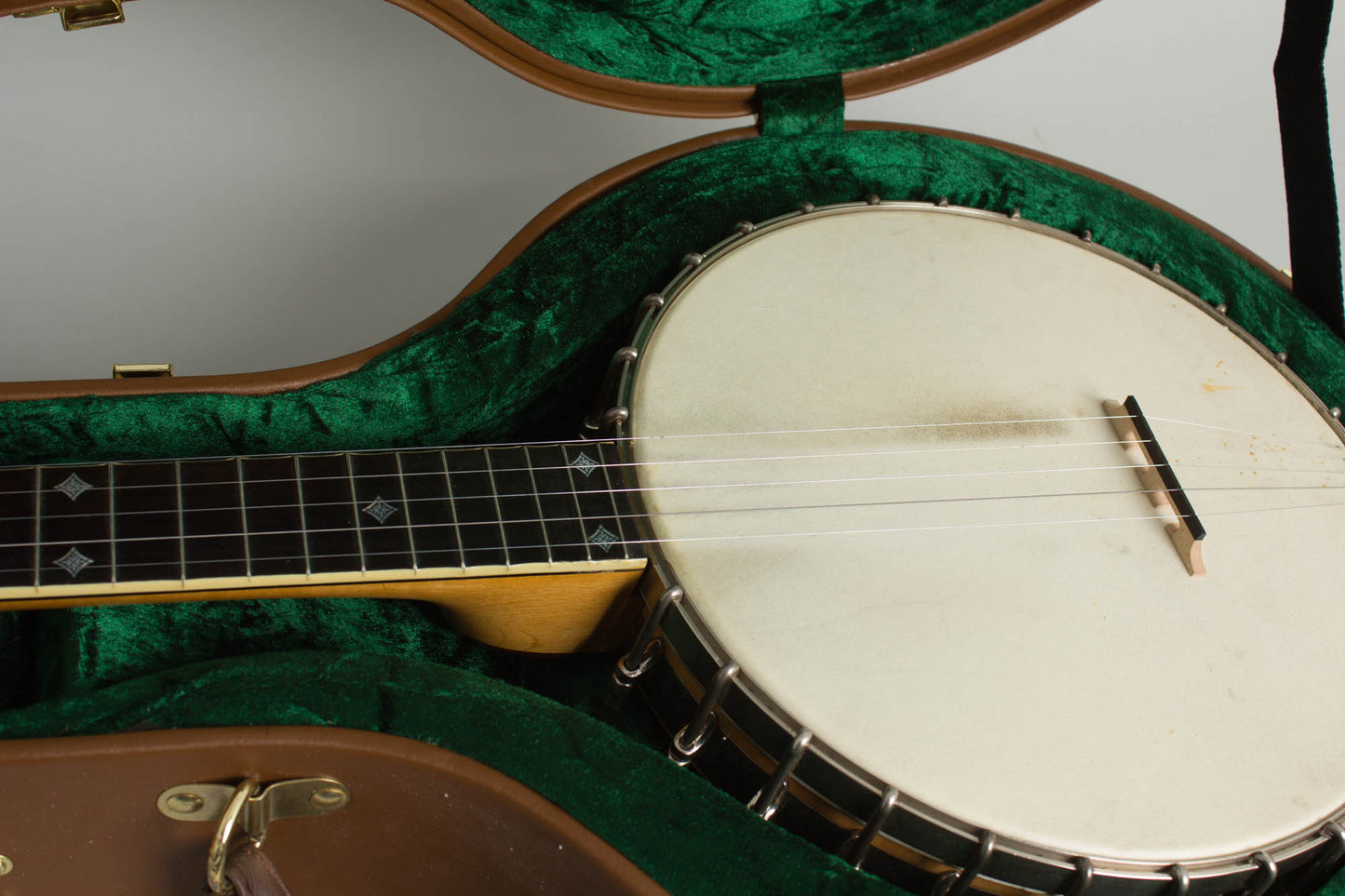
Fairbanks Whyte Laydie #2 Model 5 String Banjo (1906), made in Boston, Mass., serial # 23698, natural varnish finish, laminated maple neck and rim, ebonized fingerboard, brown tolex hard shell case. This banjo is a splendid early example of one of the world's standard openback 5-string banjos, the Fairbanks/Vega Whyte Laydie #2. It was built in 1906, just a few years after the Fairbanks company had been bought out by Vega and some time before the higher grade Tu-Ba-Phone banjos were introduced. The #2 was not the fanciest grade Whyte Laydie, but was still an elaborate creation, structurally and tonally absolutely one of the finest banjos in the world.
This particular #2 is an exceptionally beautiful banjo with elaborate early-style hand-engraved pearl inlay on the peghead and fingerboard including the famous "gryphon" design on the headstock face. According to recent scholarship master engraver Icilio Consalvi (the originator of the fantastic engraved pearl inlays on this banjo) stopped working for the Fairbanks company later in 1906 when the instruments were running around serial number 239XX. This banjo (#23698) would be a very late example of his work when his talents were in full flower. Subsequent banjos bear the work of other engravers and although beautiful never quite match the artistry of Consalvi himself. The deeply incised pearl inlays on the headstock, in particular the Gryphon's head are as finely wrought as we have ever seen, truly a master's showcase.
This banjo has a 10 3/4" heavy maple rim and 26" scale laminated maple neck; several options were available. This configuration is a classic old-time 5-string banjo and produces a sound that few others, new or old, can match. The Fairbanks "Electric" tone ring is fitted over the bracket-band rim, another patented Fairbanks feature. A tiny patent marking is visible inside the lower part of the rim, which is lined in tortoise celluloid.
The bound fingerboard is made of dyed maple with a single shaped engraved pearl floral inlay by the nut, a star at the 5th fret and engraved diamonds elsewhere. This model was mostly the brainchild of David Day, chief engineer at Fairbanks and arguably the most important if unsung banjo designer of all time. His innovations have been widely copied for decades, yet few banjo players even know his name.
As with all Fairbanks instruments, everything on this banjo is to the highest quality standards although it was not the top-line piece. By this time this Whyte Laydie was made the company's exceptional 5-strings were the undisputed standard of the world, which they remain today. Often imitated but never really improved upon in the century plus since its creation, the Fairbanks/Vega Whyte Laydie is one of those vintage instruments that instantly justifies its stellar reputation, with a superlative sound remaining one of the finest of "old school" banjos ever made.
Overall length is 35 3/4 in. (90.8 cm.), 10 3/4 in. (27.3 cm.) diameter head, and 2 3/8 in. (6 cm.) in depth, measured at side of rim. Scale length is 26 in. (660 mm.). Width of nut is 1 3/16 in. (30 mm.).
120 years along this banjo remains in very nice condition overall, with only some light wear and tear and a set of modern geared tuners added in place of the non-geared originals for playability's sake. The lightly ambered natural varnish finish has only minor wear overall with small dings and dents but that's really about it. The back of the neck is worn through to the wood in a few spots in the first position. The headstock face has a light clear overfinish (the dyed veneer often cracks and flakes) with some chipping around the tuner shafts.
There are several tiny pinholes inside the rm and one on the dowel, probably from an ancient mute assembly removed long ago. Except for the modern geared tuners the hardware appears all original including the full set of hooks and nuts and the original No-Knot tailpiece. The rim plating still shines bright showing only minor wear. The original frets and fingerboard show some wear in the lower positions but still play fine, the binding has shrunk up a bit with typical minor splits over the fret ends. The banjo is set up with a slightly worn looking but lovely sounding old skin head and makes for a truly excellent sounding and playing old-time banjo, easily tunable with the geared pegs and living in a nice modern HSC Overall Excellent - Condition.