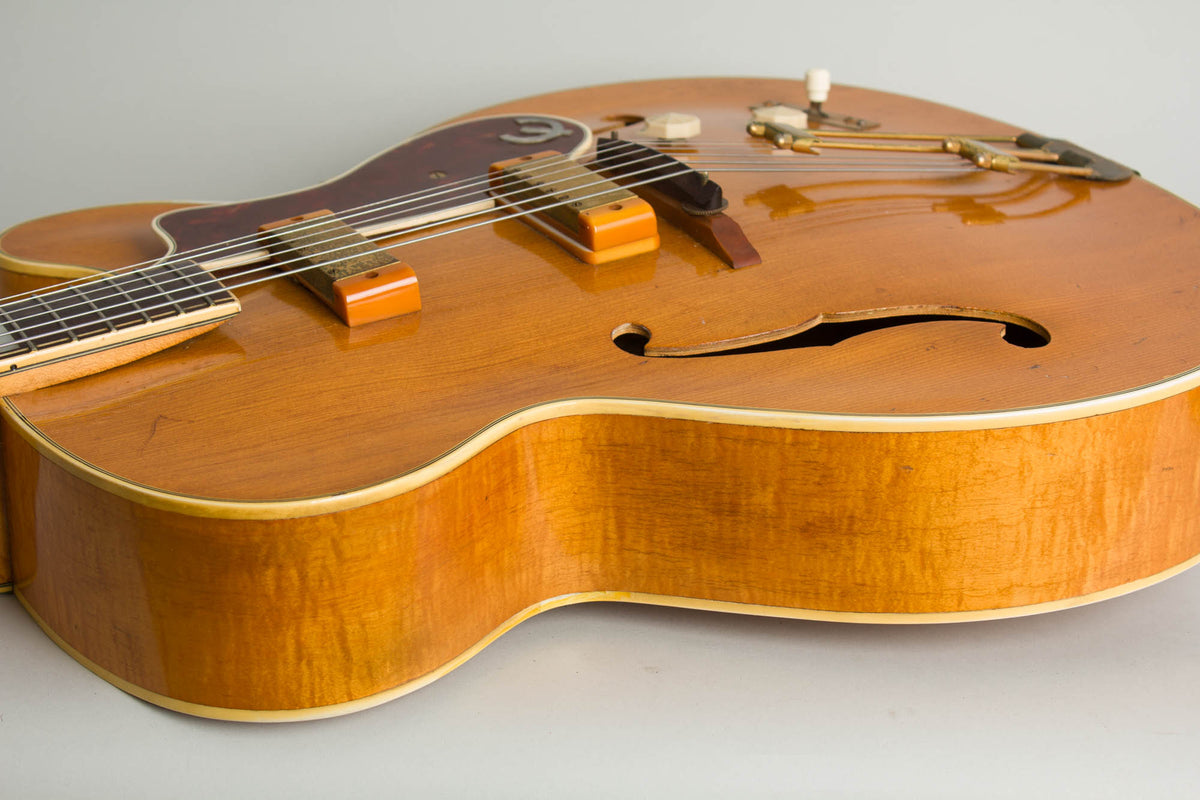
Epiphone Zephyr Deluxe Regent Model Arch Top Hollow Body Electric Guitar (1950), made in New York, NY, serial # 85369, natural lacquer finish, laminated maple body and neck, rosewood fingerboard., original brown hard shell case.
The large and fancy Zephyr Deluxe Regent was introduced in 1947-8 originally the top of the line New York-made Epiphone electric guitar. While in 1950 the company upped the ante with the even larger and grander 3-pickup Emperor Zephyr Regent, the Deluxe electric remained a high-end and popular guitar. In many ways it was the best instrument the company fielded, less cumbersome than the Emperor and a worthy competitor to Gibsons of the era.
This is a full 17.5" two-pickup archtop with quite fancy trim, including 5-ply body binding, a multi-bound vine inlaid headstock, and split abalone/pearl blocks on the fingerboard. The laminated maple body has a spruce top and carries a lovely honey-natural finish, showing off the flamed back and side grain to good advantage. The multi-laminate maple neck has a very soft "V" profile and a bit chunkier than some we have had but still quite comfortable. The rosewood fingerboard is bound with a decorative line in from the edge and Epiphone's fanciest pearl-and-abalone split block inlay. This example still has the old Epiphone "Thrust Rod" truss rod adjusted at the body end, something that would change the next year to a more Gibson-style system.
The twin gold-plated pickups are Epiphone's single coil "New York" units, with adjustable poles and mounted in unique amber Catalin blocks. The controls are a master tone and volume, with a large 3-way lever selector switch mounted down near the lower body edge. The tailpiece is Epiphone's proprietary two-tine Frequensator, and the tuners are the company's own deluxe enclosed machines. This very attractive Deluxe is still housed in its brown hard shell case, looking used but not abused since its birth in 1950.
Overall length is 42 1/4 in. (107.3 cm.), 17 1/2 in. (44.4 cm.) width, and 3 7/16 in. (8.7 cm.) in depth, measured at side of rim. Scale length is 25 1/2 in. (648 mm.). Width of nut is 1 11/16 in. (43 mm.).
This is a somewhat worn in example of this very classy early electric Epiphone, showing its 75+ years in places but still a very solid player. The finish has typical checking overall and mostly small dings, chips and other wear marks. The finish on the back of the neck is worn to the wood down by the nut running up along both fingerboard edges, up to around the 8th fret ion the treble side. A larger area of finish is worn away on the lower side below the tailpiece, and a spot is worn to the wood on the heel where it shades into the neck, possible from the thumb of a player reaching for those high notes a lot. The headstock face has some heavy checking with some finish flaked off a few sections of the pearl inlay.
There is no major damage or repair; there are small lamination checks around the jack and one to in the center of the back, but everything is solid. The Celluloid binding is in better shape than many from this period; this is often a problem area with old New York made guitars. There is some very minor shrinkage evident but nothing is shrinking off badly or deteriorating. There is some slight gapping in spots along the back edge and one piece of the outer layer patched in down by the tailpiece; a few errant glue marks can be seen along the binding edges from old repairs. The neck binding on the bass side of the fingerboard has some stress marks and one crack at the 7th fret but is solid and not crumbling away.
All hardware remains original including the oft-missing bound Celluloid pickguard and bracket; even the glued-on "E" logo is intact. The gold plating shows noticeable wear most heavily to the pickup covers and tailpiece, which has a small solid but visible repair at the baseplate, another common Epiphone issue. The guitar has never had a neck reset; the treble pickup riser has been lowered a bit and playability is very good. The original frets show some noticeable wear but still play well. Overall this is a nice old Zephyr Deluxe, a solid player with a great vibe still in the worn-but-solid original NY hard case. Overall Very Good + Condition.