


Epiphone Triumph Owned and Played by Frank Haggerty Arch Top Acoustic Guitar (1945)


1
/
of
15
Couldn't load pickup availability
Item #12741
Epiphone Triumph Owned and Played by Frank Haggerty Model Arch Top Acoustic Guitar (1945), made in New York City, serial # 53129, natural lacquer finish, maple back, sides and neck, spruce top, rosewood fingerboard, black hard shell case.
This well-played Epiphone Triumph from 1945 is a really cool example of this long-running model with a particularly great history, owned and used by Frank Haggerty, a professional swing/new Orleans style player for decades. The instrument represents the just-post war version of the Triumph, a model originally introduced in 1931 and by this point upgraded and enlarged to a full 17 3/8" body from the original 15 1/12". The Triumph was the lowest grade "professional" guitar in Epiphone's line, a relative bargain at $125 and a real workhorse for pro players who could not afford the top-line Deluxe or Gibson L-5.
The natural finish carved spruce top is triple bound with unbound soundholes and the back single bound. The single-bound headstock is faced with darker wood with "Epiphone" and a decorative doodad inlaid not in pearl, but composite plastic, which we have only seen on a few wartime examples. The 5-piece laminated mahogany neck is fairly slim with a noticeable taper, the medium-shallow "C" profile hinting at a "V" in the lowest position and notched diamond pearl inlay on the bound rosewood fingerboard. The tuners are the company's excellent proprietary sealed-gear machines, never used on other brands. The single bound pickguard is in the original style but is a nicely done reproduction; the original deteriorated decades ago.
When this guitar was made, Epiphone was located on the second floor of a large loft building on West 14th street where they operated an integrated factory and showroom in the heart of swing-era New York. This Epiphone Triumph dates to the period just after the war when demand for guitars was high and sales were booming; not long after this the company began a gradual decline, moving away from New York in 1951 and eventually being sold at a pittance to Gibson's parent company CMI in 1957. These original high-end Epiphone archtop guitars were very popular among professional users when new, and many like this were played for decades by the original owners.
The top is carved quite thin and this is a very lively sounding guitar. It has a fantastic history with a fairly obscure but still important rhythm player from the later swing era. It was purchased new in the 1940s by Frank Haggerty, an professional American swing/jazz guitarist and later banjoist. He was born in 1918 in California and died in there 2004. He worked as Columbia Broadcasting System's west coast staff guitarist for a number of years and played most of the top radio and stage shows, including with Frank Sinatra at the Golden Gate Theatre in San Francisco, running 10 times a day to full houses. He also backed at different times Jimmy Durante, Mel Torme and Andy Williams. He worked extensively with Frank Sinatra Junior, who specially featured him in honor of his history with Frank Sr.
Haggerty also worked as a studio musician in San Francisco, Los Angeles and Hollywood. He is best known for being featured extensively on Kid Ory's numerous Verve LP recording sessions, which are considered absolute classics of the genre and some of the best albums of later New Orleans-style Jazz ever cut. This guitar would have been the featured instrument for all his acoustic rhythm playing on those jobs. Frank's son Terry Haggerty was the guitarist in San Francisco's renowned Sons of Champlain and a very well regarded player in his own right.
This guitar includes the August 1975 issue of GUITAR PLAYER magazine featuring both Haggertys, and an amazing and fascinating self-published autobiographical treatise by Frank himself detailing the ups and downs of his life and career. This last is a truly unique document, a completely (sometimes painfully) unvarnished account of what it was like to be a working guitarist in the 1930s, '40s and '50s. While the past history of this instrument is far better documented than most, it still has plenty more music to make in the 21st century.
Overall length is 42 in. (106.7 cm.), 17 3/16 in. (43.7 cm.) wide at lower bout, and 3 3/8 in. (8.6 cm.) in depth, measured at side of rim. Scale length is 25 1/2 in. (648 mm.). Width of nut is 1 11/16 in. (43 mm.).
This is obviously a well played guitar, but also a well cared for one. Mr. Haggerty bought it new and used this as his primary acoustic guitar for decades. While it has some typical wear and repair this old Epiphone remains largely original and a fine player's instrument. The finish remains original except for a light clear overspray to the top and the back of the neck, which obviously took the brunt of the play wear. There are dings, dents and scratches to the top, some under and some through this later coating, which is pretty thin. The back of the neck was worn down to the wood before the overfinsh, which has some subsequent dings and dents. The back and sides of the body show much less wear.
There are several repaired spruce grain splits to the top, one coming off the back of and one below the treble side F-hole. There is a deep scratch above the bass side soundhole, which looks like a crack but does not go through the wood. The top center seam appears to have been resealed before the overfinish was applied, and there is a long repaired grain split just above the top edge of the pickguard, where there is old discoloration from the original outgassing celluloid pickguard. There is a correct style repro pickguard currently fitted along with a later Gibson adjustable rosewood bridge, that looks to have been there for decades. The original Frequensator tailpiece is intact but has two extra holes drilled in the top of the baseplate, purpose unknown.
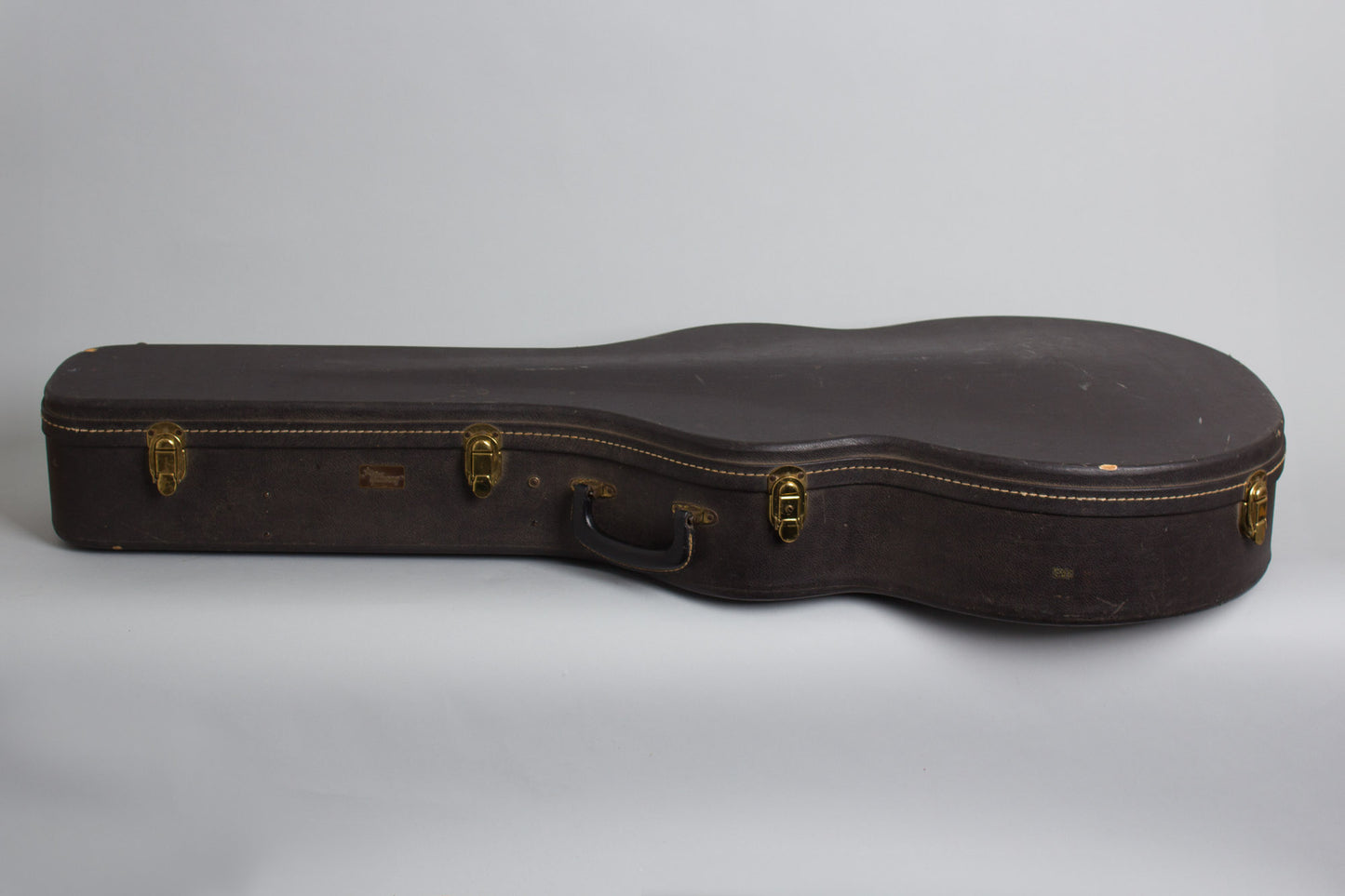
The rosewood fingerboard has been trued and refretted with appropriate wire and shows little subsequent wear. This is a really fine player's guitar with a truly wonderful sound, as played into it by Mr. Haggerty over many decades. It is not the cleanest of fanciest old Epiphone we have had but carries a serious vibe; this guitar has shared the room with some historically important folks over the years! It resides in an older Gibson hard shell case from the 1960s. Overall Very Good + Condition.
View full details
This well-played Epiphone Triumph from 1945 is a really cool example of this long-running model with a particularly great history, owned and used by Frank Haggerty, a professional swing/new Orleans style player for decades. The instrument represents the just-post war version of the Triumph, a model originally introduced in 1931 and by this point upgraded and enlarged to a full 17 3/8" body from the original 15 1/12". The Triumph was the lowest grade "professional" guitar in Epiphone's line, a relative bargain at $125 and a real workhorse for pro players who could not afford the top-line Deluxe or Gibson L-5.
The natural finish carved spruce top is triple bound with unbound soundholes and the back single bound. The single-bound headstock is faced with darker wood with "Epiphone" and a decorative doodad inlaid not in pearl, but composite plastic, which we have only seen on a few wartime examples. The 5-piece laminated mahogany neck is fairly slim with a noticeable taper, the medium-shallow "C" profile hinting at a "V" in the lowest position and notched diamond pearl inlay on the bound rosewood fingerboard. The tuners are the company's excellent proprietary sealed-gear machines, never used on other brands. The single bound pickguard is in the original style but is a nicely done reproduction; the original deteriorated decades ago.
When this guitar was made, Epiphone was located on the second floor of a large loft building on West 14th street where they operated an integrated factory and showroom in the heart of swing-era New York. This Epiphone Triumph dates to the period just after the war when demand for guitars was high and sales were booming; not long after this the company began a gradual decline, moving away from New York in 1951 and eventually being sold at a pittance to Gibson's parent company CMI in 1957. These original high-end Epiphone archtop guitars were very popular among professional users when new, and many like this were played for decades by the original owners.
The top is carved quite thin and this is a very lively sounding guitar. It has a fantastic history with a fairly obscure but still important rhythm player from the later swing era. It was purchased new in the 1940s by Frank Haggerty, an professional American swing/jazz guitarist and later banjoist. He was born in 1918 in California and died in there 2004. He worked as Columbia Broadcasting System's west coast staff guitarist for a number of years and played most of the top radio and stage shows, including with Frank Sinatra at the Golden Gate Theatre in San Francisco, running 10 times a day to full houses. He also backed at different times Jimmy Durante, Mel Torme and Andy Williams. He worked extensively with Frank Sinatra Junior, who specially featured him in honor of his history with Frank Sr.
Haggerty also worked as a studio musician in San Francisco, Los Angeles and Hollywood. He is best known for being featured extensively on Kid Ory's numerous Verve LP recording sessions, which are considered absolute classics of the genre and some of the best albums of later New Orleans-style Jazz ever cut. This guitar would have been the featured instrument for all his acoustic rhythm playing on those jobs. Frank's son Terry Haggerty was the guitarist in San Francisco's renowned Sons of Champlain and a very well regarded player in his own right.
This guitar includes the August 1975 issue of GUITAR PLAYER magazine featuring both Haggertys, and an amazing and fascinating self-published autobiographical treatise by Frank himself detailing the ups and downs of his life and career. This last is a truly unique document, a completely (sometimes painfully) unvarnished account of what it was like to be a working guitarist in the 1930s, '40s and '50s. While the past history of this instrument is far better documented than most, it still has plenty more music to make in the 21st century.
Overall length is 42 in. (106.7 cm.), 17 3/16 in. (43.7 cm.) wide at lower bout, and 3 3/8 in. (8.6 cm.) in depth, measured at side of rim. Scale length is 25 1/2 in. (648 mm.). Width of nut is 1 11/16 in. (43 mm.).
This is obviously a well played guitar, but also a well cared for one. Mr. Haggerty bought it new and used this as his primary acoustic guitar for decades. While it has some typical wear and repair this old Epiphone remains largely original and a fine player's instrument. The finish remains original except for a light clear overspray to the top and the back of the neck, which obviously took the brunt of the play wear. There are dings, dents and scratches to the top, some under and some through this later coating, which is pretty thin. The back of the neck was worn down to the wood before the overfinsh, which has some subsequent dings and dents. The back and sides of the body show much less wear.
There are several repaired spruce grain splits to the top, one coming off the back of and one below the treble side F-hole. There is a deep scratch above the bass side soundhole, which looks like a crack but does not go through the wood. The top center seam appears to have been resealed before the overfinish was applied, and there is a long repaired grain split just above the top edge of the pickguard, where there is old discoloration from the original outgassing celluloid pickguard. There is a correct style repro pickguard currently fitted along with a later Gibson adjustable rosewood bridge, that looks to have been there for decades. The original Frequensator tailpiece is intact but has two extra holes drilled in the top of the baseplate, purpose unknown.
The rosewood fingerboard has been trued and refretted with appropriate wire and shows little subsequent wear. This is a really fine player's guitar with a truly wonderful sound, as played into it by Mr. Haggerty over many decades. It is not the cleanest of fanciest old Epiphone we have had but carries a serious vibe; this guitar has shared the room with some historically important folks over the years! It resides in an older Gibson hard shell case from the 1960s. Overall Very Good + Condition.


Loading...
Just arrived!
Item #