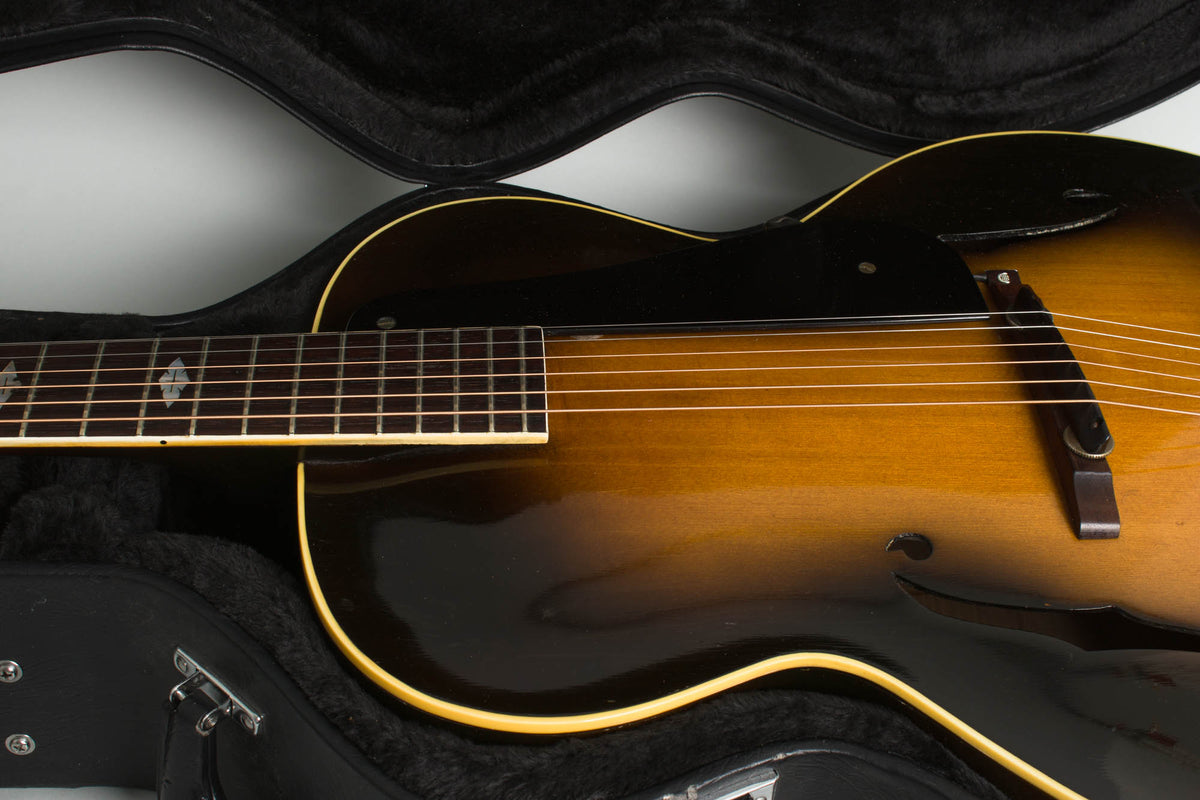
Epiphone Triumph Model Arch Top Acoustic Guitar (1935), made in Long Island City, NY, serial # 8215, sunburst top, dark back and sides finish, laminated maple back and sides, solid carved spruce top; laminated mahogany neck with rosewood fingerboard, hard shell case.
This lovely Epiphone Triumph from late 1934 is a fairly early example of this long-running model with features typical of the period. This instrument represents the second major version of the Triumph, originally introduced in 1931 and then recently enlarged to a 16 1/2" body from the original 15 1/12"; within a year it would again be enlarged to over 17" wide. This model was basic no-frills professional guitar in Epiphone's line, a relative bargain at $125 and a real workhorse for depression era players who could not afford the top-line $275 Deluxe or Gibson L-5. The triumph changed features often in this period and this is a fairly rare variation.
The carved spruce top is single bound with early-style segmented f-holes, finished in a fairly somber brown sunburst. The back and neck are finished to match while the rims are finished in a dark stain. The slim center-peak headstock is unbound with an inlaid pearl "Epiphone" logo over a pearl fleur-de-lys design. The 5-piece laminated mahogany neck is fairly slim with a noticeable taper, shaped in a shallow "soft V" profile which rounds out fully above the 5th fret. The single bound rosewood fingerboard is inlaid with large notched pearl diamonds, a then-new touch that became a trademark of this model. The carved rosewood adjustable bridge and simple tailpiece are common to most Epiphone models in this period. The black composite pickguard is another understated touch.
In 1934 Epiphone, Inc. was headed up by its namesake Epaminondas ("Epi") Stathopoulo. By all accounts an extremely fastidious and dedicated man, and it is said that he personally inspected every instrument that bore his name. All pro-grade carved-top Epiphone guitars are fine instruments, but the earlier models produced under his watch are among the very best and were often preferred by the era's top players to anything else available.
Not long after this guitar was made, the Stathopoulo family moved their guitar-building operation from Long Island City to the second floor of a large loft building on West 14th street where Epiphone, Inc. would operate an integrated factory and showroom in the heart of swing-era New York. This "second generation" Epiphone Triumph dates to the period just before the company enlarged and completely redesigned the model in response to arch-rival Gibson's "Advanced" line in 1935-6. These original pro-grade Epiphone archtop guitars were very popular among professional users when new, but many were played for decades and nice examples are hard to find today.
Overall length is 41 1/2 in. (105.4 cm.), 16 1/2 in. (41.9 cm.) wide at lower bout, and 3 3/8 in. (8.6 cm.) in depth, measured at side of rim. Scale length is 25 1/2 in. (648 mm.). Width of nut is 1 11/16 in. (43 mm.).
This guitar has seen some work over the decades but presents very well, showing not much actual wear looking very clean and playing fine. The top finish is original with some tiny touchups but does not show much play wear, just small dings and scratches. There is a spot of errant glue in between the tailpiece arms that resists easy removal. There are a few small grain marks but no cracks through the wood. The back and some areas of the sides show more recent overspray, especially below the heel around the back center seam which has been resealed. The back of neck up to the headstock line is more heavily oversprayed as well. There is touch up along the lower back/side joint where the back likely separated and smaller spots around binding repairs in each waist.
The guitar has had the neck reset, with overspray around the heel and a tiny sealed split to the side just below it. The fingerboard does not appear to have been refretted but some divots in the lower positions were filled in; the wire has been crowned pretty low but is still fully playable. All the binding appears original; the celluloid used on New York guitars from the 1930's thru the 1960's has often deteriorated badly over the years so this is a nice find.
The original tailpiece is in the case, with a small split to the baseplate. The guitar is currently fitted with a modern tailpiece modified to accommodate an endpin jack for a non-intrusive under-bridge pickup, which is functional. The tuners are recent reissue Grover G-98 style branded Gotoh. A strap button has been added to the heel. The guitar has a powerful sound, sweeter than some, incisive without being overly brash. This is typical of early Epiphones, and a big part of their initial success. This old veteran looks very sharp and plays very well, a wonderful survivor of early swing era New York in a modern HSC. Overall Very Good + Condition.