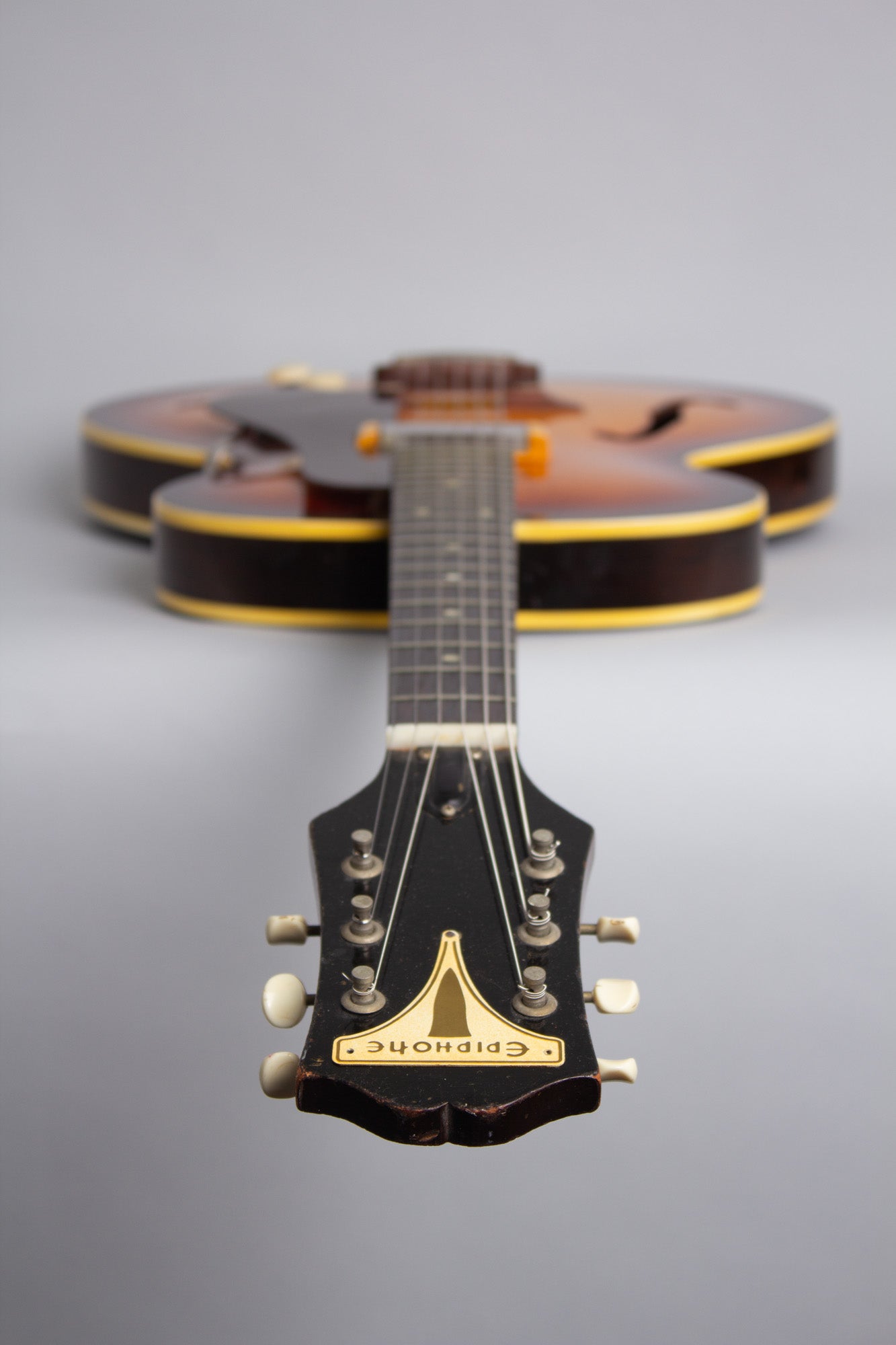
Epiphone Century E-422T Model Thinline Hollow Body Electric Guitar (1959), Kalamazoo, Michigan, serial # A-2749.
After Gibson's parent company Chicago Musical Instruments bought the defunct Epiphone operation in 1957, it took them a year or so to come up with a new instrument line using the former competitor's name. Samples were shown at the NAMM show in summer 1958 but production only began in earnest for the 1959 model year. This E-422T Century is one of those first models, the rare earliest 1959 version built with some actual leftover New York Epiphone components.
The Century was not one of the higher-end Epiphone models; it is a student grade non-cutaway hollowbody archtop with a single pickup. It was basically the equivalent model to Gibson's ES-125T, sold to teaching studios or suitable for pro players on a budget. Gibson was moving to thinner bodies at the time, and the Century follows this trend with a rim well under 2" deep on its 16 1/2" wide body. This gives the guitar a slightly unusual look and feel, slimmer than most guitars this size and looking a bit rounder in the bouts than its Gibson cousins.
This guitar's primary difference from the 1960s models that followed is the use of an original NY-made neck blank, a stock of which was included with CMI's purchase of the company. This is made of a 3-strip mahogany/maple laminate with a slim, medium-soft "V" shaped profile quite unlike period Gibson necks with a sharply pointed heel with a celluloid cap. The pickup is also unusual, the less common non-polepiece version of the "New York" Epiphone unit. These were used on the original deeper-body Epiphone Century in the '50s; a small stock came to Kalamazoo and appear only on the earliest Epiphone budget guitars shipped out in 1959-60. The sound is less powerful but somewhat brighter than Gibson's P-90.
This model was one of the first new Epiphones to carry the banner for Kalamazoo. 276 Centurys shipped out in 1959 and a further 235 in 1960, during which time the original Epiphone hardware was used up and the model adopted a P-90 pickup and standard mahogany Gibson neck. The list price was $159.50 in 1960, plus $47.75 for the hardshell case, which the original purchaser of this guitar apparently ponied up for (most would have gone for the $13.75 chipboard instead!) This budget model was the best seller of the new Epiphone line, but these numbers are a fraction of what similar Gibson models sold the same years (the ES-125T shipped over 2000 units in 1959 alone). This is a neat example of this transitional Epiphone, surprisingly handy for its size, a fun guitar to play and a cool historic piece.
Overall length is 41 1/2 in. (105.4 cm.), 16 1/2 in. (41.9 cm.) wide at lower bout, and 1 13/16 in. (4.6 cm.) in depth, measured at side of rim. Scale length is 25 1/4 in. (641 mm.). Width of nut is 1 11/16 in. (43 mm.).
This is a relatively clean and original version of this interesting guitar, a nice player with some minor wear and several restored parts. The all-original finish has some typical checking, rubs, scuffs and dings but no heavy wear. The New York style pickup and wiring are original, including the hard-to-find prewar style white pointer knobs. The tailpiece is original while the rosewood bridge is a generic 1960's style primarily seen on Guild guitars. The pickguard is a nicely done repro. The Kluson Deluxe tuners and arched metal truss rod cover are original, while the Epiphone logo plate on the headstock is an accurate repro. A strap button was added to the heel. The original frets have some light wear but the guitar plays very well with a cool blusey sound and a great vibe. It rests in what appears to be the original hardshell case, a variant on the standard Gibson cases of the period. Excellent - Condition.