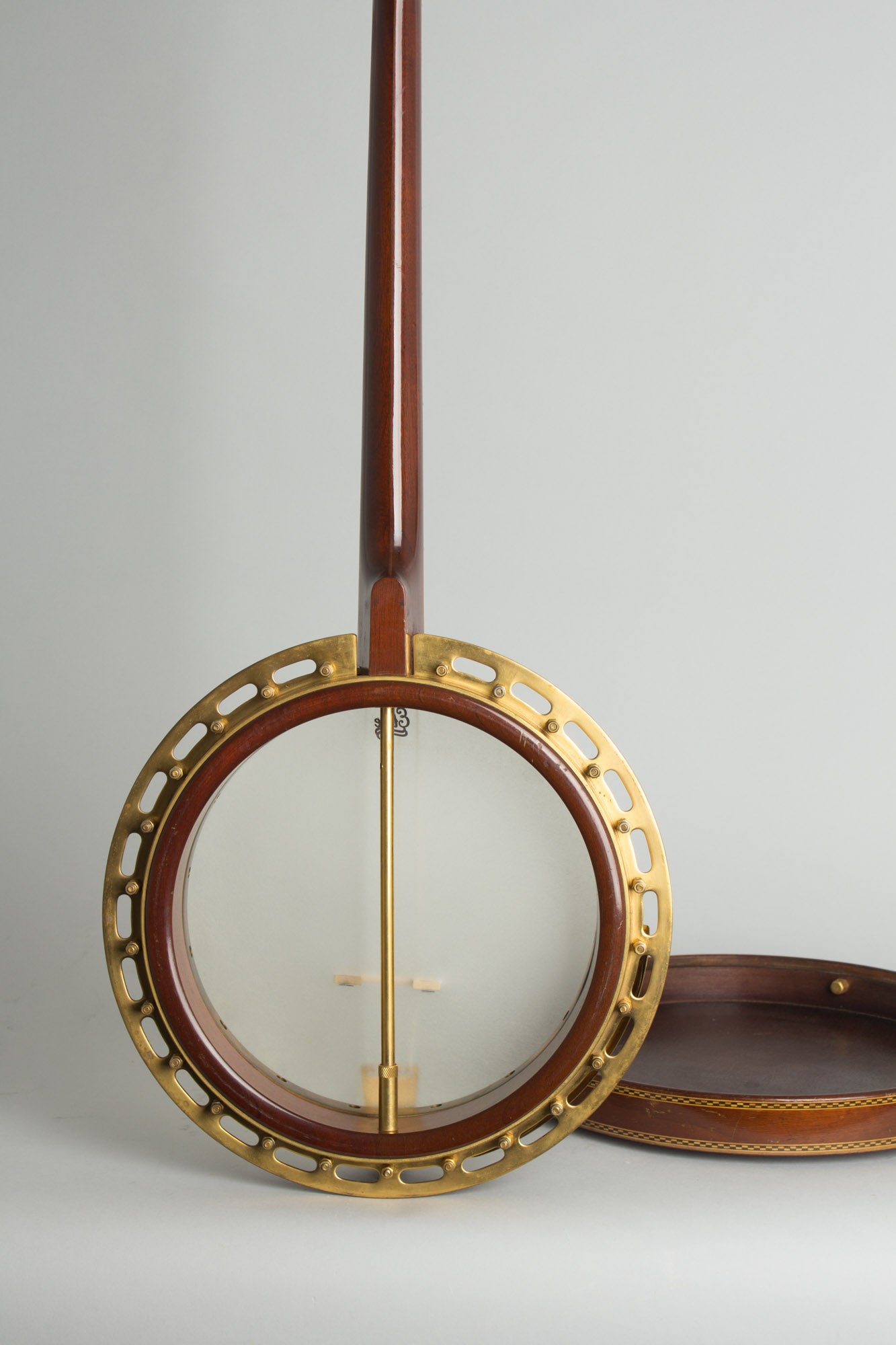
Bruno Commander DeLuxe Model Tenor Banjo, made by Epiphone (1927), made in Long Island City, NY, natural finish, Laminated mahogany neck, rim and resonator; rosewood fingerboard, black tolex hard shell case.
This is a very interesting mid-line 1920s tenor banjo, a little-known model sold by one of New York's biggest catalog jobbers but made here as well, by a young up-and-coming company called Epiphone. Wholesale jobbers like C. Bruno & Son generally commissioned their house-brand instruments from whichever manufacturer offered them the best price point. Often this meant one of the big Chicago factories, usually Slingerland, Harmony, or Regal. NYC-based firms sometimes found it more expedient to order from a local operator, which in the mid-'20s still encompassed a number of options.
Epiphone was one of these, then in the process of growing from a small family workshop into a large manufacturing operation. The former "House of Stathopoulo" provided custom label banjos to several local distributors, including Bruno and Carl Fischer. As was the norm at the time, the manufacturer was not indicated and only the Jobber brand name appeared on the headstock. That means the instruments must be identified by features, which in Epiphone's case is easy as their instruments are always distinctive.
C. Bruno & Son was one of the oldest and most well-established jobbers in New York with a history stretching back into the 1850s. They were the biggest distributor of Orpheum banjos in the 1910s, and offered custom-branded Lange-made tenor banjos under the names Tempo Grande and Royal Artist in the 1920s. For some reason, these were abruptly dropped in 1927, replaced with the Epiphone-built Commander and Commander De Luxe.
Despite apparently being introduced in 1927, this Commander De Luxe features the older tone ring Epiphone had already abandoned on its high-end models in favor of the complex Recording rim design. Perhaps this was an opportunity to use up the old parts, enabling a relative bargain price to Bruno for these mid-priced, off-brand instruments. This early-style Epiphone ring produces a surprisingly rich and warm sound, somewhat less strident than the much heavier later Recording models.
The general design of the banjo is basically an Epiphone Rialto model dressed up a bit. The entire banjo is made of mahogany which was a relatively inexpensive place to start. The hardware is gold-plated, usually reserved for higher end instruments and the likely upgrade meriting the "Deluxe" part of the name. The rosewood fingerboard is bound with small diamond fret markers a pattern that appears unique among Epiphone banjos. The resonator has checkered wood purfling side and back, plus a dramatic marine-themed decal in the center playing off the Commander name.
The hardware is medium-grade with Epiphone's early heavy one-piece flange, geared Grover two-tab tuners, and a Waverly tailpiece. The headstock is faced with the slightly gaudy hand-cut and colored engraved pearloid veneer typical of Epiphone, which is nicely done but has a distinctly slightly funky look about it. This is a very good sounding and playing instrument, with a warmer sound than some tenors but plenty of volume. They didn't sell many of these, and it is also a neat piece of early Epiphone history.
Overall length is 33 5/8 in. (85.4 cm.), 11 in. (27.9 cm.) diameter head, and 3 in. (7.6 cm.) in depth, measured at side of rim. Scale length is 23 in. (584 mm.). Width of nut is 1 1/8 in. (29 mm.).
This is a relatively clean banjo, and remains all original except for the head and bridge. The finish shows some light general wear with small scuffs, dings, and scrapes, mostly to the resonator back. The gold-plated hardware is worn in many places, notably almost completely gone from the tailpiece. Some of the veneer is lifting a bit on the headstock, but there are no structural issues. The neck and frets are in excellent condition and this banjo plays very well. This is a lovely survivor and a splendid if slightly whimsical example of the long-lost New York banjo tradition and Epiphone's place in it. A newer HSC is included. Excellent Condition.