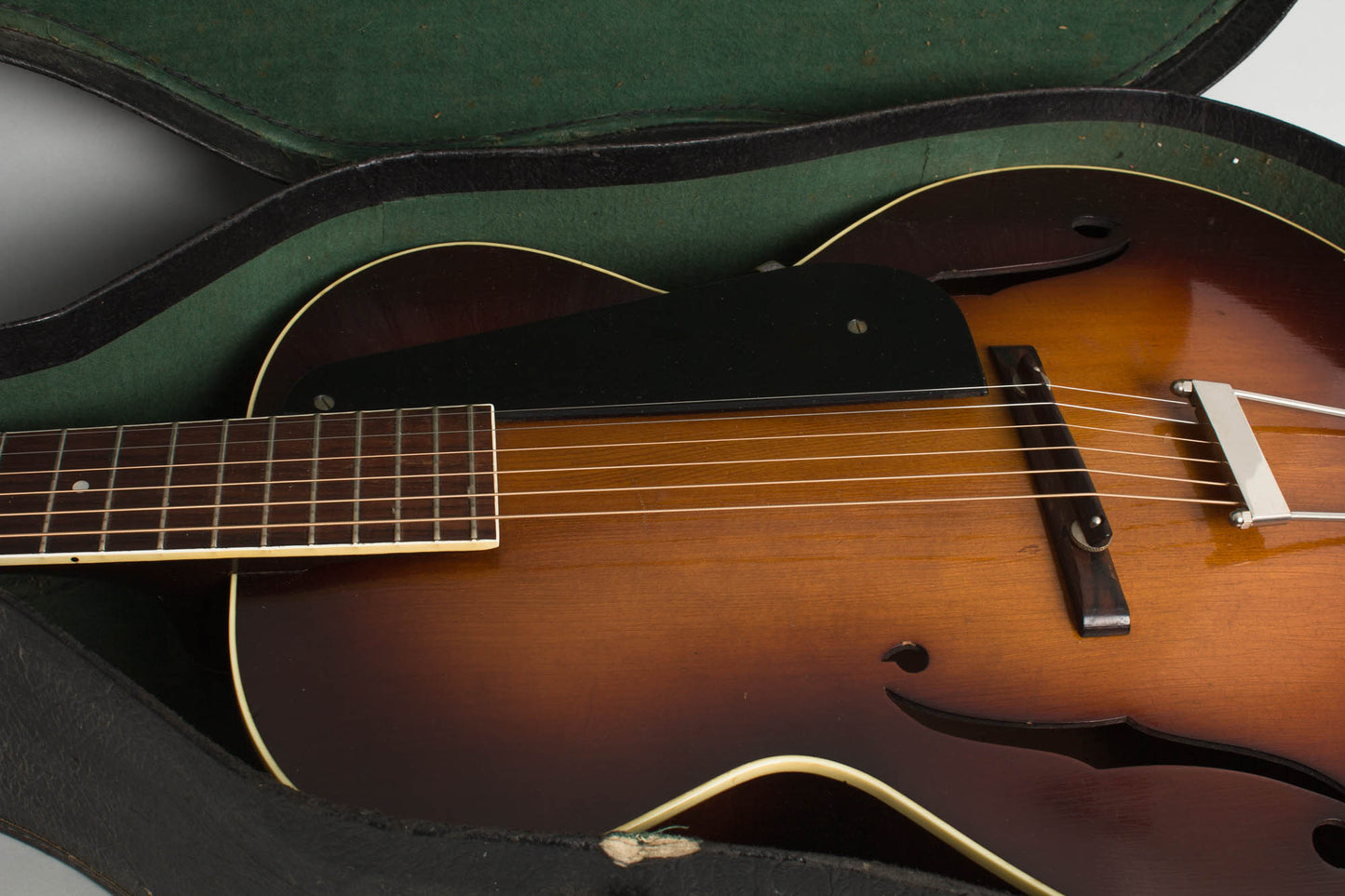
Epiphone Blackstone Model Arch Top Acoustic Guitar (1934), made in New York City, sunburst top, dark back and sides finish, mahogany back and sides, spruce top; mahogany neck with rosewood fingerboard, black chipboard case.
This Epiphone Blackstone from 1934 is a nice fairly early example of this somewhat obscure but long-running model. This instrument represents the second version of the Blackstone, originally introduced in 1931 with a small 14 3/4" wide body and recently enlarged to a 15 1/8". By 1936 it would be enlarged again to over 16" wide as was the industry trend. Originally it was offered in a ebony finish (likely the origin of the name) but by 1934 had a more standard sunburst top. This model was on the cusp of the amateur/professional transition in Epiphone's line, a relative bargain at $75 and a workhorse for depression era players who could not afford the top-line $275 Deluxe or Gibson L-5.
Epiphone changed features on their guitars often in this period making this a fairly rare variation of the Blackstone. The carved spruce top is single bound with segmented F-holes and finished in a fairly somber amber/brown sunburst, the back and rims finished in a dark stain. The carved rosewood adjustable bridge and simple tailpiece are common to most Epiphone models in this period, the simple pickguard is black Bakelite.
The one-piece mahogany neck is fairly wide with a noticeable taper, the medium-shallow "C" profile hinting at a "V" in the lower positions. The rosewood fingerboard is bound with pearl dot inlay; the double dots are at the 7th fret instead of the 12th, an Epiphone oddity of the time. The center-peak headstock has a pearl block-letter "Epiphone" logo over a pearl "stickpin" inlay (that looks like an exclamation point!) and carries individual openback Grover tuners with plastic buttons.
In 1934 Epiphone, Inc. was headed up by its namesake Epaminondas ("Epi") Stathopoulo. By all accounts, he was an extremely fastidious and dedicated man who personally inspected every instrument. All carved-top Epiphone guitars are fine instruments, but the earlier models produced under his watch are among the very best and were often preferred by the era's top players to anything else available. This Blackstone would not have been considered a really professional-grade guitar but was still a quality instrument.
Not long before this guitar was made, the Stathopoulo family moved their guitar-building operation from Long Island City to the second floor of a large loft building on West 14th street where Epiphone, Inc. would operate an integrated factory and showroom in the heart of swing-era New York. This "second generation" Blackstone has evolved noticeably from the initial 1931 models but still dates to the period before the company enlarged and completely redesigned the model in response to arch-rival Gibson's "Advanced" line in 1935. The original Epiphone Masterbilt archtop guitars were popular among both amateur and professional users when new, but many were played for decades and nice all-original examples like this are hard to find today.
Overall length is 40 1/2 in. (102.9 cm.), 15 1/8 in. (38.4 cm.) wide at lower bout, and 3 3/8 in. (8.6 cm.) in depth, measured at side of rim. Scale length is 25 1/2 in. (648 mm.). Width of nut is 1 11/16 in. (43 mm.).
This guitar has seen some action over the decades but presents very well, remaining all original and looking and playing fine. The original lacquer finish shows moderately heavy checking with dings, dents and scratches but little really heavy wear. The top has some odd fine spotting below the string line but this is not conspicuous. Under blacklight some of the finish on the top has an uneven appearance, there may have been some very light overfinishing in spots but the patina is uniform over the instrument.
There are no detectable cracks or repairs, the binding is all solid with no deterioration. The guitar may have had the neck reset but if so it was a very clean job leaving little trace. All hardware remains original and in good condition and no strap button was ever added to the heel. The frets appear original with only some light wear and still play fine. The guitar has an incisive sound without being overly brash, not the loudest early Epiphone we have had but sweeter than some. This lovely old veteran plays very well, a cool survivor of swing era New York in a period (likely original) chipboard case. Overall Excellent - Condition.