Dobro Electric Spanish Model Arch Top Hollow Body Electric Guitar (1936), made in Chicago, serial # 122, sunburst lacquer finish, laminated maple body with spruce top, mahogany neck with rosewood fingerboard, original black hard shell case.
This rather battered but historic instrument is a very early commercially built electric guitar, the newly merged National/Dobro company's first serious entry into nascent amplified Spanish market. The earlier Dobro "All Electric" with its pickup stuffed awkwardly into a resonator guitar a had been a resounding flop, so this more conventional attempt was launched in 1935. We have seen variants of this model branded both National and Supro, but this is the first "Dobro" logo'd example this early we have come across. The guitar surfaced in Canada, and the small "Made in USA" stamped into the pickup housing indicates it was likely ,originally sold there.
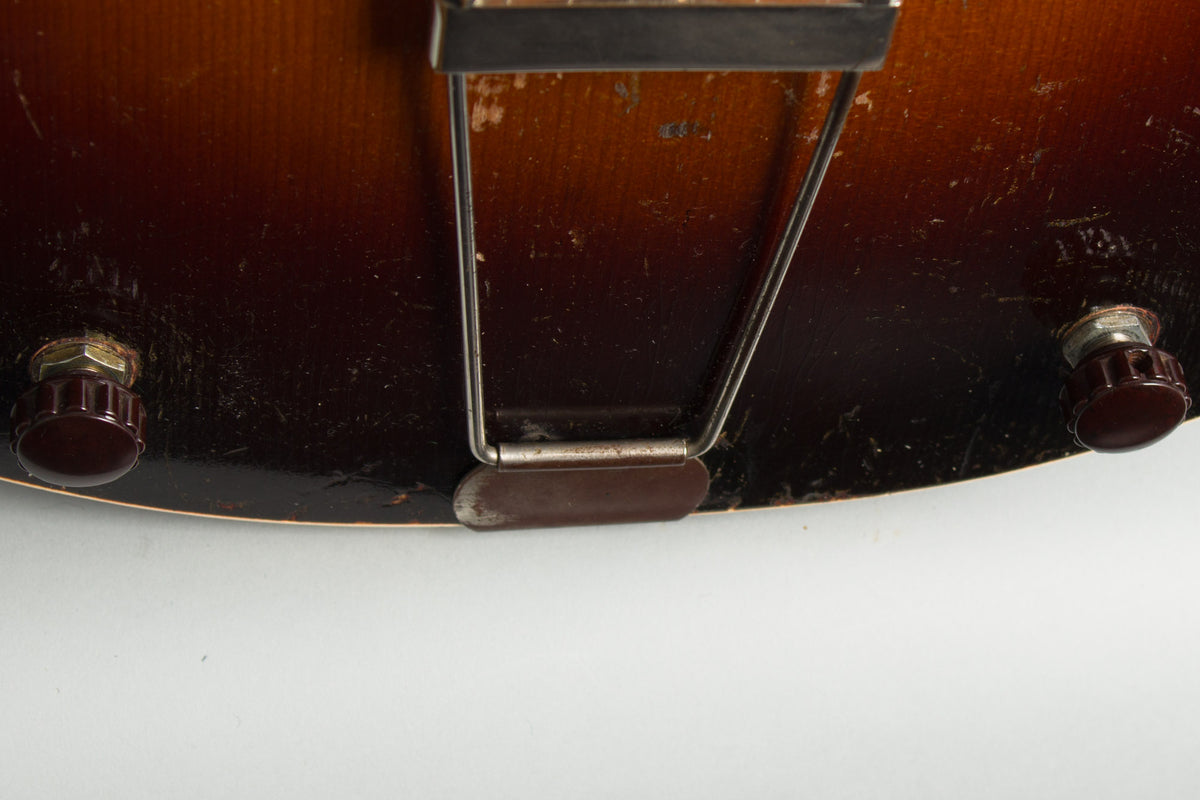
The arch-top body and neck were purpose built in Chicago, likely by Regal. The pickup is the same dual blade-equipped unit with an internal horseshoe magnet used on all early National and Dobro electrics, the design purchased from Seattle's Arthur J. Stimson. It is housed into a large, vary heavy metal housing mounted to the top the body with a long flange facing backwards. This along with the two knobs mounted back on either side of the tailpiece date this example to early/mid 1936. Small knurled metal knobs on either side of the pickup housing allow the blades to be adjusted for height.
The wood body and neck are fairly conventional; the body is laminated maple with a spruce top, very stoutly braced with twin soundposts for the heavy pickup with abbreviated F-holes. The mahogany neck has an unusual maple shim under the bound rosewood fingerboard which appears to be factory. The fingerboard inlay is inlaid with double and triple dots with an additional diamond at the 7th fret. A standard Dobro logo decal is affixed to the small unbound headstock, which is fitted with openback strip tuners
This guitar is very heavily used but still sounds great, with a powerful and aggressive tone. The fairly understated look soon evolved, eventually into the much flashier "New Yorker" model made famous by Memphis Minnie. This well-worn 90 year old veteran had obviously had an eventful life so far looks cool, with an understated antique Deco air and a very funky vibe.
Overall length is 40 5/8 in. (103.2 cm.), 15 11/16 in. (39.8 cm.) wide at lower bout, and 3 5/16 in. (8.4 cm.) in depth, measured at side of rim. Scale length is 25 1/2 in. (648 mm.). Width of nut is 1 3/4 in. (44 mm.).
This is a fully playable but HEAVILY battered guitar; there is wear virtually everywhere. Someone played this guitar HARD for a quite some time "back in the day" likely when it was the only electric they had. There is extensive pick scratching and general wear to the top, with deep dings, scrapes and gouges. The back and sides are heavily worn as well, and the back of the neck is mostly worn down to the bare wood.
Along the way the neck was reset (a bit sloppily) and more recently the fingerboard trued and neatly refretted with period-appropriate wire. The pickup and electronics appear original (including, oddly, a Canadian-made "Aerovox" capacitor on the tone control) except a conventional phone plug output jack was substituted for the original Amphenol jack. A large and ugly repair to the lower side accompanies this switch; it appears the original jack was crushed into the body at some point and the area hastily repaired with what looks like black putty. This area of the side is solid but looks pretty bad, however the guitar functions properly with its later jack mounted just above where the original sat.
The brown Bakelite radio knobs are period but not original, the tuners are repro openback strips, the adjustable rosewood bridge appears original to the guitar but has had a small lateral shim added to one side under the base and the string slots cut deeper. The pickguard is the original style; it has an extra hole for another bracket so may have been repurposed from another instrument. The guitar is a REAL relic but after a 100,000 mile clean up and checkup is ready to fire up again, somewhat amazingly still in the supremely battered-but-solid OHSC. Overall Very Good Condition.