


D'Angelico Special Cutaway Arch Top Acoustic Guitar (1954)


1
/
of
16
Regular price
$24,500.00
Regular price
$24,500.00
Sale price
$24,500.00
Unit price
/
per
Item #12165
D'Angelico Special Cutaway Model Arch Top Acoustic Guitar (1954), made in New York City, serial # 1941, sunburst lacquer finish, maple back and sides, spruce top; maple neck with ebony fingerboard, original brown hard shell case.
This is a well-played but slightly unusual original 1950s D'Angelico, not one of the master's top-line instruments but a great sounding one nonetheless. It shows a lot of work done over the years but remains true to the way it was built over 70 years ago. These were working guitars when built, and although usually cherished by their owners were often worked hard.
The D'Angelico ledgers record this guitar as a "Cutaway Special" and indicate it was sold to Lou Tosta on March 13, 1954. We'd guess Lou was pinching pennies a bit; the guitar is functionally the same as a cutaway Excel but rather less fancy! Essentially it is what a cutaway Style B would have looked like if John continued building his lower priced models into the mid-1950s. He first made cutaway instruments in 1947, following Gibson's lead and by the time this guitar was made the rounded treble-side cutaway had become a pretty standard feature.
Each D'Angelico guitar was individually built to order, often reflecting the player's personal preferences but all shared the same standard of craftsmanship that characterizes these purely handmade instruments. Whatever Lou paid for this piece, he really got his money's worth! This is a fully carved guitar, well over 17" wide with an X-braced spruce top and solid maple back and sides. The instrument is finished in sunburst overall, the top and back are 7-ply bound. The neck is one piece maple with a bound, pearl block inlaid ebony fingerboard and a comfortable medium "C" profile; the nut is slim at 1 5/8".
The triple-bound headstock has a dramatically fluted shape, although sporting less pearl inlay than many and no decorative finial at the top. There is a small "D'Angelico New York" script inlay lower on the face over a large engraved pearl block; there is no truss rod cover although the guitar does have metal reinforcement in the neck. The tuners are a real oddity; these are Epiphone made as used on their guitars exclusively in the 1940s and '50s. We wonder if Lou saved a few bucks giving them to John to fit to his guitar; they are definitely original to the instrument!
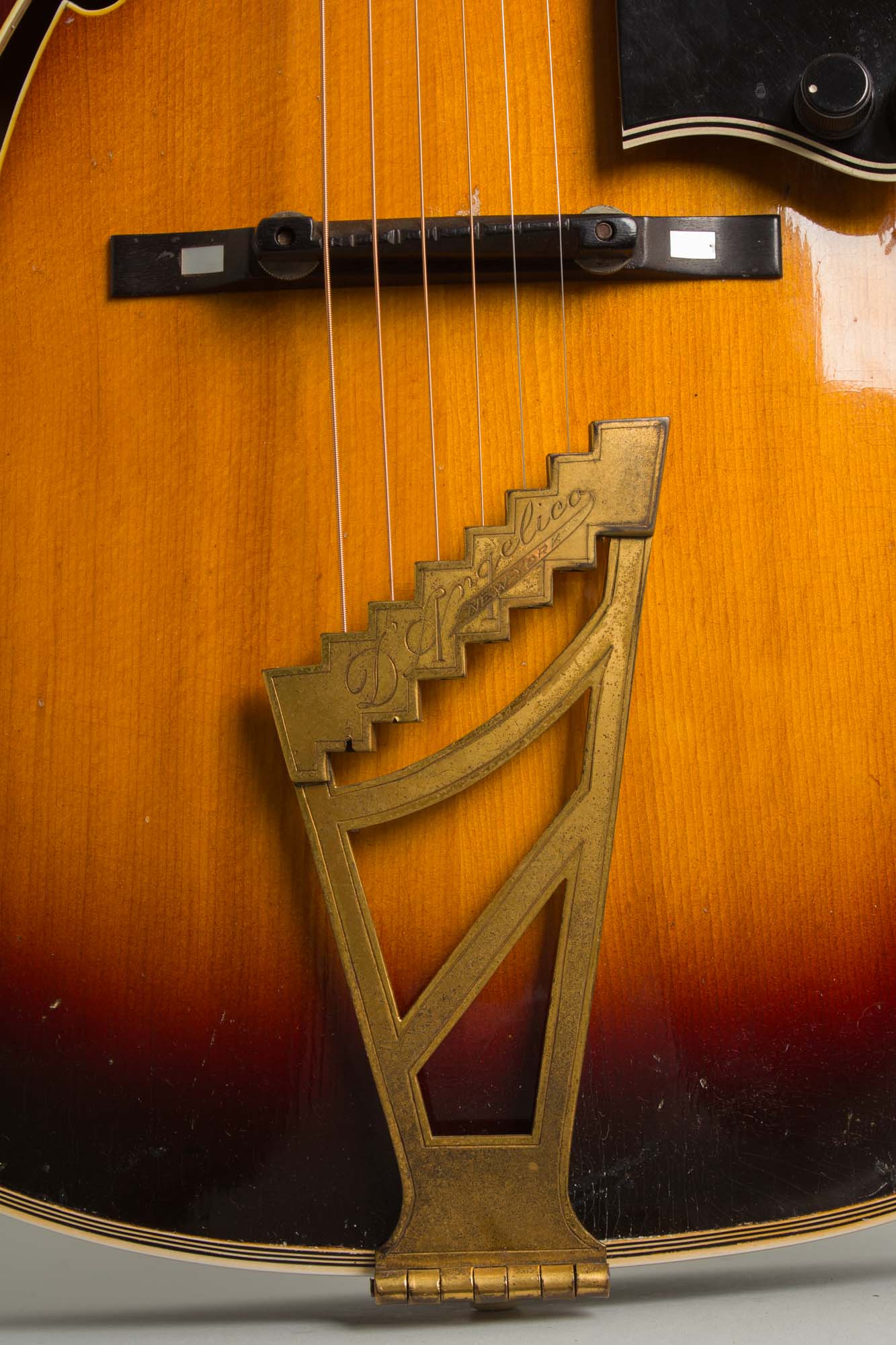
The heavy gold-plated stairstep tailpiece is engraved "D'Angelico New York" and the ebony bridge is John's later style carved piece with an angled saddle and pearl insets in the base. There is an older Gibson pickguard currently mounted on the guitar and a black-covered floating pickup that appears to be an older Bartolini style, though it is not marked. Tone and volume controls are mounted to the pickguard, while the output is wired to a jack in the standard spot on the lower side. Although perhaps a bit scruffy in appearance this is a really fabulous sounding guitar both amplified and unplugged, a "giggable" genuine cutaway D'Angelico and a tribute to this builder's artistry even when the customer had a somewhat limited budget.
Overall length is 42 in. (106.7 cm.), 17 5/8 in. (44.8 cm.) wide at lower bout, and 3 3/16 in. (8.1 cm.) in depth, measured at side of rim. Scale length is 25 in. (635 mm.). Width of nut is 1 5/8 in. (41 mm.).
This guitar shows quite a bit of typical repair work but remains a fine-playing and sounding instrument. As is often the case with older D'Angelicos it has been completely rebound, as the original Celluloid often disintegrated decades ago. In terms of neatness the he work is something of a mixed bag but generally accurate to the original look and style, if not a perfect recreation of the original work. The outer edge of the top and back binding is not perfectly even along the sides, and there is some visible scarring to the finish all along the binding lines. The work on the fingerboard is neater, while the headstock face splits the difference. The F-holes look to have been rebound long ago, with a bit of gassing into the finish around them and checking lines to the celluloid currently in place. None of this affects the guitar in a functional way, but if John himself or Jimmy D'Aquisto saw it they would likely not be thrilled.
Much of the guitar has a thin clear overspray, most notable at the edges done at the time of the rebind. The instrument shows general play wear from both before and after this work was done. There are dings, dents and scrapes to the finish (some under and some through the overspray) but no really heavy play wear. The most notable finish work is to the back, which has scrapes and worn spots to the wood both under and through the added finish, with less of the original sunburst surviving and much of the red color lost. The entire back of the neck running into the area of the side in the cutaway have a heavier smooth overfinish, better executed but it does not blacklight as lacquer.
The instrument shows less in the way of crack repairs than many older archtops; The top has no visible cracks, the back possibly a resealed seam to the center seam off the neck block and what might be a well-hidden split off the upper edge. There is a small split to the side sealed with topical overfinish in the upper waist, and a similar finish spot in the lower waist although no repair is visible. There is a small patched strap button holes on the side above the heel, and a strap button added to the heel itself. Small filled screw holes from an old DeArmond mounting on the side of the fingerboard extension are still visible.
The guitar is fitted with an old Gibson 3-layer pickguard with an attached black covered Bartolini-style pickup (unmarked) with tone and volume controls on the pickguard wired to an output jack on the lower side. This sounds quite good in the classic amplified archtop mode. The fingerboard was trued and refretted with appropriate wire and the guitar plays very well indeed. While the above catalog of condition flaws may seem daunting, the guitar itself does not seem to care. It performs brilliantly both acoustically and amplified with the beautiful sound of D'Angelicos have been prized for since before WWII. It still rests in the original case, solid but also showing its age with some heavy wear to areas of the lining from outgassing binding long ago. Overall Very Good Condition.
View full details
This is a well-played but slightly unusual original 1950s D'Angelico, not one of the master's top-line instruments but a great sounding one nonetheless. It shows a lot of work done over the years but remains true to the way it was built over 70 years ago. These were working guitars when built, and although usually cherished by their owners were often worked hard.
The D'Angelico ledgers record this guitar as a "Cutaway Special" and indicate it was sold to Lou Tosta on March 13, 1954. We'd guess Lou was pinching pennies a bit; the guitar is functionally the same as a cutaway Excel but rather less fancy! Essentially it is what a cutaway Style B would have looked like if John continued building his lower priced models into the mid-1950s. He first made cutaway instruments in 1947, following Gibson's lead and by the time this guitar was made the rounded treble-side cutaway had become a pretty standard feature.
Each D'Angelico guitar was individually built to order, often reflecting the player's personal preferences but all shared the same standard of craftsmanship that characterizes these purely handmade instruments. Whatever Lou paid for this piece, he really got his money's worth! This is a fully carved guitar, well over 17" wide with an X-braced spruce top and solid maple back and sides. The instrument is finished in sunburst overall, the top and back are 7-ply bound. The neck is one piece maple with a bound, pearl block inlaid ebony fingerboard and a comfortable medium "C" profile; the nut is slim at 1 5/8".
The triple-bound headstock has a dramatically fluted shape, although sporting less pearl inlay than many and no decorative finial at the top. There is a small "D'Angelico New York" script inlay lower on the face over a large engraved pearl block; there is no truss rod cover although the guitar does have metal reinforcement in the neck. The tuners are a real oddity; these are Epiphone made as used on their guitars exclusively in the 1940s and '50s. We wonder if Lou saved a few bucks giving them to John to fit to his guitar; they are definitely original to the instrument!
The heavy gold-plated stairstep tailpiece is engraved "D'Angelico New York" and the ebony bridge is John's later style carved piece with an angled saddle and pearl insets in the base. There is an older Gibson pickguard currently mounted on the guitar and a black-covered floating pickup that appears to be an older Bartolini style, though it is not marked. Tone and volume controls are mounted to the pickguard, while the output is wired to a jack in the standard spot on the lower side. Although perhaps a bit scruffy in appearance this is a really fabulous sounding guitar both amplified and unplugged, a "giggable" genuine cutaway D'Angelico and a tribute to this builder's artistry even when the customer had a somewhat limited budget.
Overall length is 42 in. (106.7 cm.), 17 5/8 in. (44.8 cm.) wide at lower bout, and 3 3/16 in. (8.1 cm.) in depth, measured at side of rim. Scale length is 25 in. (635 mm.). Width of nut is 1 5/8 in. (41 mm.).
This guitar shows quite a bit of typical repair work but remains a fine-playing and sounding instrument. As is often the case with older D'Angelicos it has been completely rebound, as the original Celluloid often disintegrated decades ago. In terms of neatness the he work is something of a mixed bag but generally accurate to the original look and style, if not a perfect recreation of the original work. The outer edge of the top and back binding is not perfectly even along the sides, and there is some visible scarring to the finish all along the binding lines. The work on the fingerboard is neater, while the headstock face splits the difference. The F-holes look to have been rebound long ago, with a bit of gassing into the finish around them and checking lines to the celluloid currently in place. None of this affects the guitar in a functional way, but if John himself or Jimmy D'Aquisto saw it they would likely not be thrilled.
Much of the guitar has a thin clear overspray, most notable at the edges done at the time of the rebind. The instrument shows general play wear from both before and after this work was done. There are dings, dents and scrapes to the finish (some under and some through the overspray) but no really heavy play wear. The most notable finish work is to the back, which has scrapes and worn spots to the wood both under and through the added finish, with less of the original sunburst surviving and much of the red color lost. The entire back of the neck running into the area of the side in the cutaway have a heavier smooth overfinish, better executed but it does not blacklight as lacquer.
The instrument shows less in the way of crack repairs than many older archtops; The top has no visible cracks, the back possibly a resealed seam to the center seam off the neck block and what might be a well-hidden split off the upper edge. There is a small split to the side sealed with topical overfinish in the upper waist, and a similar finish spot in the lower waist although no repair is visible. There is a small patched strap button holes on the side above the heel, and a strap button added to the heel itself. Small filled screw holes from an old DeArmond mounting on the side of the fingerboard extension are still visible.
The guitar is fitted with an old Gibson 3-layer pickguard with an attached black covered Bartolini-style pickup (unmarked) with tone and volume controls on the pickguard wired to an output jack on the lower side. This sounds quite good in the classic amplified archtop mode. The fingerboard was trued and refretted with appropriate wire and the guitar plays very well indeed. While the above catalog of condition flaws may seem daunting, the guitar itself does not seem to care. It performs brilliantly both acoustically and amplified with the beautiful sound of D'Angelicos have been prized for since before WWII. It still rests in the original case, solid but also showing its age with some heavy wear to areas of the lining from outgassing binding long ago. Overall Very Good Condition.


Loading...
Just arrived!
Item #