


D'Angelico Excel Arch Top Acoustic Guitar (1950)


1
/
of
23
Regular price
$29,500.00
Regular price
$29,500.00
Sale price
$29,500.00
Unit price
/
per
Item #13643
D'Angelico Excel Model Arch Top Acoustic Guitar (1950), made in New York City, serial # 1843, natural lacquer finish, flame maple back and sides, spruce top; maple neck with ebony fingerboard, original brown hard shell case.
This beautiful one-family-owned natural finish D'Angelico Excel survives substantially unaltered if well-used since its creation in 1950. While not D'Angelico's most elaborate or expensive guitar creation (that was the 18" New Yorker), this 17" Excel was built to the same high standard with all the care and beauty that characterizes the master's purely handmade instruments. Many preferred the slightly smaller and easier to handle Excel to the massive New Yorker; even if no longer the flagship model these remained just as popular with pro players.
This Excel is a 17 3/8" wide non-cutaway guitar from the period that saw the full flowering of D'Angelico's talents, made just as the cutaway-style body was becoming the more common variant. The guitars of this period were built almost entirely by John himself with rough tasks handled by his original apprentice Jimmy DiSerio; the young James D'Aquisto had not yet joined the team.
This Excel is registered in the D'Angelico ledgers as "Sherman 6-24-50" and has a great story. The original owner was named Bernard Sherman; the guitar was purchased for him by his mother, Betty, as a Junior high school graduation gift. (We can only add that's a heck of a graduation gift!). The guitar has remained in the family since it was purchased new in 1950; Bernard was born in 1935 he was then all of 15 years old. He must have been quite the young player to merit this guitar at such a young age, or his family had a lot of faith that he would be!
This Excel is generally typical of late-1940s D'Angelicos, built with the highest-grade materials throughout. The top is very fine spruce, bound in 9-ply celluloid and finished in a beautiful natural finish well ambered over time. The F-holes are bound as well. The top is parallel braced as was common with earlier D'Angelicos but often superseded by X-bracing by this time; this guitar was likely specified as a rhythm instrument for ensemble playing. There is a superb and very attractive curl figure to the maple throughout, particularly the back.
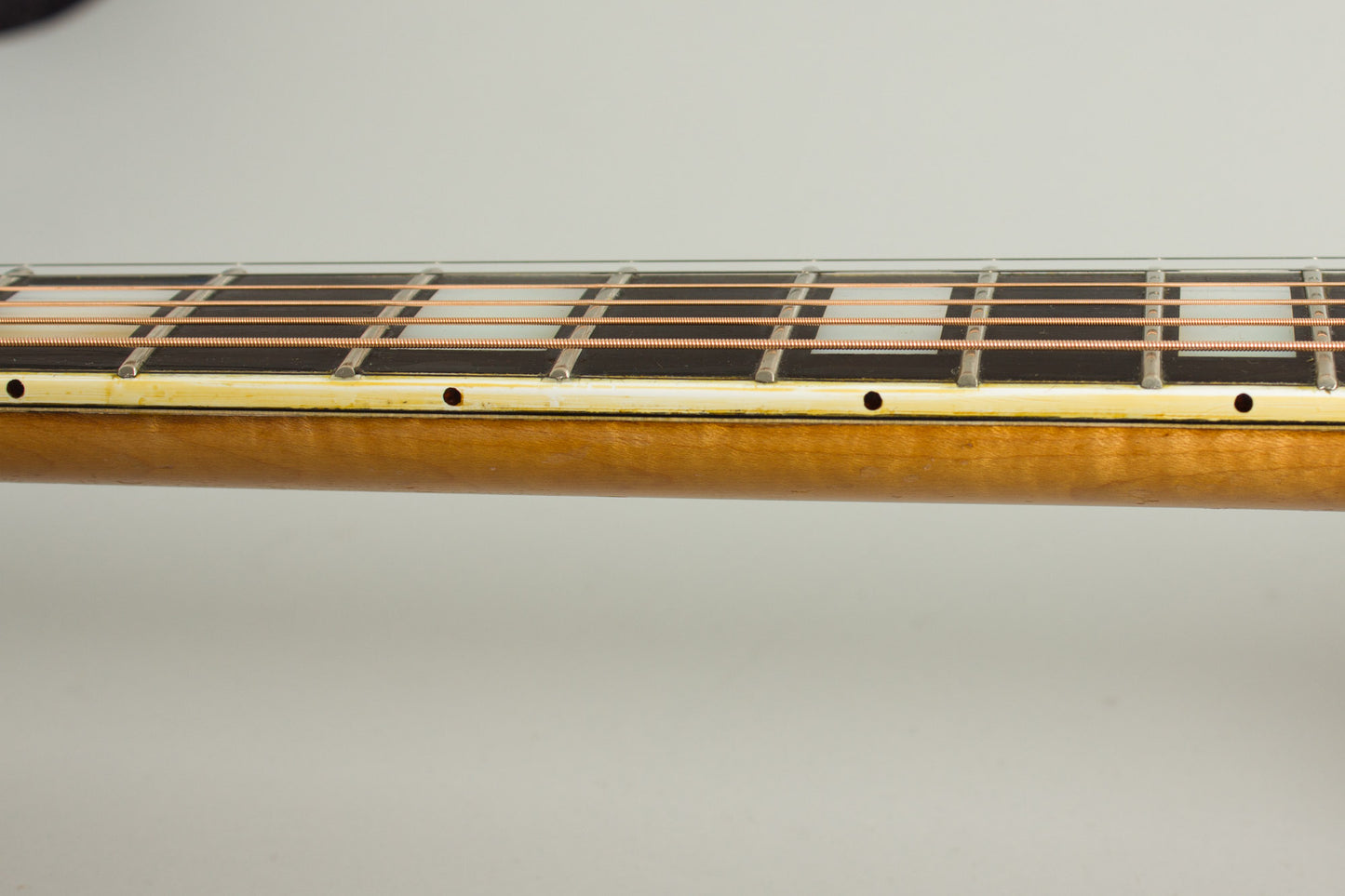
The neck is a single piece of subtly curled maple, with a surprisingly chunky profile considering it was made for such a young player. The ebony fingerboard is multi-bound with pearl block inlay. The flared peghead is triple-bound and faced in ebony, with a pearl "D'Angelico" inlay and "Excel" on an engraved pearl block underneath and the typical ornamental pediment at the crown. It is fitted with Kluson Sealfast tuners with "tulip" buttons, also used by Gibson at the time. The tailpiece is the elaborate engraved gold-plated trapeze seen on many D'Angelicos from this period, with the master's logo on the crossbar. The bridge is adjustable ebony with the typical slanted but not compensated saddle.
This guitar is quite powerful sounding but retains an overriding sweetness and balance that is the hallmark of this maker's best work, while not sacrificing volume. Largely due to the parallel top bracing, compared to many later X-braced cutaway D'Angelicos from the 1950s this guitar still has a pronounced swing-era punch, quite able to drive an ensemble while still offering a beautiful and responsive tone when played solo. It appears that the young Mr. Sherman got many decades of use out of it; His family informed us he played the Catskills for some years as a professional guitarist, most likely at "The Pines" In later years at home they recall his favorite song to play on it was "Guantanamera".
Overall length is 43 in. (109.2 cm.), 17 3/8 in. (44.1 cm.) wide at lower bout, and 3 1/2 in. (8.9 cm.) in depth, measured at side of rim. Scale length is 24 3/4 in. (629 mm.). Width of nut is 1 3/4 in. (44 mm.).
This guitar has been well used for generations and remains a magnificent instrument both to play and to hear, a super player's example of a mid-period D'Angelico. It has seen many years of use but remains completely solid, showing the effects of celluloid deterioration but with no major damage, just cosmetic wear and maintenance repair over time.
The celluloid binding on old D'Angelicos is the major source of condition issues as they age. The body binding on this guitar is in excellent shape with no major shrinkage or cracking; it is quite old and we believe it was re-done long ago by either John himself or more likely Jimmy D'Aquisto, who was the only person many owners trusted with this work while he was alive. ("Only Jimmy's hands touch this guitar" an original owner once told us). The headstock binding was re-done at the same time as were the single-bound F-holes; which again show some minor check lines in the celluloid and a bit of errant binding glue. At the time the entire instrument (with the possible exception of the back of the neck) was given a very thin clear overspray. The areas of the top around the F-hole show some staining to the wood from the original binding outgassing; there is also some noticeable staining and finish disturbance to the area under the pickguard, which is an obvious replacement.
Structurally the guitar is excellent; there is one small spruce grain split to the top under the tailpiece but no other cracks. The back center seam has been resealed, solidly but visibly. The neck may have been reset at some point (which is fairly unusual for a D'Angelico) and the angle is excellent. The fingerboard was recently refretted and rebound. The heelcap has some staining where it meets the body but is not shrinking heavily or crumbling. There are dings, dents, chips and small scratches to the finish overall (both over and under the overspray) but really not much heavy wear.
The hardware remains original including the Kluson tuners, engraved tailpiece, carved ebony bridge and even the endpin are intact with the gold plating showing average wear. The trademark side-of-the-neck strap hook is even still in place. The original pickguard did deteriorate long and was replaced with an earnest if somewhat klunky reproduction with extra-wide binding, which now has enough age that it has shrunk downwards a bit. The small "vampire" holes on the side of the neck from a DeArmond pickup bracket are open; as many players might want to fit a floating pickup we have elected to leave these for now but they can be filled if desired.
While not the cleanest D'Angelico we have had this has one of the best stories, and a killer vibe. Playability is excellent and as with many D'Angelico creations, this guitar sings with a voice that is hard to describe -- warm and even with a perfectly balanced tone, one of the nicest late swing-era guitars one could wish for. This previously uncirculated one-family instrument served one player well for decades; hopefully justifying a mother's faith in her son's talent! The original case is included; it is externally solid and functional but shows the effects of celluloid damage. There is a tight crack in the lid over the pickguard area, and a good deal of the lining on the sides is in tatters. Several photographs are included showing the guitar in action with the young Mr. Sherman, including one where he is in mock prison attire! Overall Very Good + Condition.
View full details
This beautiful one-family-owned natural finish D'Angelico Excel survives substantially unaltered if well-used since its creation in 1950. While not D'Angelico's most elaborate or expensive guitar creation (that was the 18" New Yorker), this 17" Excel was built to the same high standard with all the care and beauty that characterizes the master's purely handmade instruments. Many preferred the slightly smaller and easier to handle Excel to the massive New Yorker; even if no longer the flagship model these remained just as popular with pro players.
This Excel is a 17 3/8" wide non-cutaway guitar from the period that saw the full flowering of D'Angelico's talents, made just as the cutaway-style body was becoming the more common variant. The guitars of this period were built almost entirely by John himself with rough tasks handled by his original apprentice Jimmy DiSerio; the young James D'Aquisto had not yet joined the team.
This Excel is registered in the D'Angelico ledgers as "Sherman 6-24-50" and has a great story. The original owner was named Bernard Sherman; the guitar was purchased for him by his mother, Betty, as a Junior high school graduation gift. (We can only add that's a heck of a graduation gift!). The guitar has remained in the family since it was purchased new in 1950; Bernard was born in 1935 he was then all of 15 years old. He must have been quite the young player to merit this guitar at such a young age, or his family had a lot of faith that he would be!
This Excel is generally typical of late-1940s D'Angelicos, built with the highest-grade materials throughout. The top is very fine spruce, bound in 9-ply celluloid and finished in a beautiful natural finish well ambered over time. The F-holes are bound as well. The top is parallel braced as was common with earlier D'Angelicos but often superseded by X-bracing by this time; this guitar was likely specified as a rhythm instrument for ensemble playing. There is a superb and very attractive curl figure to the maple throughout, particularly the back.
The neck is a single piece of subtly curled maple, with a surprisingly chunky profile considering it was made for such a young player. The ebony fingerboard is multi-bound with pearl block inlay. The flared peghead is triple-bound and faced in ebony, with a pearl "D'Angelico" inlay and "Excel" on an engraved pearl block underneath and the typical ornamental pediment at the crown. It is fitted with Kluson Sealfast tuners with "tulip" buttons, also used by Gibson at the time. The tailpiece is the elaborate engraved gold-plated trapeze seen on many D'Angelicos from this period, with the master's logo on the crossbar. The bridge is adjustable ebony with the typical slanted but not compensated saddle.
This guitar is quite powerful sounding but retains an overriding sweetness and balance that is the hallmark of this maker's best work, while not sacrificing volume. Largely due to the parallel top bracing, compared to many later X-braced cutaway D'Angelicos from the 1950s this guitar still has a pronounced swing-era punch, quite able to drive an ensemble while still offering a beautiful and responsive tone when played solo. It appears that the young Mr. Sherman got many decades of use out of it; His family informed us he played the Catskills for some years as a professional guitarist, most likely at "The Pines" In later years at home they recall his favorite song to play on it was "Guantanamera".
Overall length is 43 in. (109.2 cm.), 17 3/8 in. (44.1 cm.) wide at lower bout, and 3 1/2 in. (8.9 cm.) in depth, measured at side of rim. Scale length is 24 3/4 in. (629 mm.). Width of nut is 1 3/4 in. (44 mm.).
This guitar has been well used for generations and remains a magnificent instrument both to play and to hear, a super player's example of a mid-period D'Angelico. It has seen many years of use but remains completely solid, showing the effects of celluloid deterioration but with no major damage, just cosmetic wear and maintenance repair over time.
The celluloid binding on old D'Angelicos is the major source of condition issues as they age. The body binding on this guitar is in excellent shape with no major shrinkage or cracking; it is quite old and we believe it was re-done long ago by either John himself or more likely Jimmy D'Aquisto, who was the only person many owners trusted with this work while he was alive. ("Only Jimmy's hands touch this guitar" an original owner once told us). The headstock binding was re-done at the same time as were the single-bound F-holes; which again show some minor check lines in the celluloid and a bit of errant binding glue. At the time the entire instrument (with the possible exception of the back of the neck) was given a very thin clear overspray. The areas of the top around the F-hole show some staining to the wood from the original binding outgassing; there is also some noticeable staining and finish disturbance to the area under the pickguard, which is an obvious replacement.
Structurally the guitar is excellent; there is one small spruce grain split to the top under the tailpiece but no other cracks. The back center seam has been resealed, solidly but visibly. The neck may have been reset at some point (which is fairly unusual for a D'Angelico) and the angle is excellent. The fingerboard was recently refretted and rebound. The heelcap has some staining where it meets the body but is not shrinking heavily or crumbling. There are dings, dents, chips and small scratches to the finish overall (both over and under the overspray) but really not much heavy wear.
The hardware remains original including the Kluson tuners, engraved tailpiece, carved ebony bridge and even the endpin are intact with the gold plating showing average wear. The trademark side-of-the-neck strap hook is even still in place. The original pickguard did deteriorate long and was replaced with an earnest if somewhat klunky reproduction with extra-wide binding, which now has enough age that it has shrunk downwards a bit. The small "vampire" holes on the side of the neck from a DeArmond pickup bracket are open; as many players might want to fit a floating pickup we have elected to leave these for now but they can be filled if desired.
While not the cleanest D'Angelico we have had this has one of the best stories, and a killer vibe. Playability is excellent and as with many D'Angelico creations, this guitar sings with a voice that is hard to describe -- warm and even with a perfectly balanced tone, one of the nicest late swing-era guitars one could wish for. This previously uncirculated one-family instrument served one player well for decades; hopefully justifying a mother's faith in her son's talent! The original case is included; it is externally solid and functional but shows the effects of celluloid damage. There is a tight crack in the lid over the pickguard area, and a good deal of the lining on the sides is in tatters. Several photographs are included showing the guitar in action with the young Mr. Sherman, including one where he is in mock prison attire! Overall Very Good + Condition.


Loading...
Just arrived!
Item #