


Danelectro Longhorn Guitarlin Model 4123 Semi-Hollow Body Electric Guitar (1965)


1
/
of
14
Regular price
$5,750.00
Regular price
$5,750.00
Sale price
$5,750.00
Unit price
/
per
Item #13919
Danelectro Longhorn Guitarlin Model 4123 Model Semi-Hollow Body Electric Guitar (1965), Neptune, NJ, serial # 1025.
The Danelectro Model 4123 Guitarlin (better known as the "Longhorn guitar") is a serious rarity and simply one of the coolest 6-strings ever designed! This was one of Nathan Daniels' greatest gifts to the world, conceived from a doodle he sketched in the later 1950s of an "extreme cutaway" guitar.
The Model 4123 was introduced in the company's 1958 catalog alongside matching 4-string and 6-string basses. Although never a big seller, the Guitarlin survived in the company's line up into the end of the 1960s with only minor alterations. Still, according to Deke Dickerson (Hi Deke!) Danelectro maven Steve Soest estimates only a couple of hundred of these striking guitars were ever made.
Listed for the entire run at $150.00, this was one of Danelectro's most expensive instruments. Although one of the New Jersey company's best-remembered creations all Longhorns are fairly rare, and this 6-string Guitar seems to have been far less popular than the bass models. All the Longhorns were heavily outsold by the "Standard" models (called "Shorthorns" in retrospect) that retailed around $50.00 less; most Danelectro customers were budget conscious even then!
Then and now, this Longhorn is a completely unique concept. "Guitarlin" is a contraction of "Guitar+Mandolin" and the idea was the 31 fret neck enabled the player to cover the range of both instruments. The same catalog blurb was used for years, reading: "This new instrument is a guitar with the fingerboard extended deep into the body. 31 frets combine guitar and mandolin range. Guitar tone in the lower register shades into mandolin in the upper register". The unique bronze/white sunburst finish on both body and neck was the only finish offered.
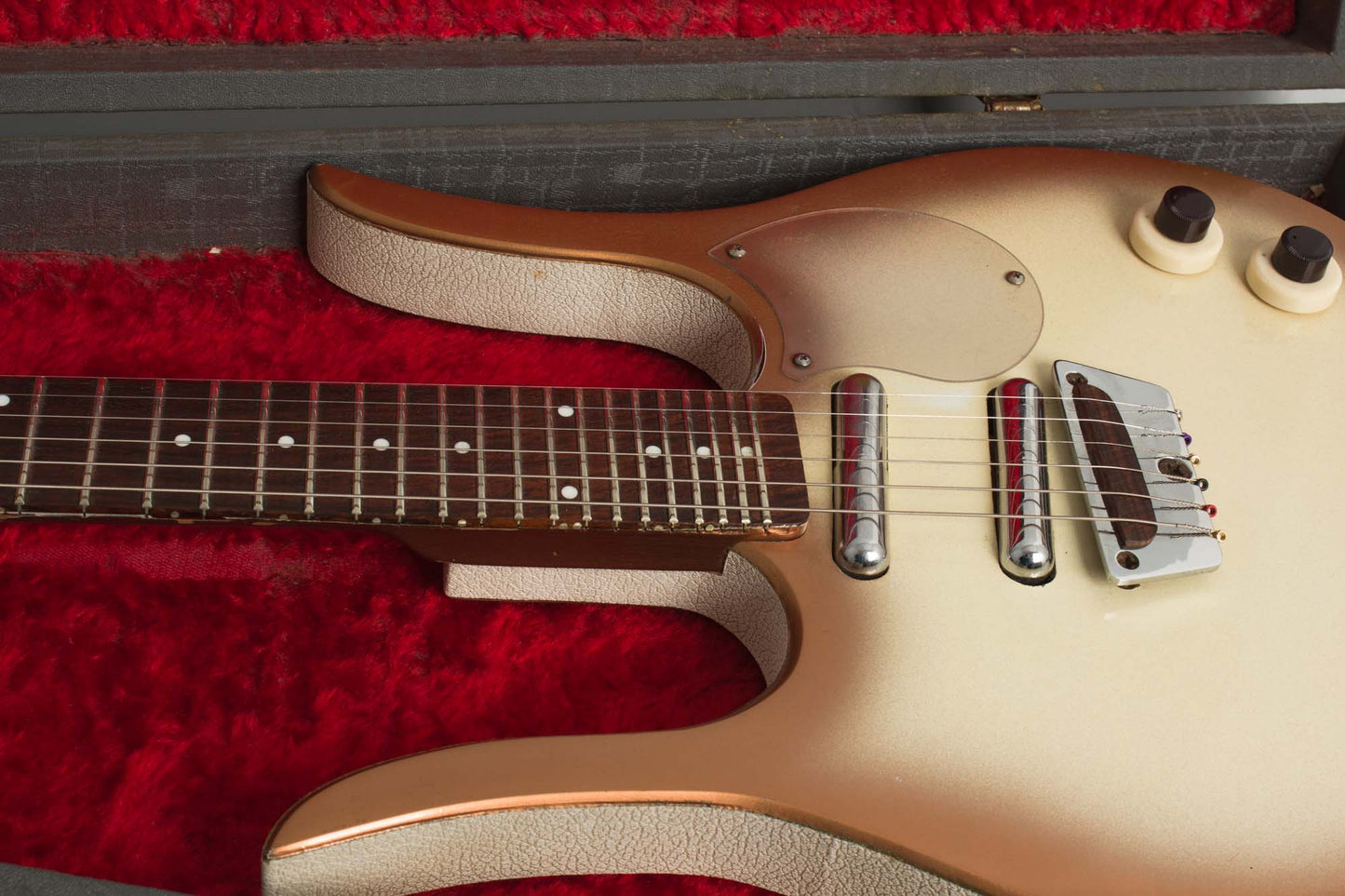
The basic Masonite-and-pine body and poplar/rosewood neck components are identical on all three models, the basses having 24 frets instead of 31 on the same neck blank. The guitar bridge is mounted much higher on the body, resulting in the two pickups being very close together in the small space between fingerboard and bridge. With the neck set deep into the body the instrument is compact and handles very well. The small, light semi-hollow body is extremely handy and the two Danelectro "lipstick tube" pickups produce a tight and punchy sound.
All Longhorns originally had a simple but eccentric wiring scheme with on/off flipper switches mounted concentrically above rotary volume controls. The tone of each pickup was fixed with a pre-set bass-heavy or treble-heavy capacitor which was always in circuit. In practice many users found this system very limiting; most surviving examples were rewired long ago including this one. It now has a set of later concentric tone and volume pots without the pre-set tones; this allows the natural sound of the lipstick-tube pickups to be heard and blended effectively. The concentric knobs are from a Danelectro reissue and are the correct style for a late '60s Longhorn; all the other hardware on the guitar is original.
This Guitarlin dates to 1965; the ink stamp on the neck heel indicates that part was fabricated the 10th week of that year. Period features include a three-screw triangle pattern neck attachment, the "tilt-neck" adjustment at the heel, Danelectro in-house "Skate key" tuners and a stock aluminum nut. The bridge is the standard ubiquitous Dann-O item, a metal plate adjustable for height with a sliding rosewood saddle. The pickguard is a small clear plastic plate screwed to the top while the metal control cavity coverplate on the back is held by 2 screws.
The Longhorn bass proved more of a hit than the guitars; it was more commonly spotted during the 1960s and examples are more easily found today. There was a spurt in Longhorn production in 1965; they were first imported to the UK that year and became a brief sensation on the London scene. The Who had a set of them, and Graham Nash of the Hollies brandished one as well for a time. Of course the most famous Guitarlin player of all was Link Wray, who recorded and performed memorably with one from 1959 into the early 1960s forever marking the model as one of his trademarks.
We are very pleased to offer very rare 6-string Guitarlin, a nice example of this iconic instrument and the first one we have had in several decades. A salute to Nathan Daniel is in order for creating the immortal Longhorn, an unforgettable one-of a kind twang machine.
Overall length is 38 3/8 in. (97.5 cm.), 13 1/8 in. (33.3 cm.) wide at lower bout, and 1 1/2 in. (3.8 cm.) in depth, measured at side of rim. Scale length is 25 in. (635 mm.). Width of nut is 1 3/4 in. (44 mm.).
While not a pristine instrument this is one of the cleaner 1960s Guitarlins we have seen, showing some play time over the last 60 years but no really heavy wear. The copper 'burst finish is prone to chipping, especially on the neck. In one of those inexplicable Danno quirks the color coats were sprayed OVER the sealer lacquer, so the topcoat is generally not that well adhered. The back of this guitar's neck has some larger chips and dings and an area of play wear to the undercoat around the 1st-3rd fret area. The edges of the headstock have some chipping but the face is relatively clean with a well-preserved logo. The body has some finish chips, scratches and dings with heavier wear to the upper edges on the back and some dirt on the vinyl edging. The fairly minimal hardware shows some general wear but nothing too serious.
As noted the concentric pots have been replaced, a very common situation. Although we generally prefer all-original instruments, we will state for the record the guitar sounds better this way without the intrusive limited pre-set caps shaping the pickup output. The natural Danno lipstick tube sound is fine as it is! The knobs are the correct style for a c. 1967-8 Longhorn and were sourced from a later Danelectro re-issue.
This is a good player for the most part; the long poplar neck is in good shape if not perfectly straight after 60 years. A few of the very upper frets are splatty but the guitar plays fine to the 24th fret at least! Apart from the re-wiring it remains as God and Nathan Daniel intended when it left the loading dock at Neptune (New Jersey, that is). This striking rarity sounds fantastic and looks wicked as all get-out doing it, still in the original trapezoidal Masonite case. This is simply as cool as they come; there have been a number of re-issues over the decades BUT this is the genuine 1960s American Masonite and poplar original here, one of the greatest products of Nathan Daniels' offbeat genius. Overall Very Good + Condition.
View full details
The Danelectro Model 4123 Guitarlin (better known as the "Longhorn guitar") is a serious rarity and simply one of the coolest 6-strings ever designed! This was one of Nathan Daniels' greatest gifts to the world, conceived from a doodle he sketched in the later 1950s of an "extreme cutaway" guitar.
The Model 4123 was introduced in the company's 1958 catalog alongside matching 4-string and 6-string basses. Although never a big seller, the Guitarlin survived in the company's line up into the end of the 1960s with only minor alterations. Still, according to Deke Dickerson (Hi Deke!) Danelectro maven Steve Soest estimates only a couple of hundred of these striking guitars were ever made.
Listed for the entire run at $150.00, this was one of Danelectro's most expensive instruments. Although one of the New Jersey company's best-remembered creations all Longhorns are fairly rare, and this 6-string Guitar seems to have been far less popular than the bass models. All the Longhorns were heavily outsold by the "Standard" models (called "Shorthorns" in retrospect) that retailed around $50.00 less; most Danelectro customers were budget conscious even then!
Then and now, this Longhorn is a completely unique concept. "Guitarlin" is a contraction of "Guitar+Mandolin" and the idea was the 31 fret neck enabled the player to cover the range of both instruments. The same catalog blurb was used for years, reading: "This new instrument is a guitar with the fingerboard extended deep into the body. 31 frets combine guitar and mandolin range. Guitar tone in the lower register shades into mandolin in the upper register". The unique bronze/white sunburst finish on both body and neck was the only finish offered.
The basic Masonite-and-pine body and poplar/rosewood neck components are identical on all three models, the basses having 24 frets instead of 31 on the same neck blank. The guitar bridge is mounted much higher on the body, resulting in the two pickups being very close together in the small space between fingerboard and bridge. With the neck set deep into the body the instrument is compact and handles very well. The small, light semi-hollow body is extremely handy and the two Danelectro "lipstick tube" pickups produce a tight and punchy sound.
All Longhorns originally had a simple but eccentric wiring scheme with on/off flipper switches mounted concentrically above rotary volume controls. The tone of each pickup was fixed with a pre-set bass-heavy or treble-heavy capacitor which was always in circuit. In practice many users found this system very limiting; most surviving examples were rewired long ago including this one. It now has a set of later concentric tone and volume pots without the pre-set tones; this allows the natural sound of the lipstick-tube pickups to be heard and blended effectively. The concentric knobs are from a Danelectro reissue and are the correct style for a late '60s Longhorn; all the other hardware on the guitar is original.
This Guitarlin dates to 1965; the ink stamp on the neck heel indicates that part was fabricated the 10th week of that year. Period features include a three-screw triangle pattern neck attachment, the "tilt-neck" adjustment at the heel, Danelectro in-house "Skate key" tuners and a stock aluminum nut. The bridge is the standard ubiquitous Dann-O item, a metal plate adjustable for height with a sliding rosewood saddle. The pickguard is a small clear plastic plate screwed to the top while the metal control cavity coverplate on the back is held by 2 screws.
The Longhorn bass proved more of a hit than the guitars; it was more commonly spotted during the 1960s and examples are more easily found today. There was a spurt in Longhorn production in 1965; they were first imported to the UK that year and became a brief sensation on the London scene. The Who had a set of them, and Graham Nash of the Hollies brandished one as well for a time. Of course the most famous Guitarlin player of all was Link Wray, who recorded and performed memorably with one from 1959 into the early 1960s forever marking the model as one of his trademarks.
We are very pleased to offer very rare 6-string Guitarlin, a nice example of this iconic instrument and the first one we have had in several decades. A salute to Nathan Daniel is in order for creating the immortal Longhorn, an unforgettable one-of a kind twang machine.
Overall length is 38 3/8 in. (97.5 cm.), 13 1/8 in. (33.3 cm.) wide at lower bout, and 1 1/2 in. (3.8 cm.) in depth, measured at side of rim. Scale length is 25 in. (635 mm.). Width of nut is 1 3/4 in. (44 mm.).
While not a pristine instrument this is one of the cleaner 1960s Guitarlins we have seen, showing some play time over the last 60 years but no really heavy wear. The copper 'burst finish is prone to chipping, especially on the neck. In one of those inexplicable Danno quirks the color coats were sprayed OVER the sealer lacquer, so the topcoat is generally not that well adhered. The back of this guitar's neck has some larger chips and dings and an area of play wear to the undercoat around the 1st-3rd fret area. The edges of the headstock have some chipping but the face is relatively clean with a well-preserved logo. The body has some finish chips, scratches and dings with heavier wear to the upper edges on the back and some dirt on the vinyl edging. The fairly minimal hardware shows some general wear but nothing too serious.
As noted the concentric pots have been replaced, a very common situation. Although we generally prefer all-original instruments, we will state for the record the guitar sounds better this way without the intrusive limited pre-set caps shaping the pickup output. The natural Danno lipstick tube sound is fine as it is! The knobs are the correct style for a c. 1967-8 Longhorn and were sourced from a later Danelectro re-issue.
This is a good player for the most part; the long poplar neck is in good shape if not perfectly straight after 60 years. A few of the very upper frets are splatty but the guitar plays fine to the 24th fret at least! Apart from the re-wiring it remains as God and Nathan Daniel intended when it left the loading dock at Neptune (New Jersey, that is). This striking rarity sounds fantastic and looks wicked as all get-out doing it, still in the original trapezoidal Masonite case. This is simply as cool as they come; there have been a number of re-issues over the decades BUT this is the genuine 1960s American Masonite and poplar original here, one of the greatest products of Nathan Daniels' offbeat genius. Overall Very Good + Condition.


Loading...
Just arrived!
Item #