Clifford Glenn 3-String Model Appalachian Dulcimer (1975), made in Sugar Grove, North Carolina, natural finish, Walnut, handmade gig bag case.
Watauga County, North Carolina was a cradle of culture as a renewed interest in traditional folk music swelled in the nation as the 1950s followed WWII. Clifford Glenn was the son of largely self-taught luthier Leonard Glenn and learned the art of making folk instruments from his father. The Glenns as well as several other notable dulcimer makers were descended from Eli Presnell who created a dulcimer pattern from what was thought to be the original classic hourglass Appalachian dulcimer. Clifford and his father's instruments came to be in fairly high demand in the area and with traditional musicians all around Appalachia.
This is a pretty straightforward but very well-constructed example of a 3-string Appalachian dulcimer, the most commonly offered instrument from Clifford's bench although "coupled-string" dulcimers were available upon request. This dulcimer almost looks like mahogany but we feel appears to be a darker stained walnut all the way around (save the replaced tuners). It has a narrow headstock with larger friction tuners, stainless steel frets, and the family tradition hourglass body with those ever-charming heart shaped soundholes.
Crucially, the Glenns are widely known to have built many historically significant Appalachian folk instruments for their neighbor, Frank Proffitt Sr. Proffitt is not only renowned as a builder, but as a folk performer who made a major contribution to American musical history including being featured in Alan Lomax's essential "Folk Songs of North America." Clifford and his "made to be played" instruments remained a constant in the community until his passing in 2015. This is a beautiful traditional instrument, finely built with exacting attention to detail delicate touches particular to this family's instruments.
Length is 35 1/2 in. (90.2 cm.), 6 5/8 in. (16.8 cm.) wide at lower bout, and 3 in. (7.6 cm.) in depth at deepest point.
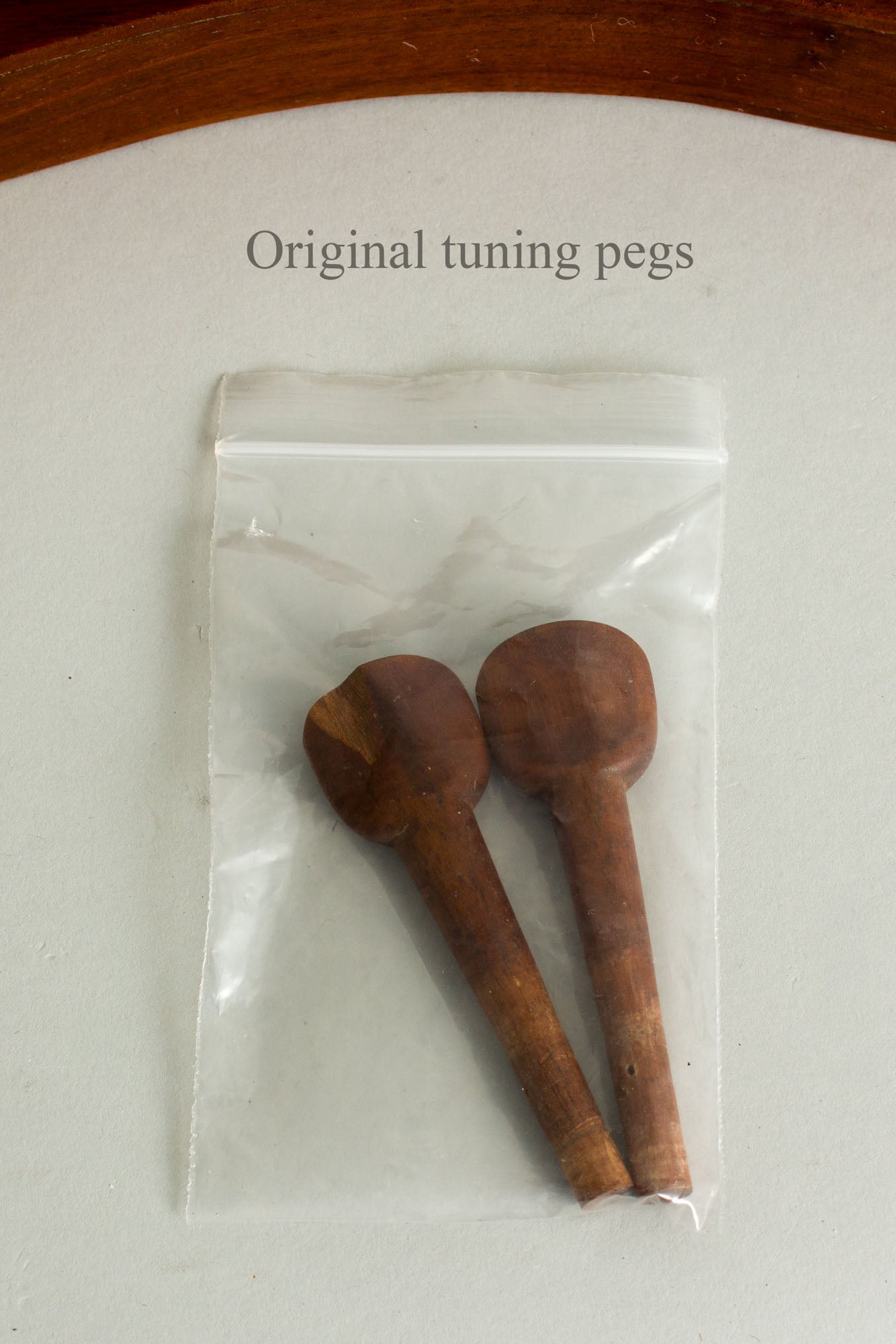
Here is another visibly higher quality genuine handmade dulcimer from the long line of Glenn dulcimer makers. The stained walnut is generally well-kept with a few little scratches and dings largely concentrated to the back. The narrow 3-string peghead has a few little scuffs on the very head but is in perfect working order with the three replacement rosewood tuning pegs; the original damaged tuners are included for posterity's sake, but needed replacing. The original frets are in good shape with next to no show of wear. The whole unit held close emits a faint woody aroma and plays very well.
Clifford learned well from his father, and the superior buildsmanship shines through in the smaller decorative details such as the classic heart soundholes and the subtle taper of the fingerboard beyond the frets. The handwritten and dated Clifford Glenn label is a touch faded over the years but still completely intact and legible inside the lower treble side bout soundhole. It would almost certainly have not left the shop in an original bag or case, but it now cozily resides in an specially ordered Amish-made dulcimer bag. Very Good + Condition.