


Carvin #71-BG Owned by Jeff Tweedy of Wilco Solid Body Electric Bass Guitar (1961)


1
/
of
12
Regular price
$3,500.00
Regular price
$3,500.00
Sale price
$3,500.00
Unit price
/
per
Item #13132
Carvin #71-BG Owned by Jeff Tweedy of Wilco Model Solid Body Electric Bass Guitar (1961), made in Covina, California, natural lacquer finish, Maple body and neck, rosewood fingerboard, black gig bag case.
This 1961 Carvin #71-BG is a cool historical piece, an interesting and quite compact solidbody electric bass. Carvin guitars and amps were the product of the same Southern California spawning grounds as Fender, Rickenbacker, Magnatone, Bigsby and Mosrite; while Carvin is not usually mentioned in connection with these other pioneers, the company was an active part of the scene from early on.
Carvin founder Lowell Kiesel moved his fledgling steel guitar manufacturing operation from Nebraska to California around 1948, and by 1950 had changed the name from Kiesel to Carvin, combining his two sons' names. Carvin became known for selling primarily electric instruments exclusively through mail order and as one of the few 1950s sources selling individual parts for do-it-yourself electric guitar tinkerers. Carvin's most remembered products of the era are the spectacular sounding AP-6 pickups, the early favorite of Semie Moseley for his handmade guitars.
Carvin offered only one bass in 1961, this new #71-BG. It was a development of the earlier model #7-BG of 1959 with a re-designed more Fender-esque body shape, a nod to Leo's ever-increasing success and influence. Unlike the Fender bass this is a VERY short-scale instrument with a 25 1/8" string length This was officially intended to make it more friendly to guitar players, but also meant Carvin did not actually have to design or produce a bass neck. They just drilled four holes in a guitar headstock and assembled a 4-string instrument whenever an order came in!
This #71-BG sports two AP-4 pickups, 4-pole versions of the AP-6. On this early model these were made by simply fitting 4 polepiece screws to the 6-string coil, with the leftover filled holes clearly visible in the cover. Interestingly the screws used for the G string are smaller than those for the rest, likely to make that string "pop" less through the treble-heavy coil. While not designed as bass units the AP pickups simply sound great in any context. A Model #81-BG Bass was also offered, using the same pickup coils without any adjustable poles.
The Fender-like (well, Fender guitar-like) maple neck has a truss rod adjusted at the heel and a thick slab rosewood fingerboard, something Carvin used before Leo. The double cutaway solid (nicknamed "Butcher Block") flat-contoured maple body has a deeper treble side cutaway than a Fender bass but no contouring art all. Hardware consists of a rough-cast Bigsby knockoff aluminum bridge saddle compensated for guitar but slotted for only four strings and a cutoff Harmony-style chrome metal tailpiece screwed to the rim, a major improvement on the fragile plastic units previously used. The pots are date coded 6047 marking it as an early example of the new model likely built in 1961.
Carvin's main sale items at the time were still steel guitars and amplifiers; the Spanish guitars and especially basses from this era are quite rare. While admittedly somewhat of a crude concoction of re-purposed guitar parts next to a Fender Bass this is a very solidly-made instrument, and with a 3-way switch and individual tone and volume controls is powerful and versatile-sounding considering the very short scale. These early Carvins have a definite homemade aspect to them, but are well-built where it counts.
The 1961 direct mail price for the #71-BG was $135.00; the #81-BG sold for $115.00 and a left-handed #71-LH (something of an unusual offering at the time) listed at $145.00. A set of Carvin flat-wound bass strings was $13.90. Amazingly enough the bass was offered with Carvin's Guitar-Vibro, a very crude vibrato unit mounted to the strings between the bridge and tailpiece which added $19.50 to the package; this would have been of very limited use on a heavy-strung bass!
Known mostly to vintage tone connoisseurs, the original AP-6 pickup is regarded as worthy of listing with the pre-war Rickenbacker horseshoe, the Fender Broadcaster pickups, and the Gibson PAF as one of the finest-sounding coils of wire ever wound. As the AP-4 they also sound great for bass, although the guitar-scale marks this as something of a novelty instrument it is a fine sounding one considering its limitations, probably the best of this eccentric 4-string sub-genre ever made.
Overall length is 38 7/8 in. (98.7 cm.), 12 5/8 in. (32.1 cm.) wide at lower bout, and 1 1/2 in. (3.8 cm.) in depth, measured at side of rim. Scale length is 25 1/8 in. (638 mm.). Width of nut is 1 9/16 in. (40 mm.).
This is a mostly clean and all-original example of this rare early short-scale solidbody bass. The finish is very thin; it feels rather more like 1950's kitchen furniture than a typical guitar finish! There are some dings, scratches and dents overall but nothing too serious. The back of the neck has wear down to the wood in the lower positions like an old Fender neck.
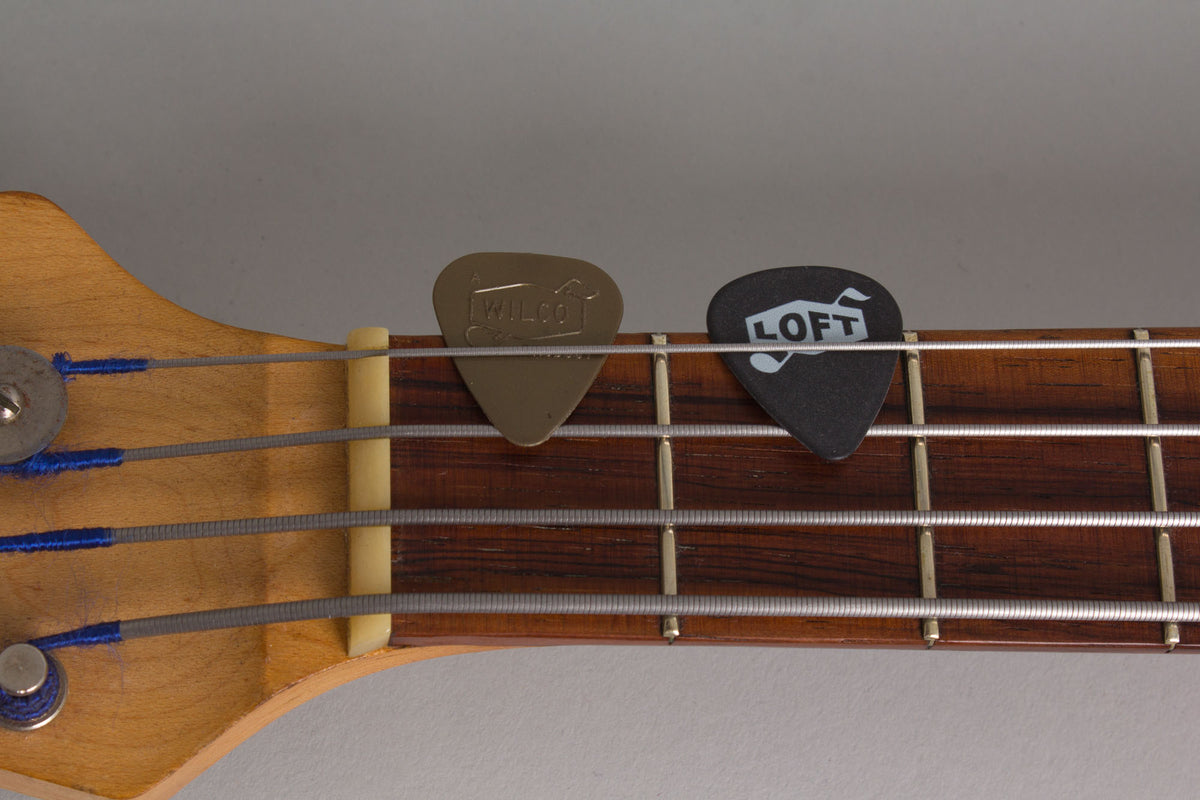
The guitar retains all the original fittings components. The crucial AP-4 pickups and somewhat crude single-strand wiring are unaltered except for a grounding strip added to the bridge, something Carvin did not bother with. The upper strap button is Fender style and likely replaced, the lower remains the original plastic. This 25 1/4" scale bass is rather eccentric in feel but plays well with a surprisingly good sound. Conveniently it takes standard short-scale bass strings, the heavier the better! This bass is a recent denizen of the Wilco loft in Chicago, although the supplied gig bag is not marked as such. Excellent - Condition.
View full details
This 1961 Carvin #71-BG is a cool historical piece, an interesting and quite compact solidbody electric bass. Carvin guitars and amps were the product of the same Southern California spawning grounds as Fender, Rickenbacker, Magnatone, Bigsby and Mosrite; while Carvin is not usually mentioned in connection with these other pioneers, the company was an active part of the scene from early on.
Carvin founder Lowell Kiesel moved his fledgling steel guitar manufacturing operation from Nebraska to California around 1948, and by 1950 had changed the name from Kiesel to Carvin, combining his two sons' names. Carvin became known for selling primarily electric instruments exclusively through mail order and as one of the few 1950s sources selling individual parts for do-it-yourself electric guitar tinkerers. Carvin's most remembered products of the era are the spectacular sounding AP-6 pickups, the early favorite of Semie Moseley for his handmade guitars.
Carvin offered only one bass in 1961, this new #71-BG. It was a development of the earlier model #7-BG of 1959 with a re-designed more Fender-esque body shape, a nod to Leo's ever-increasing success and influence. Unlike the Fender bass this is a VERY short-scale instrument with a 25 1/8" string length This was officially intended to make it more friendly to guitar players, but also meant Carvin did not actually have to design or produce a bass neck. They just drilled four holes in a guitar headstock and assembled a 4-string instrument whenever an order came in!
This #71-BG sports two AP-4 pickups, 4-pole versions of the AP-6. On this early model these were made by simply fitting 4 polepiece screws to the 6-string coil, with the leftover filled holes clearly visible in the cover. Interestingly the screws used for the G string are smaller than those for the rest, likely to make that string "pop" less through the treble-heavy coil. While not designed as bass units the AP pickups simply sound great in any context. A Model #81-BG Bass was also offered, using the same pickup coils without any adjustable poles.
The Fender-like (well, Fender guitar-like) maple neck has a truss rod adjusted at the heel and a thick slab rosewood fingerboard, something Carvin used before Leo. The double cutaway solid (nicknamed "Butcher Block") flat-contoured maple body has a deeper treble side cutaway than a Fender bass but no contouring art all. Hardware consists of a rough-cast Bigsby knockoff aluminum bridge saddle compensated for guitar but slotted for only four strings and a cutoff Harmony-style chrome metal tailpiece screwed to the rim, a major improvement on the fragile plastic units previously used. The pots are date coded 6047 marking it as an early example of the new model likely built in 1961.
Carvin's main sale items at the time were still steel guitars and amplifiers; the Spanish guitars and especially basses from this era are quite rare. While admittedly somewhat of a crude concoction of re-purposed guitar parts next to a Fender Bass this is a very solidly-made instrument, and with a 3-way switch and individual tone and volume controls is powerful and versatile-sounding considering the very short scale. These early Carvins have a definite homemade aspect to them, but are well-built where it counts.
The 1961 direct mail price for the #71-BG was $135.00; the #81-BG sold for $115.00 and a left-handed #71-LH (something of an unusual offering at the time) listed at $145.00. A set of Carvin flat-wound bass strings was $13.90. Amazingly enough the bass was offered with Carvin's Guitar-Vibro, a very crude vibrato unit mounted to the strings between the bridge and tailpiece which added $19.50 to the package; this would have been of very limited use on a heavy-strung bass!
Known mostly to vintage tone connoisseurs, the original AP-6 pickup is regarded as worthy of listing with the pre-war Rickenbacker horseshoe, the Fender Broadcaster pickups, and the Gibson PAF as one of the finest-sounding coils of wire ever wound. As the AP-4 they also sound great for bass, although the guitar-scale marks this as something of a novelty instrument it is a fine sounding one considering its limitations, probably the best of this eccentric 4-string sub-genre ever made.
Overall length is 38 7/8 in. (98.7 cm.), 12 5/8 in. (32.1 cm.) wide at lower bout, and 1 1/2 in. (3.8 cm.) in depth, measured at side of rim. Scale length is 25 1/8 in. (638 mm.). Width of nut is 1 9/16 in. (40 mm.).
This is a mostly clean and all-original example of this rare early short-scale solidbody bass. The finish is very thin; it feels rather more like 1950's kitchen furniture than a typical guitar finish! There are some dings, scratches and dents overall but nothing too serious. The back of the neck has wear down to the wood in the lower positions like an old Fender neck.
The guitar retains all the original fittings components. The crucial AP-4 pickups and somewhat crude single-strand wiring are unaltered except for a grounding strip added to the bridge, something Carvin did not bother with. The upper strap button is Fender style and likely replaced, the lower remains the original plastic. This 25 1/4" scale bass is rather eccentric in feel but plays well with a surprisingly good sound. Conveniently it takes standard short-scale bass strings, the heavier the better! This bass is a recent denizen of the Wilco loft in Chicago, although the supplied gig bag is not marked as such. Excellent - Condition.


Loading...
Just arrived!
Item #