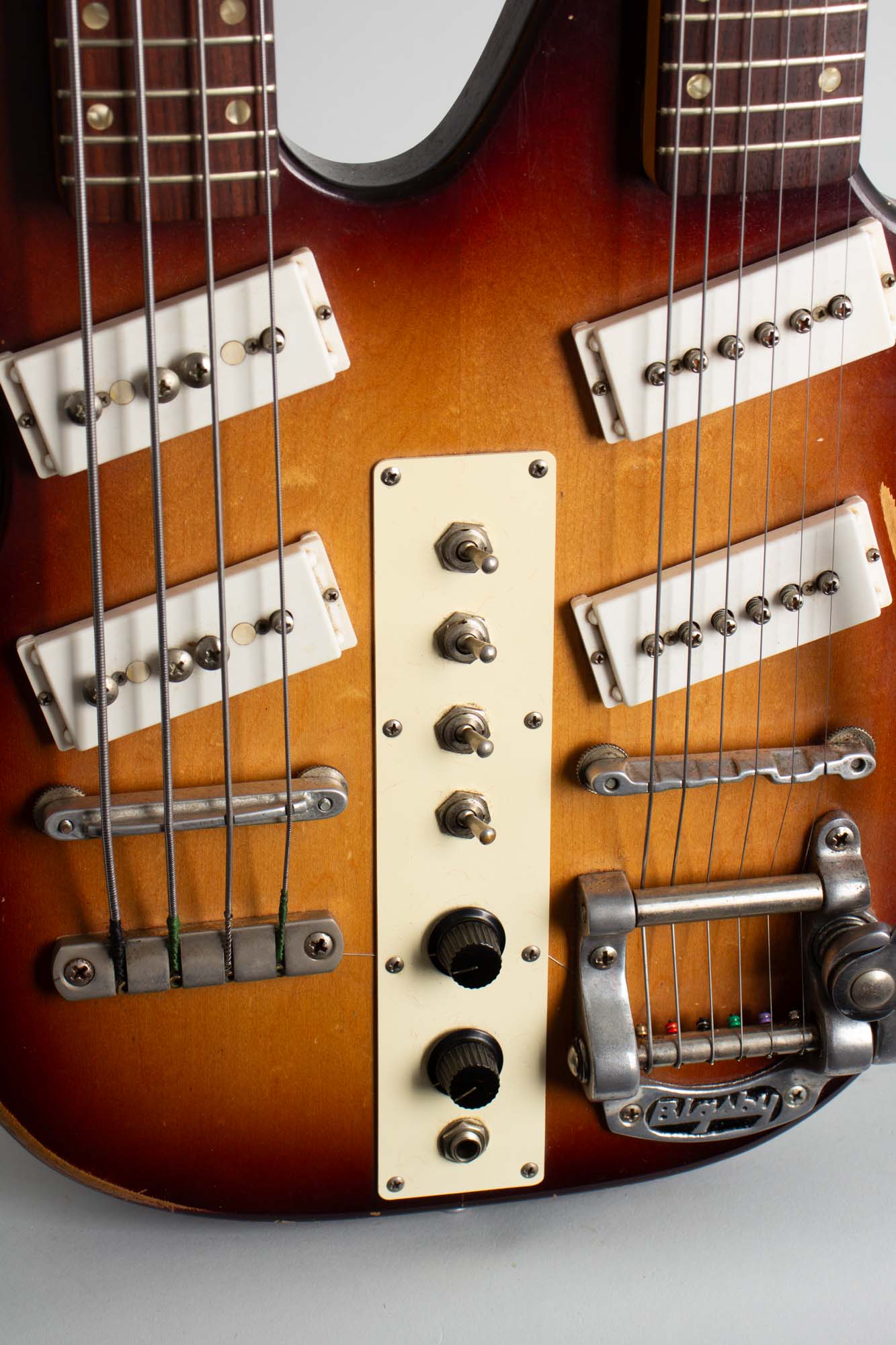
Carvin #4 BS Double Neck Bass & Guitar Model Solid Body Electric Guitar (1966), made in Covina, California, sunburst lacquer finish, maple body; maple necks with rosewood fingerboards, original black sparkle hard shell case.
This super cool if eccentric looking doubleneck guitar and bass is a rare and historically interesting piece, and (at least on the guitar side) a fine sounding instrument despite its rather homey appearance! Carvin guitars and amps are a product of the same Southern California spawning grounds as Fender, Rickenbacker, Magnatone, Bigsby and Mosrite; while Carvin is not usually mentioned in connection with these other pioneers, the company was active from early on and is still in business.
Carvin founder Lowell Kiesel moved his fledgling operation from Nebraska to California around 1948, and by 1950 changed the name from Kiesel to Carvin, combining his two sons' names. By the mid-50s Carvin became known for selling electric instruments via direct mail order only, as well as being one of the few sources in the 50's offering parts for do-it-yourself electric guitar tinkerers. Carvin's best remembered products of the era are their spectacular sounding AP-6 pickups, the early favorite of Semie Moseley (among others) for his handmade guitars.
The Model 4-BS doubleneck was pretty much Carvin's top of the line solid body, debuting in the 1959 catalog which included solidbody electric guitars, basses, mandolins, and also a doubleneck guitar/mandolin. At that time Carvin trumpeted their use of a natural finish exclusively, but by the mid-'60s started applying a sunburst finish to the maple bodies.
The 4-BS mounts a standard 6-string guitar neck under a 25 1/4" "Guitar scale" 4-string bass neck; until the early '70s Carvin only made basses with this guitar-length neck. Carvin made their own necks in this period, carved from solid rock maple with heavy rosewood fingerboards and an adjustable truss rod. They are quite well made, but apparently the company didn't want to tool up for an actual bass neck at the time! All 10 tuners are guitar-size Kluson Deluxe with metal buttons.
The minimalist eccentrically-shaped body of this 1966 example packs a lot of equipment into a very small space, making it handier than most such instruments then or now. The guitar half has two slant-mounted plastic-covered AP-6 pickups and a Bigsby tailpiece, which added $29 to the list price. The bass side has two AP-4 bass pickup (which is rare, most have one) and a metal bridge and tailpiece. Oddly enough the pickups on this instrument are slanted in the opposite direction than shown in the catalog! A bank of switches on a plastic panel between the two allows any pickup to be turned on or off, mated to master volume and tone knobs. This versatile set up and allows for a wide range of sounds from either side, and some interesting "ghost tone" effects if desired.
Known mostly to vintage tone connoisseurs, the AP-6 is regarded as worthy of ranking with the pre-war Rickenbacker horseshoe, the Fender Broadcaster pickups, and the Gibson PAF as one of the finest-sounding coils of wire ever wound. AP-6 pickups are most famous for use on Joe Maphis' and Larry Collins' Mosrite doublenecks, and the sound is pure Hollywood Hillbilly Heaven all the way.
The 1966 direct sale price of this instrument was $229.00 plus $29.90 for the Bigsby and $29 for the case. The pots are date coded 6531 indicating it was likely assembled later in 1965 or in 1966. While perhaps odd-looking to the uninitiated, this #4 BS is handy, weighing in at well under 10 Lbs. and quite a powerful and versatile-sounding guitar, with a thumpy easy-playing bass half thrown in for good measure. While early Carvins have a somewhat homemade aspect to them, this is well-designed, very good-playing and fine-sounding instrument.
Overall length is 39 1/8 in. (99.4 cm.), 12 1/8 in. (30.8 cm.) wide at lower bout, and 1 1/2 in. (3.8 cm.) deep. Scale length is 25 1/4 in. (641 mm.). Width of nut is 1 11/16 in. (43 mm.)., 9.55 lbs.
This is a generally clean and all-original piece, one of the few of these bass/guitar doubles we have ever seen. The original thin lacquer finish has light wear overall, most heavily worn through on the top edge of the body and more noticeably in the area below the bridge pickup on the guitar. There is some belt buckle and edge wear to the back as well. Somebody definitely gigged this odd duck, but took good care of it along the way.
The original frets remain in very good shape and both necks are beautifully straight and playable. The bass is still equipped with three heavy period flatwound strings, and the low E is an old replacement. This is really a great sounding and quite useful instrument, despite its eccentric looks. It resides in the original HSC, a bit worn but fully solid. Excellent - Condition.