


C. F. Martin OM-18 Flat Top Acoustic Guitar (1931)


1
/
of
18
Regular price
$26,500.00
Regular price
$26,500.00
Sale price
$26,500.00
Unit price
/
per
Item #14269
C. F. Martin OM-18 Model Flat Top Acoustic Guitar (1931), made in Nazareth, PA, serial # 46656, natural lacquer finish, mahogany back, sides and neck, spruce top; ebony fingerboard, black tolex hard shell case.
The OM-18 is one of the most iconic of all flat-top guitars, along with its rosewood sister the OM-28 representing the first flowering of the "Modern" American steel-string flat top. The combination of a 14-fret, long scale neck with a shortened 000 sized body created a new guitar paradigm that has been revered (and imitated) ever since. Add the delicately scalloped "advanced" 1930s X-braced top and you get the full measure of "golden age" Martin.
This original Martin OM-18 has seen some ups and downs since its birth in Nazareth Pa. in mid-1931. The bulk of the guitar has an old lacquer overfinish and there are some notable repairs to the sides but it still presents as far less worn than many. According to Greig Hutton's Martin registry this guitar began with shop order 967, one of a batch of 25 OM-18s with serial numbers from #46652-46676. The neck block was stamped with the number #46656 on April 20, 1931. Hutton adds that "250 regular OM-18 guitars were made in 1931, in 10 batches of 25. This the 105th OM-18 made in 1931".
Originally conceived for Atlanta banjoist/guitarist Perry Bechtel the ground-breaking 14-fret rosewood OM-28 first appeared in late 1929. The mahogany-bodied OM-18 followed in early 1930 and proved an immediate success, even as the depression set in. The design was so well received that after 1933 nearly all Martin guitars switched to the "Orchestra Model" format. The OM-18 designation was dropped and this 14-fret model simply called the 000-18, a company mainstay ever since. Martin made an important change soon after by shortening the scale to 24 3/4", leaving the original 1930-33 OM-18 to become one of the most sought-after of all mahogany Martins.
In one of those great fretted ironies Martin catalogs described OM models as "designed for plectrum playing in orchestra work" but they have become renowned as the greatest fingerstyle guitar ever built. In another vein OM's quickly became popular with hard-strumming cowboy, recording and radio entertainers. Since the early 1930's the OM has been celebrated as one of Martin's crowning achievements, among the greatest flat tops ever created.
This mid-1931 OM-18 has some transitional features. It has the second style tortoise celluloid pickguard, a bit larger than first "teardrop" version but still carries the Grover banjo pegs which were replaced with standard guitar machines soon after. The slim soft profile neck has a rounder-feeling profile with a 1 3/4" nut width and is fitted with bar frets, phased out a couple of years later. The headstock face carries no "C.F. Martin" which would appear later in the year; the small Martin stamp on the headstock rear is the only external logo.
1931 was the OM-18's peak production year. Introduced at $60 in 1930, it was quickly reduced to a rock-bottom $50 in 1931 and '32; Martin had to make guitars affordable in the Depression's hardest years! At the time this OM was a distinctly modern guitar design, still built with the exemplary craftsmanship of Martin's 19th century traditions. The OM-18's 15" wide narrow-waisted light mahogany body and scallop-braced spruce top coupled with the longer scale neck make for a warm and exceptionally responsive guitar. Although somewhat re-worked (as many were) this first-generation OM-18 remains a superb player's instrument, even with the added finish in cleaner condition than many and a lovely guitar to play.
Overall length is 40 in. (101.6 cm.), 15 1/8 in. (38.4 cm.) wide at lower bout, and 4 1/8 in. (10.5 cm.) in depth at side, taken at the end block. Scale length is 25 1/4 in. (641 mm.). Width of nut is 1 3/4 in. (44 mm.).
This OM is not in completely original condition but for a 95 year old instrument as delicately built as this it is very solid. As noted visible finish work was done along the way. There is an old clear lacquer on the entire instrument except for the face of the headstock, which somehow escaped. There is some wear visible underneath this including minor dings and dents to the top confirming the original finish is largely intact beneath the later lacquer. There is also later pickwear completely through this finish, mostly along the front edge of the pickguard. The guard itself is original, recently removed, flattened and reglued with some scuffing marks to the top surface.
The finish work was almost certainly due to some fairly major repairs to the sides; the top and back have had comparatively little work done. There is a large oval patch repair to the lower side all along the turn of the treble bout, well faired in to the surrounding wood on the outside but a bit sloppy on the inside with a decent amount of excess glue around the area and several reinforcing strips added to the side internally. Adjacent to this is a smaller bash mark on the side/back edge about 4 1/2" below the endpin, also sealed but visible.
There is a much smaller but similar patch repair (done by the same hand) to the upper side along the turn of the bass side bout again fairly very well disguised from the outside but plainly visible internally; this was installed with no internal reinforcement added. Another small repaired bash mark is on the side lower down from this closer to the endpin, again sealed with some glue visible internally.
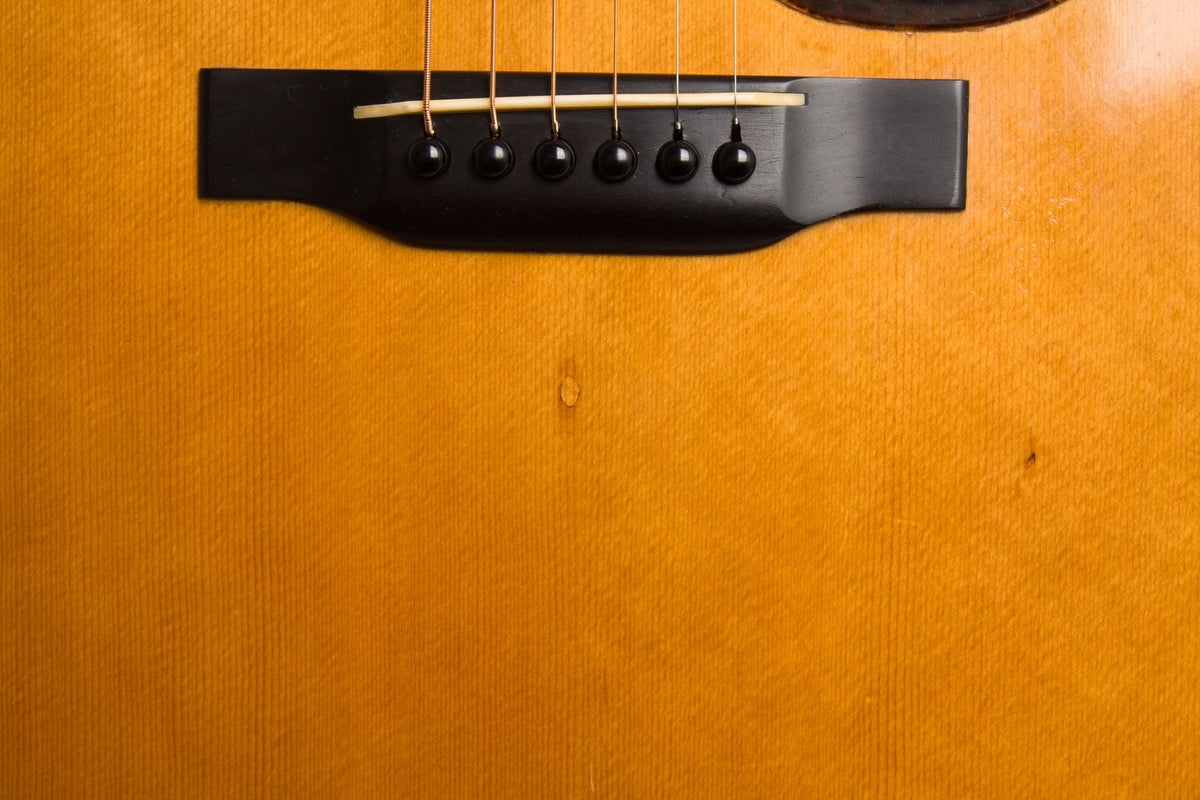
The only notable repair to the top is a small rather inexplicable small screw-sized hole patched along the centerline about an inch behind the bridge; this was very neatly done but visible both internally and externally. There is also a small pinhole under the pickguard which some glue leeched through when the guard was reglued; this is not visible externally. The top has no cracks, which is delightful especially considering how lightly built it is. The delicate scalloped bracing and small maple bridgeplate remain intact, with a couple of small spots appearing to have been reglued at some point. The bridge looks like a superb older ebony repro, slightly lower than the original and possibly shimmed from below. The back shows no notable repairs.
The neck has been neatly reset, the fingerboard leveled and expertly refretted with correct style bar frets. The original Grover "pancake" banjo tuners still work well; they were recently inspected and lubricated. The instrument plays superbly and the sound is nicely detailed, the guitar responds immediately to even a light touch and every note shimmers with a life of its own. Despite a checkered past this is a fine player's example of one of the most sought-after of all flat-top guitars, truly a Martin for the ages. The Greig Hutton certificate is included in the later period hard case. Overall Very Good + Condition.
View full details
The OM-18 is one of the most iconic of all flat-top guitars, along with its rosewood sister the OM-28 representing the first flowering of the "Modern" American steel-string flat top. The combination of a 14-fret, long scale neck with a shortened 000 sized body created a new guitar paradigm that has been revered (and imitated) ever since. Add the delicately scalloped "advanced" 1930s X-braced top and you get the full measure of "golden age" Martin.
This original Martin OM-18 has seen some ups and downs since its birth in Nazareth Pa. in mid-1931. The bulk of the guitar has an old lacquer overfinish and there are some notable repairs to the sides but it still presents as far less worn than many. According to Greig Hutton's Martin registry this guitar began with shop order 967, one of a batch of 25 OM-18s with serial numbers from #46652-46676. The neck block was stamped with the number #46656 on April 20, 1931. Hutton adds that "250 regular OM-18 guitars were made in 1931, in 10 batches of 25. This the 105th OM-18 made in 1931".
Originally conceived for Atlanta banjoist/guitarist Perry Bechtel the ground-breaking 14-fret rosewood OM-28 first appeared in late 1929. The mahogany-bodied OM-18 followed in early 1930 and proved an immediate success, even as the depression set in. The design was so well received that after 1933 nearly all Martin guitars switched to the "Orchestra Model" format. The OM-18 designation was dropped and this 14-fret model simply called the 000-18, a company mainstay ever since. Martin made an important change soon after by shortening the scale to 24 3/4", leaving the original 1930-33 OM-18 to become one of the most sought-after of all mahogany Martins.
In one of those great fretted ironies Martin catalogs described OM models as "designed for plectrum playing in orchestra work" but they have become renowned as the greatest fingerstyle guitar ever built. In another vein OM's quickly became popular with hard-strumming cowboy, recording and radio entertainers. Since the early 1930's the OM has been celebrated as one of Martin's crowning achievements, among the greatest flat tops ever created.
This mid-1931 OM-18 has some transitional features. It has the second style tortoise celluloid pickguard, a bit larger than first "teardrop" version but still carries the Grover banjo pegs which were replaced with standard guitar machines soon after. The slim soft profile neck has a rounder-feeling profile with a 1 3/4" nut width and is fitted with bar frets, phased out a couple of years later. The headstock face carries no "C.F. Martin" which would appear later in the year; the small Martin stamp on the headstock rear is the only external logo.
1931 was the OM-18's peak production year. Introduced at $60 in 1930, it was quickly reduced to a rock-bottom $50 in 1931 and '32; Martin had to make guitars affordable in the Depression's hardest years! At the time this OM was a distinctly modern guitar design, still built with the exemplary craftsmanship of Martin's 19th century traditions. The OM-18's 15" wide narrow-waisted light mahogany body and scallop-braced spruce top coupled with the longer scale neck make for a warm and exceptionally responsive guitar. Although somewhat re-worked (as many were) this first-generation OM-18 remains a superb player's instrument, even with the added finish in cleaner condition than many and a lovely guitar to play.
Overall length is 40 in. (101.6 cm.), 15 1/8 in. (38.4 cm.) wide at lower bout, and 4 1/8 in. (10.5 cm.) in depth at side, taken at the end block. Scale length is 25 1/4 in. (641 mm.). Width of nut is 1 3/4 in. (44 mm.).
This OM is not in completely original condition but for a 95 year old instrument as delicately built as this it is very solid. As noted visible finish work was done along the way. There is an old clear lacquer on the entire instrument except for the face of the headstock, which somehow escaped. There is some wear visible underneath this including minor dings and dents to the top confirming the original finish is largely intact beneath the later lacquer. There is also later pickwear completely through this finish, mostly along the front edge of the pickguard. The guard itself is original, recently removed, flattened and reglued with some scuffing marks to the top surface.
The finish work was almost certainly due to some fairly major repairs to the sides; the top and back have had comparatively little work done. There is a large oval patch repair to the lower side all along the turn of the treble bout, well faired in to the surrounding wood on the outside but a bit sloppy on the inside with a decent amount of excess glue around the area and several reinforcing strips added to the side internally. Adjacent to this is a smaller bash mark on the side/back edge about 4 1/2" below the endpin, also sealed but visible.
There is a much smaller but similar patch repair (done by the same hand) to the upper side along the turn of the bass side bout again fairly very well disguised from the outside but plainly visible internally; this was installed with no internal reinforcement added. Another small repaired bash mark is on the side lower down from this closer to the endpin, again sealed with some glue visible internally.
The only notable repair to the top is a small rather inexplicable small screw-sized hole patched along the centerline about an inch behind the bridge; this was very neatly done but visible both internally and externally. There is also a small pinhole under the pickguard which some glue leeched through when the guard was reglued; this is not visible externally. The top has no cracks, which is delightful especially considering how lightly built it is. The delicate scalloped bracing and small maple bridgeplate remain intact, with a couple of small spots appearing to have been reglued at some point. The bridge looks like a superb older ebony repro, slightly lower than the original and possibly shimmed from below. The back shows no notable repairs.
The neck has been neatly reset, the fingerboard leveled and expertly refretted with correct style bar frets. The original Grover "pancake" banjo tuners still work well; they were recently inspected and lubricated. The instrument plays superbly and the sound is nicely detailed, the guitar responds immediately to even a light touch and every note shimmers with a life of its own. Despite a checkered past this is a fine player's example of one of the most sought-after of all flat-top guitars, truly a Martin for the ages. The Greig Hutton certificate is included in the later period hard case. Overall Very Good + Condition.


Loading...
Just arrived!
Item #