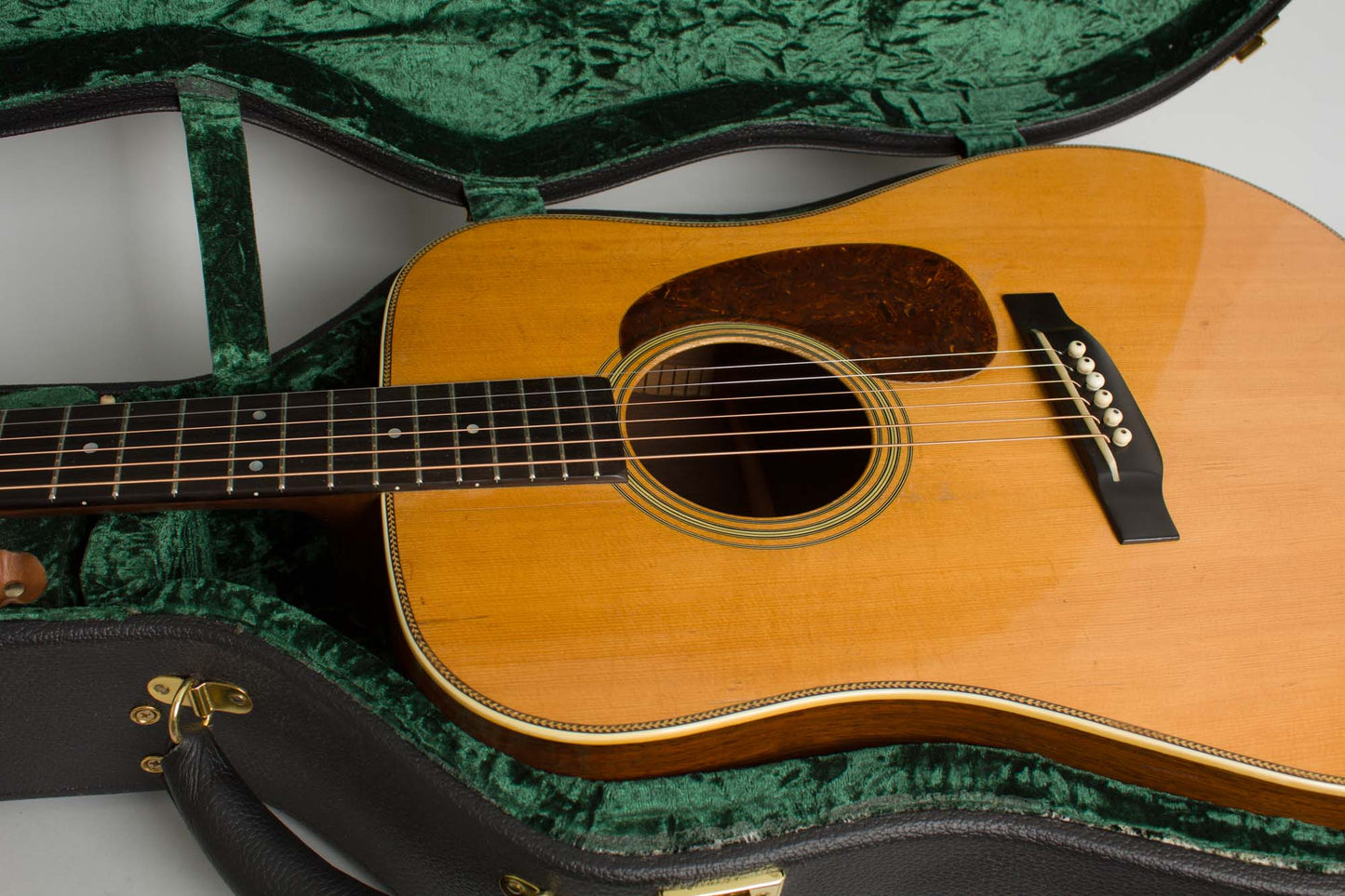
C. F. Martin D-28 Herringbone Model Flat Top Acoustic Guitar (1945), made in Nazareth, PA, serial # 93097, natural lacquer finish, Brazilian rosewood back and sides, spruce top; mahogany neck with ebony fingerboard, black tolex hard shell case.
There are certain guitars that are simply the standard by which all others are judged;-the Martin D-28 "herringbone" is always one of them. This D-28 is a latter day "Non-Scalloped Bone", made in late 1945 JUST after the war ended. Even so Martin's supply of the namesake wood marquetry was beginning to run out. As this had long been sourced from Germany, there were unsurprisingly no new supplies available at the time and Martin simply stopped using it on their instruments as their stock ran out in mid-1947.
The other features are classic period D-28 appointments. After mid-1944 the top bracing was no longer scalloped but tapered, still somewhat lighter than the typical 1950's style. The back is beautifully grained Brazilian rosewood, with more wavy figure than most coupled to straighter grained sides and a very even-grained spruce top. The bridge and fingerboard are black ebony, with mixed-sized pearl dots on the board in place of the prewar slotted diamonds. The tuners are wartime Kluson thin-plate single units with plastic buttons designed to use a minimum of metal; these are more commonly seen on period Gibsons.
This example has a serial number dating it to the final months of 1945, one of a total of 183 shipped that year; compared to modern production that is a paltry number. The mahogany-bodied D-18 cost just over half as much at $65 and sold in larger numbers, but for many the $125 D-28 represented the ultimate stage guitar. Many Country and Western performers of the period found the Martin D-28 was the best instrument available for this environment. Such a guitar represented a sizable investment for a working performer, and once obtained was often played constantly as a tool to literally put food on the table.
In this period these instruments were judged by the way the rhythm they produced powered the whole group; the kind of solo hot pickin' that characterizes the modern aesthetic was a couple of generations away. Although the D-28 is considered the ultimate Bluegrass guitar, "Bluegrass" as a musical style was just percolating in the "classic" Bill Monroe band with Lester Flatt on his D-28s right around the time this one was made. This guitar will handle any musical style with power and refinement, offering a the big booming bass D-28's are prized for but a full ringing treble as well. Some harder-hitting players feel these more robust early postwar guitars are the best choice for stage work when tonal muscle is a prime concern!
Overall length is 41 in. (104.1 cm.), 15 3/4 in. (40 cm.) wide at lower bout, and 5 in. (12.7 cm.) in depth at side, taken at the end block. Scale length is 25 1/2 in. (648 mm.). Width of nut is 1 11/16 in. (43 mm.). This is a very fine playing and sounding "Herringbone" D-28, showing signs of use but less wear and repair than many of these often heavily played instruments. The original lacquer finish is intact with no major overfinish added, just a small touch up on the back related to a grain crack repair. The finish overall shows its age with some typical checking, dings, surface scratches, and compression marks. There is some pickwear on both sides of the sound hole, with concentrated spots on the lower edge of the sound hole and off the back edge of the pickguard that go through to the wood. The area above the strings in back of the soundhole has some pick gouges as well. There are some fairly deep scratches and dings on the back but no large area o0f buckle wear. Some of the finish is worn to the wood off the back of the neck mostly in the first position.
The back shows a couple of grain cracks to the angled pattern area of the rosewood off the bottom edge, related more to movement in the grain than any damage; everything is solidly sealed up with no cleats added. There is a tiny pull to the spruce on the top along the top edge of the pickguard, but it has never opened into a full crack. There are a couple of other very small grain splits to the top, one off the lower waist on the treble side and the other off the front edge that similarly have never fully opened through to the inside. A deep scratch above the fingerboard extension looks like a crack but it not.
The ebony bridge looks to be a repro, or perhaps the original with the top re-shaped a bit over the years. A nearly invisible crack between A and G bridge pin holes has been neatly sealed; the bridge is fitted with a later compensated bone saddle. The neck has been neatly reset and refretted with appropriate wire, showing minimal subsequent wear. The bone nut is a nicely made replacement. Internally all original braces and the small maple bridgeplate remain intact, as do the original tuners. A strap button installed on the treble side of the neck heel.
This guitar, though noticeable played, must also have been well-cared for. Old D-28s from this period are real workhorse guitars; they were rarely coddled and often show the signs of very heavy use. This guitar wears its fairly light scars proudly, and remains not only a great piece of 20th century guitar history and artistry but a very fine player's instrument. It lives in a modern HSC. Overall Very Good + Condition.