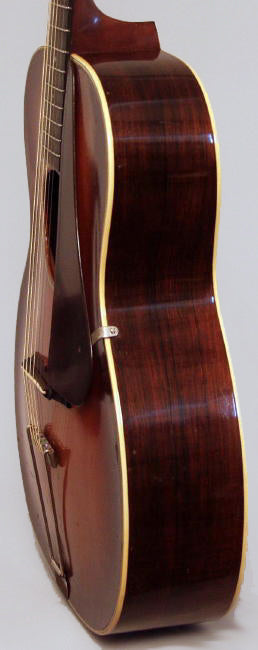
C. F. Martin C-2 Model Arch Top Acoustic Guitar (1931), made in Nazareth, PA, sunburst top, natural back and sides finish, Brazillian rosewood sides and back, spruce top, mahogany neck with ebony fingerboard, black tolex hard shell case.
One of C. F. Martin & Co.'s more interesting, but unfairly maligned, guitars, the round-hole C-2 archtop is an unusual and surprisingly versatile instrument. This is Martin's earliest attempt at an archtop guitar, and has many unique features. While Martin archtops have never been well appreciated compared to the same period's flat tops, viewed simply as a guitar (not as an OM-28 that wasn't!) this C-2 is a fine-sounding instrument, both powerful and sweet.
In 1930-31 when the guitar was being designed, the archtop guitar was still a relatively unformed concept. Gibson had lead the way, and by the late 20's their $275.00 16" wide L-5 was the emerging standard of the professional guitar with f-holes and a raised fingerboard. Lesser Gibson archtops, along with other maker's early attempts, still stuck to the familiar round soundhole.
Martin chose not to copy the L-5 (which was much more expensive than even a pearl-bordered OM-45) and essentially took their OM-body, pitched the 14-fret neck way back, and gave the top a gentle carved arch supported by a truncated X-brace. Similar guitars emerged around this time from Washburn, Vega, and Weymann, among others. The C-2 was the most successful of these hybrid instruments, selling over 250 units before being redesigned as an f-hole guitar in 1933.
This particular C-2 is a very early example, made not long after the first prototypes. The C-2 was the middle of the initial archtop line, with a Brazilian rosewood body and relatively fancy decoration similar to an OM-28, but lacking the herringbone top border which may have been considered too old-fashioned for such a modern guitar! All woods on this instrument are top-notch, with the Brazilian back and sides being particularly fine. The ebony fingerboard has slotted diamond inlay and the top is multibound in celluloid.
The unusual headstock logo reads only "MARTIN", the flanking "C. F." letters being added by 1932. The carved bridge is a little jewel in itself, with wooden height elevating wheels and a bone saddle. Tuners are early riveted individual openback Grovers and the tailpiece is a 'stringover' trapeze as used by period Gibson and Epiphone guitars.
We find this C-2 to be a delightful instrument despite its mongrel reputation. The sound is most reminiscent of an early 30's roundhole L-4 but with a distinctly deeper tone due to the rosewood body. It sounds great for early jazz, ragtime and hokum and does a pretty fair job with more modern styles as well. Gypsy jazz fans should give this guitar a fresh look as well.
All around cool guy James Cagney played one guitar his whole life�a 1931 Martin C-2! OK, maybe that's not as big an endorsement as some, but clearly a distinguished one!
Overall length is 39 3/4 in. (101 cm.), 15 1/16 in. (38.2 cm.) wide at lower bout, and 4 1/8 in. (10.5 cm.) in depth at side, taken at the end block. Scale length is 25 1/2 in. (648 mm.).
All original with some noticeable playing wear but no major cracks or repair; recent expert refret with period-correct bar frets.
Includes an old but not original period HSC. Excellent Condition.