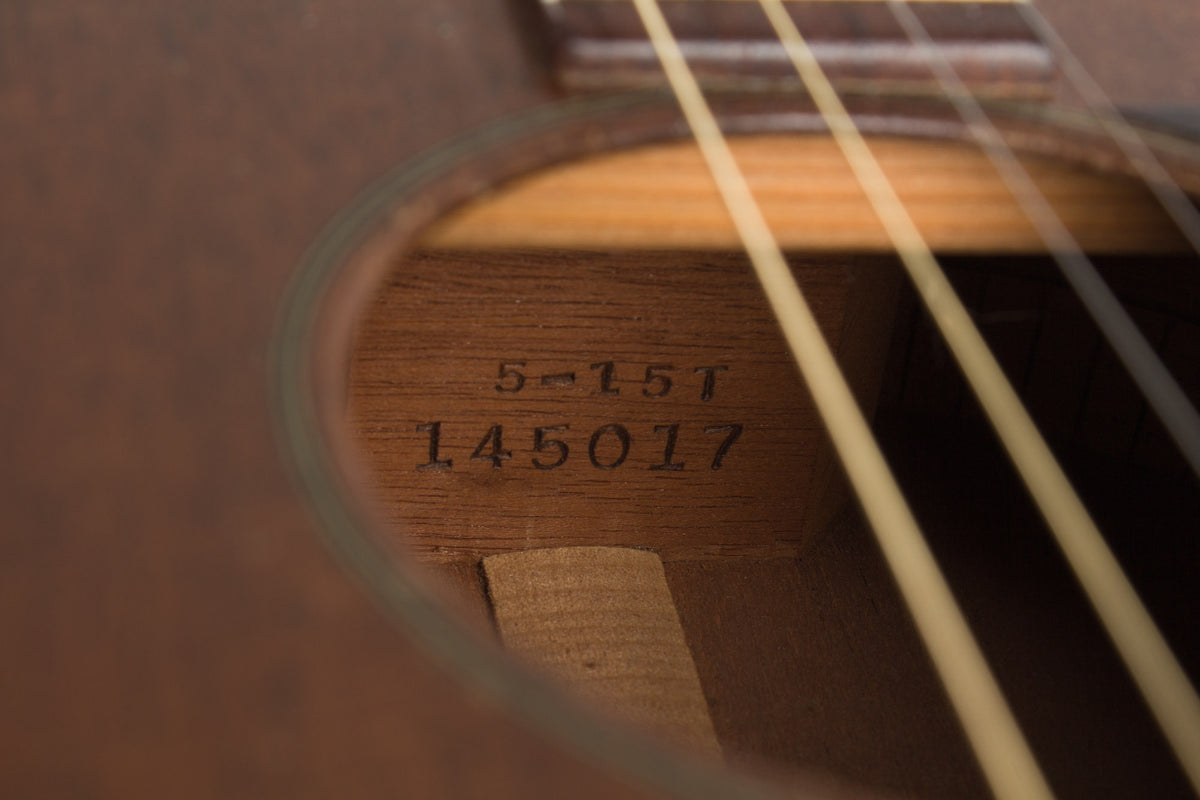
C. F. Martin 5-15T Model Flat Top Tenor Guitar (1955), made in Nazareth, PA, serial # 145017, natural mahogany finish, mahogany body and neck, rosewood fingerboard, black gig bag case.
This is a well-played example of the Martin 5-15T, one of the smallest and daintiest of latter-day tenor guitars. This model was in production from 1949 up into the early 1960s. It replaced the earlier 5-17T which had debuted in 1927, when small-bodied tenors appeared to be the next big thing. It turned out that as with 6-strings most players preferred a larger bodied instrument, but the diminutive size 5 tenor with its light and airy sound appealed to enough customers to stay in the line for well over 30 years. The only difference in the -17 and -15 designated models was the level of finish, which most players never even noticed.
This 5-15T was made in mid-1950, some years before Martin's 4-string sales got a boost from the "folk" era influence of the Kingston Trio. Still 136 of these all mahogany tenor guitars were sold in 1955. Despite having passed their early commercial peak by the 1950s tenor guitars continued to be made at Martin after most other manufacturers had given up on them. Listing at $56 in 1955 this would have been easily the best quality budget-priced 4-string guitar in the world.
The 5-15T is a study in careful economy, the standard Martin appointments reduced to the minimum. There is no trim on the body besides a W/B/W sound hole ring and tortoise celluloid pickguard. The top, back, sides, and neck are all made of mahogany with a rosewood bridge and fingerboard on the 23" scale neck. The Brazilian rosewood-faced headstock has a small "C. F. Martin" decal logo.
While designed in the late 1920s for tenor banjoists getting pushed out of work by the preference for the guitar's mellower tone, tenor guitars have a range of possibilities still not fully explored even in the 21st century. Rabon Delmore used small tenor Martin models to play the deftly picked leads that characterize the Delmore Brothers' music, and many others have explored them since. The Martin tenor has always been the best available and even this small economy model has few peers for 4-string flat-top sonics.
Overall length is 34 1/2 in. (87.6 cm.), 11 1/4 in. (28.6 cm.) wide at lower bout, and 3 7/8 in. (9.8 cm.) in depth at side, taken at the end block. Scale length is 23 in. (584 mm.). Width of nut is 1 1/4 in. (32 mm.).
Overall this is a good playing example the simplest, smallest-body Martin tenor showing a decent amount of wear and light repair but nothing tragic. The original thin lacquer finish has checking, dings, dents and scratches overall with heavier wear to the unbound body edges and a deeper chip to the top/back edge above the endpin. The back of the neck shows some wear but no heavy capo marks. There is a sealed grain crack along the top edge of the pickguard in the typical spot, a bit sloppily done but solid and another one cleanly sealed on the top lower treble bout coming off the back edge.
The original rosewood bridge has never been cut down but has a newer bone saddle is fitted. Internally the bracing and original small bridgeplate remain intact and unaltered. The original frets have been polished out and show hardly any subsequent wear, the original ebony nut is intact. The original Waverly openback tuners are still quite functional. This little 4-string Style 5 has a nice punchy sound, sweet but more powerful than one might expect. It lives in a modern gig bag. Very Good Condition.