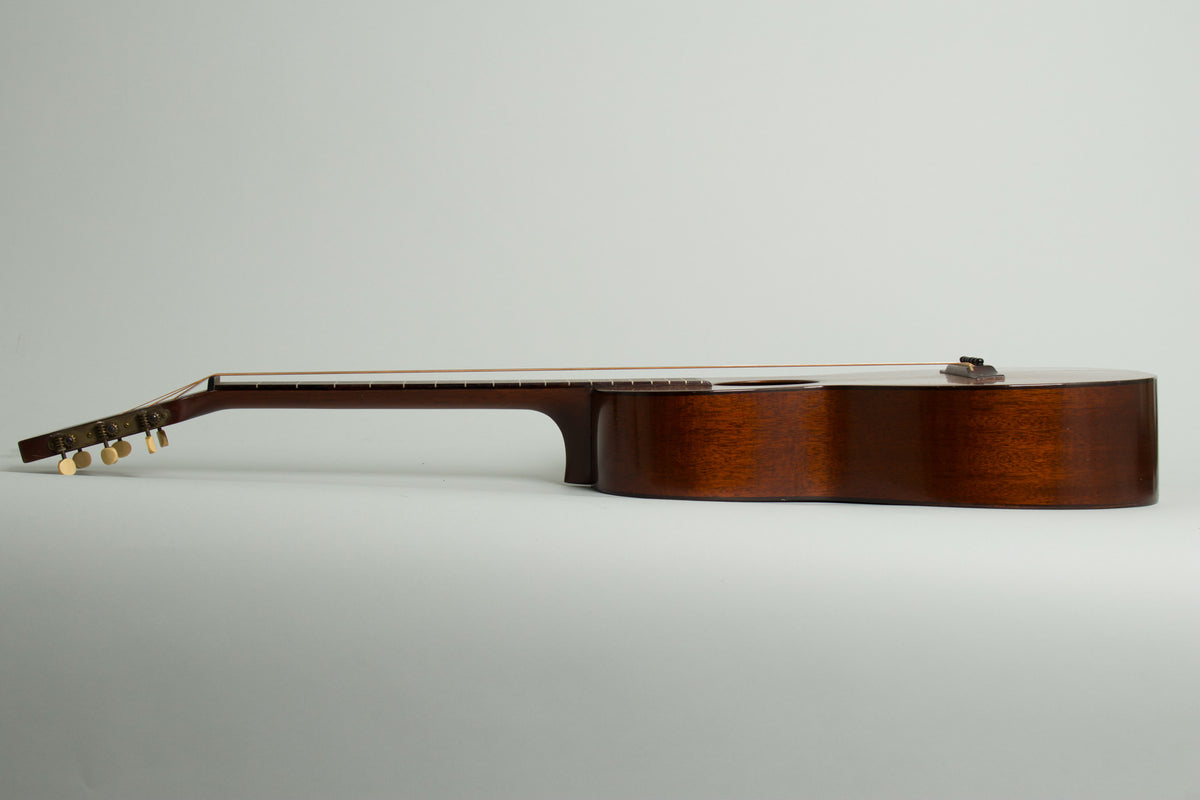
C. F. Martin 2-17H Hawaiian Model Flat Top Acoustic Guitar (1928), made in Nazareth, PA, serial # 36753, natural mahogany finish, mahogany body and neck, rosewood fingerboard, original black chipboard case.
This 2-17H is a Hawaiian version of the 2-17, Martin's first dedicated steel-string guitar. Even into the 1920s the C. F. Martin Company considered gut-strung guitars the norm, with steel stringing a cheap and somewhat low-class anomaly. The popularity of Jazz, Vaudeville and especially Hawaiian styles made this a redundant strategy, and in 1922 the all-mahogany 2-17 was introduced with steel strings as standard. It was clearly designed as a budget guitar, in keeping with the concept that only cheap players used steel strings!
This rare 2-17H variant was offered only between 1927 and 1931 with a high nut, flush frets and a straight saddle for lap steel playing. Only 551 ever made, this being one of 150 shipped in 1928. It was aimed at students learning the Hawaiian guitar, offering Martin quality at the lowest price the company could manage. To this end it is a very basic instrument with all mahogany construction and minimal appointments. At the end of 1929 it was made more basic still by eliminating the rosewood bindings on the top edge; this 1928 model still has discreet wood trim around the top and a larger soundhole ring. The other appointments include a plain straight bridge, headstock facing and small-dot inlaid fingerboard all made of rosewood.
The 1928 list price was $32.50, if a paltry sum for a Martin still an expensive guitar by the standards of the time. You could get a pearl-trimmed rosewood Hawaiian guitar from Sears for less than that! The "regular" 2-17 proved a Martin mainstay through the 1920s right into worst years of the Depression, but the Hawaiian version saw a final batch od 51 built in 1931 before disappearing forever. Many of these extremely lightly built, delicately scallop-braced guitars have not survived the original steel guitar High A tuning; this one is unusual in retaining its original Hawaiian format and never having been converted for standard play. As such it is a fine sounding example with a sparkly tone and a surprising power and depth for its diminutive body. While few players in the 21st century still employ small flat tops like this for acoustic steel playing, this is a superb example and could of course be converted for standard play if desired.
Overall length is 37 in. (94 cm.), 12 1/4 in. (31.1 cm.) wide at lower bout, and 4 in. (10.2 cm.) in depth at side, taken at the end block. Scale length is 24 3/8 in. (619 mm.). Width of nut is 1 3/4 in. (44 mm.).
This nearly century old Hawaiian guitar remains original and unaltered, an increasing rarity in the 2020s when most have been converted for standard play. Overall the all-original finish is mostly quite clean; the top has a deep scratch behind the bridge and some light wear below the sound hole in the typical strumwear spot; the rest of the lacquer is relatively shows only some very small dings, dents, and scratches most heavily on the lower sides. The back of the body has deeper scrapes and dings with an area polished out where some deeper scratching occurred. The neck is untouched having never had a hand in contact with it; by this point Martin was milling the bar frets flush with the fingerboard on their Hawaiian guitars.
Structurally this Hawaiian 2-17 is in much better shape than many. The thin mahogany top is solid with only very minor arching; the top center seam has been resealed. There is one sealed crack on the lower back touched up and polished out a bit. The straight-saddle rosewood bridge, delicate scalloped bracing and tiny maple bridge plate are all original and intact. The unplated strip tuners are original, even the bridgepins and endpin appear original as well.
As these early mahogany Hawaiian guitars go this is an excellent example, used but well cared for over almost a century. In the early days of "records and the radio" this would have been a dream maker for somebody. Today in its steel guitar form it is something of a relic; to make it playable as a standard guitar the conversion process is fairly elaborate requiring a neck reset and refret with bar frets so we will leave it to the next owner to decide if it should be altered for "Spanish" play or left original. As it stands this is a delightful example of the almost extinct wooden small-body Hawaiian style instrument. It resides in the original heavy chipboard case, still functional with some wear. Overall Excellent - Condition.