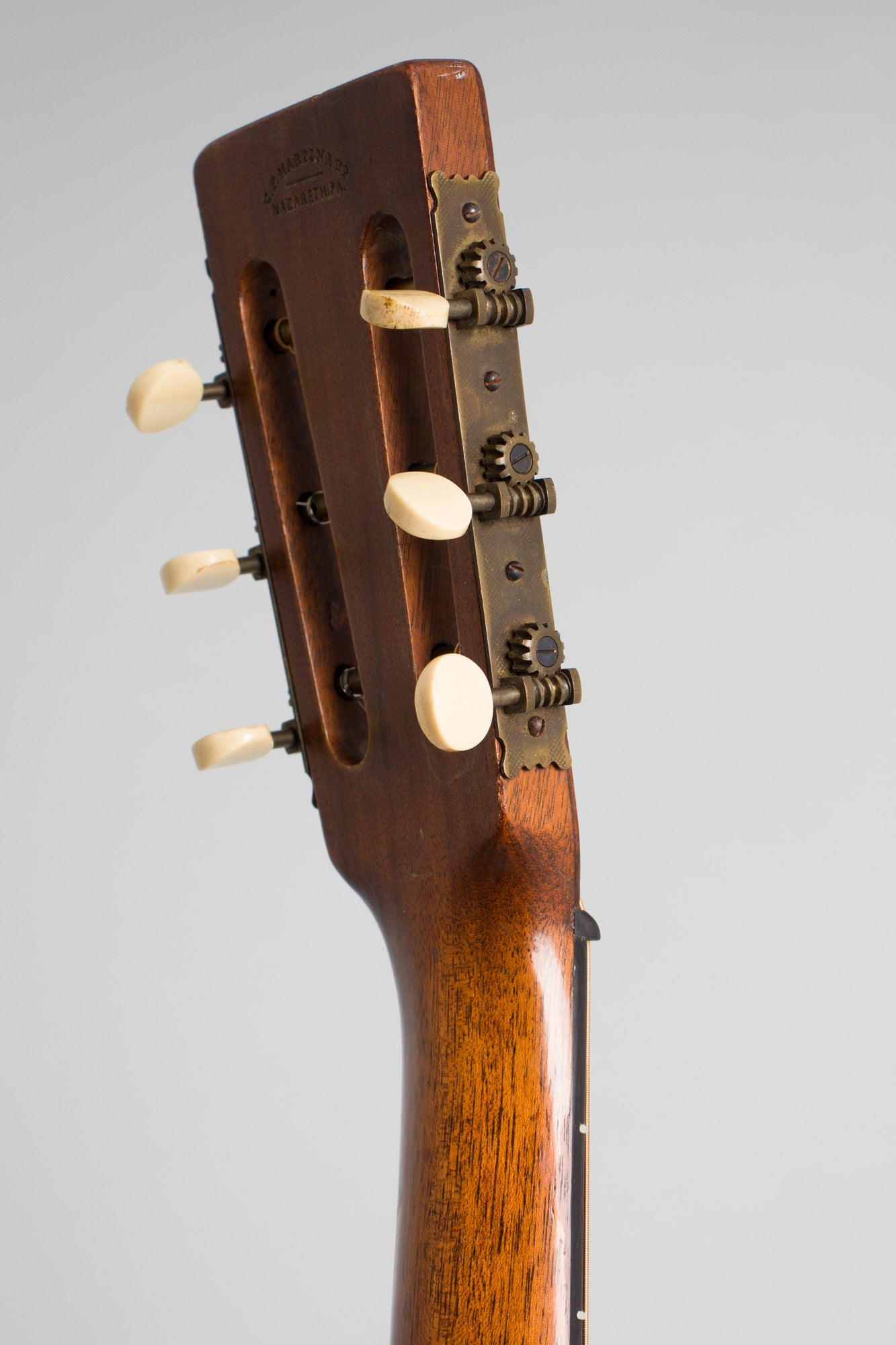
C. F. Martin 000-18 Model Flat Top Acoustic Guitar (1926), made in Nazareth, PA, serial # 24389, natural finish, spruce top, mahogany back & sides, ebony fingerboard and bridge, black tolex hard shell case.
In 1926 the 000-18 was Martin's largest and most expensive mahogany-bodied instrument; all models above this were built with rosewood back and sides. It was also at this point just recently primarily a steel-string guitar, which was a then-new development. Through the 1920s the Martin company gradually transitioned their line away from the traditional gut stringing, but up into the latter years of the decade many of the expensive Brazilian rosewood guitars were still built in the older gut-strung pattern unless specifically ordered for steel. The 000-18 transitioned to "modern" steel strings sooner than these.
This year the 000-18 had a list price of $50, up from $45 the year before. While that seems like nothing today, at the time it represented a considerable investment for many guitarists. Still, it was a real bargain in a professional quality instrument...at the time even a plain professional tenor banjo would run at least $100, and a Gibson L-5 archtop was $275!
The 15" wide 000-18 is a big-sounding guitar then and now, very loud for its day but retaining plenty of definition even when played hard. This helped make it a popular choice for period vaudeville and early "hillbilly" entertainers, since it offered a lot of bang for the buck. 1926 was the up-to-then peak production year for the model, with 224 being built. Still by today's standards that is a minimal quantity.
This particular 12-fret 000-18 has survived the years very well. The Adirondack spruce top is bordered with wooden binding -- there was no plastic trim on the Style 18s yet! -- and wood sound hole rings. The back and sides are nicely grained mahogany with a prominent knot figure on either side of the heel that is unusual on a vintage Martin. The unbound ebony fingerboard has three plain graduated-size dot inlays and bar frets. The bridge and nut are ebony and the Waverly tuners are unplated brass with grained ivoroid buttons.
With the very light, early steel-string scalloped bracing on the 15" wide featherweight 12-fret body, this guitar just sings. The neck has a fairly slim soft "V" contour and wide ebony fingerboard and is eminently playable. This is a very versatile guitar, responding extremely well to gentle fingerpicking and vigorous flatpicking. This would be one of the ultimate instruments for a truly authentic 1920s-style fiddle band, but really excels in any playing style vintage or modern. This is simply a great guitar and a wonderful find in a 12-fret large-body, steel-string Martin now approaching its 100th birthday.
Overall length is 39 5/8 in. (100.6 cm.), 15 in. (38.1 cm.) wide at lower bout, and 4 in. (10.2 cm.) in depth at side, taken at the end block. Scale length is 25 1/4 in. (641 mm.). Width of nut is 1 7/8 in. (48 mm.).
This is a well-preserved guitar for its age (almost a century on now) extremely playable with some light wear and typical maintenance repair. The very thin original finish has not been oversprayed; it shows dings, dents, and scrapes overall with some pickwear through the lacquer on the top in the typical spot below the strings. The back of the neck has some small shallow dings but no heavy wear, remaining thankfully free of the deeper old capo marks often encountered.
The only crack repair runs along just above the center seam on the back from just below the heel to the waist area; it has been neatly sealed without any over finishing and shows no signs of movement. The top and sides are delightfully crack free. The neck has been reset with an ebony shim under the fingerboard extension and refretted with correct style bar frets. The original bridge has been replaced with a well-done correct repro ebony pyramid bridge; there is some light scarring around the base. This bridge appears to have been slightly lowered on the treble side. The original very thin maple bridge plate has been replaced with a slightly larger maple bridge plate that appears to have been stained on the top surface. The original bridge plates on these first-generation steel strung 000's were very small for the top area and often failed many decades ago.
While this is not an untouched pristine guitar, considering its 90+ years on the planet it survives in excellent playing condition. This largest-bodied 1920s mahogany Martin remains a truly fine-playing instrument, quite powerful-sounding and extremely articulate even when pushed. We rarely find the earliest steel-string Martins of this period that have not had more extensive wear and/or damage; considering its age this 000 is better cared for than most, an outstanding piece that we don't see every day. Overall Excellent - Condition.