


C. F. Martin 00-18G Owned and Played by Alan Lomax Classical Guitar (1941)


1
/
of
20
Regular price
$40,000.00
Regular price
$40,000.00
Sale price
$40,000.00
Unit price
/
per
Item #14282
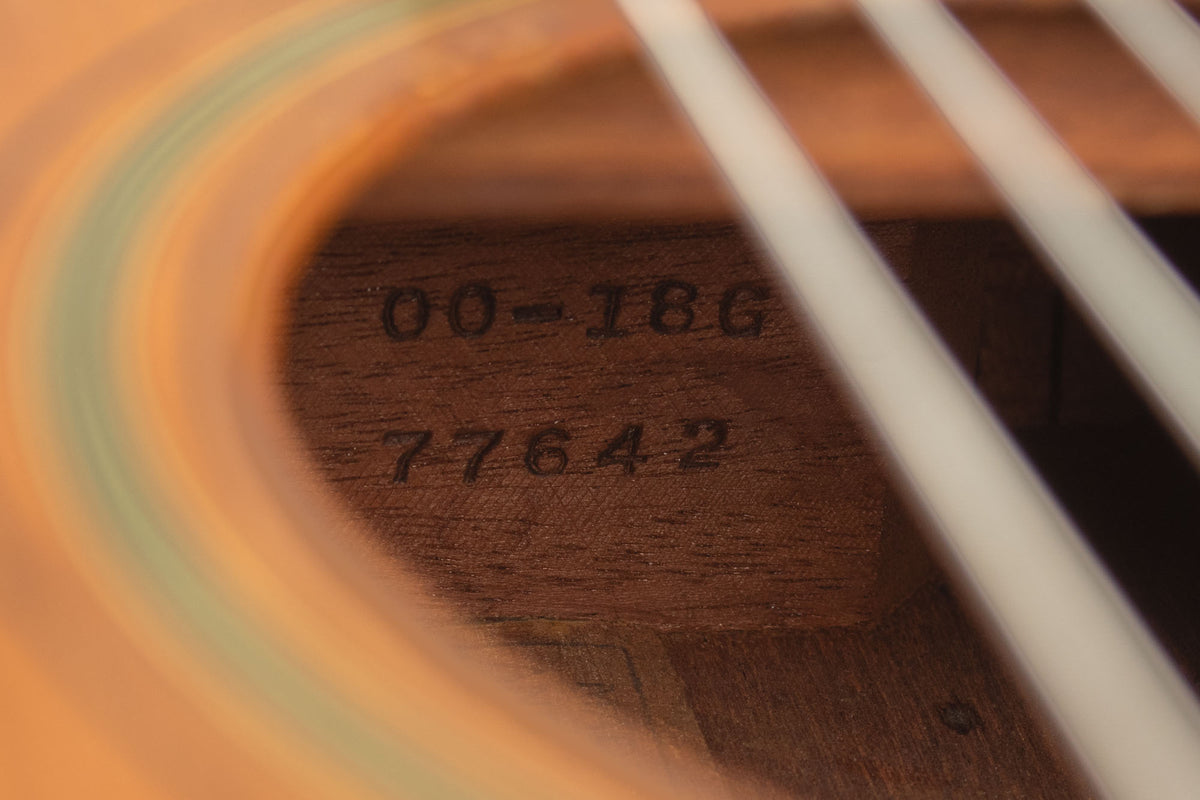
C. F. Martin 00-18G Owned and Played by Alan Lomax Model Classical Guitar (1941), Nazareth, PA, serial # 77642.
Alan Lomax (1915-2002) has been called "The man who recorded the world"; although not primarily known as a musician himself he is one of the seminal figures in 20th century folk musical history. Folklorist, ethnomusicologist, archivist, writer, scholar, political activist, oral historian and filmmaker; his extensive and amazing biography is widely available online and we can only offer a digest version here.
Starting out in company with his father John Lomax and then alone Alan was the most important figure active during the 20th century engaged in the collection, preservation and dissemination of American (and world) vernacular music. Pete Seeger said of him: "Alan Lomax is the person whom I think should be given major credit for what has been called the Folk Song Revival". Over the course of his life Lomax collected materials including over 17,000 songs, dances, interviews, and social practices from endlessly diverse local cultures both in America and abroad, at times seemingly racing to document traditions and sub-cultures he saw being subsumed by 20th century mass culture; radio, commercial recordings and television. He traveled to the remotest mountains of Appalachia, sharecropping communities, plantations and penitentiaries in the South, saloons, roadhouses and the most poverty-stricken homes in neglected regions all in search of songs and stories of the people. Along the way he was lauded by Congress, given than National Medal of Arts by President Ronald Reagan and investigated by the FBI and MI5 in England.
Starting out with a primitive Edison cylinder machine, John and Alan recorded over 3,000 songs for the Library of Congress during the 1930s, including gospel songs, many styles of blues and jazz, Creole music, songs of workers and prisoners, flamenco, calypso, and old-time ballad singing. He was appointed director of the official Archive of American Folk Song until congress dropped the project early in WWII. Using more advanced equipment (Aluminum and acetate disc recorders and then the heavy and bulky early tape recorders) he continued to document material he deemed important even after his government funding ended. After 1942 he expanded his travels overseas to Haiti, the Bahamas, Spain, England, Scotland, Ireland, and Italy compiling a library of world folk music. Along the way he played a major role in the stories of Leadbelly, Muddy Waters, Woody Guthrie, Mississippi Fred McDowell and Pete Seeger, and many others, virtually a who's who of folk, blues and vernacular artists.
By 1959 Lomax was active in arranging the now-popular folk concerts and festivals, an organizer and board member of the initial Newport Folk Festival and later advising the Smithsonian Institute's Folklife Festival. He spent the following decades preaching the gospel of cultural equity in an increasingly homogenized society, eventually writing a book "The Land Where the Blues Began" (1993) exploring the connections between the music of the American South and the history of forced labor, debt slavery, and segregation. After his death his life's work was finally gathered together by the Library of Congress in 2004 to "brings the entire seventy years of Alan Lomax's work together under one roof at the Library of Congress, where it has found a permanent home." This is posted online as the Lomax Digital Archive.
Many do not know that Alan was a musician in his own right, who loved music as a player as well as a listener. Based on photographic evidence, Lomax owned (or at least played) several Martin guitars over the decades including a steel-string 0-18 and a sunburst 0-17. This 00-18G was bought new by him in Washington, DC in 1941, the year it was made. It has been with his family ever since; In a lovely letter accompanying the instrument his daughter Anna writes "Alan lived in Washington DC between 1941 and 1942 to be in close proximity to the Library of Congress and hosted many musical gatherings at his house where this guitar was present and played by many hands." A photograph accompanying the instrument shows a smiling Alan playing the guitar in company with Sonny Terry and Brownie McGhee.
The guitar itself is a lovely sounding model 00-18G, a design resulting from Martin back-pedaling a bit in the mid-1930s. Having switched almost their entire standard line to steel strings, the company then debuted a new series of specifically gut strung instruments in 1936 signified by a "G" suffix. This 00-18G is built with a mahogany back, sides and neck and a spruce top. It uses the then-new Martin 14-fret 00 body shape but with a 12-fret, wide classical neck and slotted headstock. Internally it is delicately fan-braced with a classical tied-string bridge. These "G-Model" Martins were not particularly successful when new; this is one of only 18 00-18G's sold in 1941 but they became popular in the early 1960s due to the huge upswing in interest in playing folk music, which of course Alan Lomax was one of the figures responsible for.
This is certainly an historic instrument; while we can't say for sure who has played it as Anna Lomax Wood writes: "think about whose lap this guitar has rested on". We are deeply honored to have been chosen to present this piece steeped fully in the Americal musical tradition to the world; Anna concludes her accompanying letter: "I truly hope this guitar transmits the aura of Alan, the players, the song hunters, and the history it represents. It is a unique and unrivaled piece of cultural, musical and material American history".
Overall length is 37 3/4 in. (95.9 cm.), 14 3/8 in. (36.5 cm.) wide at lower bout, and 4 in. (10.2 cm.) in depth at side, taken at the end block. Scale length is 25 1/4 in. (641 mm.). Width of nut is 1 15/16 in. (49 mm.).
This 85 year old exceptionally well-traveled guitar shows wear and tear from its adventures but has survived as a solid player, as well as a piece of American cultural history. The original thin lacquer finish is well-worn overall showing checking, dings, dents, dirt marks and scrapes over much of the instrument. The top has noticeable picking wear all along treble side of the strings and a small area of thumb pick wear above the bass side of the soundhole. The back of the neck is cleaner with some light wear marks and one noticeable chip through the lacquer on the centerline between the frets and second frets.
Repair work completed here earlier this year included leveling and polishing the frets, resealing a small crack to the back, re-working an old repair to a larger bash mark/split to the treble side at the turn of the lower bout and regluing the bridge and several back braces. There is evidence inside the guitar of older re-gluing attempts on the braces, and some small pull-up to the spruce along the edges of the bridge. There are several small pinholes in the bridge top, three filled and one still open. At some point during a previous repair three screws were set through the bridge and internally the holes for them and the ends are still visible, the middle one going through the center brace.
The guitar remains otherwise original except for 1950s-era metal-barreled Waverly tuners replacing the originals, a substitution probably done many decades ago. The G string shaft is bent but still works fine. Internally all the original braces and bridgeplate remain intact, with the small screw holes through the plate noted above. This is a pleasant-playing and very nice sounding guitar, considerably richer-toned than most post war examples we have had, and of course with a practically incomparable history played into it.
Included with the instrument are the original chipboard case in fairly decrepit condition and a 1970s era Japanese HSC with some old strings in the pocket. Verifying the provenance are two copies of the hand signed letter from Anna Lomax Wood, two copies of a color photo of her holding the guitar recently, A reprint of the 1940s photograph of Alan Lomax playing it in company with Sonny Terry and Brownie McGee and the recent repair receipt. Overall Very Good + Condition.
View full details
Alan Lomax (1915-2002) has been called "The man who recorded the world"; although not primarily known as a musician himself he is one of the seminal figures in 20th century folk musical history. Folklorist, ethnomusicologist, archivist, writer, scholar, political activist, oral historian and filmmaker; his extensive and amazing biography is widely available online and we can only offer a digest version here.
Starting out in company with his father John Lomax and then alone Alan was the most important figure active during the 20th century engaged in the collection, preservation and dissemination of American (and world) vernacular music. Pete Seeger said of him: "Alan Lomax is the person whom I think should be given major credit for what has been called the Folk Song Revival". Over the course of his life Lomax collected materials including over 17,000 songs, dances, interviews, and social practices from endlessly diverse local cultures both in America and abroad, at times seemingly racing to document traditions and sub-cultures he saw being subsumed by 20th century mass culture; radio, commercial recordings and television. He traveled to the remotest mountains of Appalachia, sharecropping communities, plantations and penitentiaries in the South, saloons, roadhouses and the most poverty-stricken homes in neglected regions all in search of songs and stories of the people. Along the way he was lauded by Congress, given than National Medal of Arts by President Ronald Reagan and investigated by the FBI and MI5 in England.
Starting out with a primitive Edison cylinder machine, John and Alan recorded over 3,000 songs for the Library of Congress during the 1930s, including gospel songs, many styles of blues and jazz, Creole music, songs of workers and prisoners, flamenco, calypso, and old-time ballad singing. He was appointed director of the official Archive of American Folk Song until congress dropped the project early in WWII. Using more advanced equipment (Aluminum and acetate disc recorders and then the heavy and bulky early tape recorders) he continued to document material he deemed important even after his government funding ended. After 1942 he expanded his travels overseas to Haiti, the Bahamas, Spain, England, Scotland, Ireland, and Italy compiling a library of world folk music. Along the way he played a major role in the stories of Leadbelly, Muddy Waters, Woody Guthrie, Mississippi Fred McDowell and Pete Seeger, and many others, virtually a who's who of folk, blues and vernacular artists.
By 1959 Lomax was active in arranging the now-popular folk concerts and festivals, an organizer and board member of the initial Newport Folk Festival and later advising the Smithsonian Institute's Folklife Festival. He spent the following decades preaching the gospel of cultural equity in an increasingly homogenized society, eventually writing a book "The Land Where the Blues Began" (1993) exploring the connections between the music of the American South and the history of forced labor, debt slavery, and segregation. After his death his life's work was finally gathered together by the Library of Congress in 2004 to "brings the entire seventy years of Alan Lomax's work together under one roof at the Library of Congress, where it has found a permanent home." This is posted online as the Lomax Digital Archive.
Many do not know that Alan was a musician in his own right, who loved music as a player as well as a listener. Based on photographic evidence, Lomax owned (or at least played) several Martin guitars over the decades including a steel-string 0-18 and a sunburst 0-17. This 00-18G was bought new by him in Washington, DC in 1941, the year it was made. It has been with his family ever since; In a lovely letter accompanying the instrument his daughter Anna writes "Alan lived in Washington DC between 1941 and 1942 to be in close proximity to the Library of Congress and hosted many musical gatherings at his house where this guitar was present and played by many hands." A photograph accompanying the instrument shows a smiling Alan playing the guitar in company with Sonny Terry and Brownie McGhee.
The guitar itself is a lovely sounding model 00-18G, a design resulting from Martin back-pedaling a bit in the mid-1930s. Having switched almost their entire standard line to steel strings, the company then debuted a new series of specifically gut strung instruments in 1936 signified by a "G" suffix. This 00-18G is built with a mahogany back, sides and neck and a spruce top. It uses the then-new Martin 14-fret 00 body shape but with a 12-fret, wide classical neck and slotted headstock. Internally it is delicately fan-braced with a classical tied-string bridge. These "G-Model" Martins were not particularly successful when new; this is one of only 18 00-18G's sold in 1941 but they became popular in the early 1960s due to the huge upswing in interest in playing folk music, which of course Alan Lomax was one of the figures responsible for.
This is certainly an historic instrument; while we can't say for sure who has played it as Anna Lomax Wood writes: "think about whose lap this guitar has rested on". We are deeply honored to have been chosen to present this piece steeped fully in the Americal musical tradition to the world; Anna concludes her accompanying letter: "I truly hope this guitar transmits the aura of Alan, the players, the song hunters, and the history it represents. It is a unique and unrivaled piece of cultural, musical and material American history".
Overall length is 37 3/4 in. (95.9 cm.), 14 3/8 in. (36.5 cm.) wide at lower bout, and 4 in. (10.2 cm.) in depth at side, taken at the end block. Scale length is 25 1/4 in. (641 mm.). Width of nut is 1 15/16 in. (49 mm.).
This 85 year old exceptionally well-traveled guitar shows wear and tear from its adventures but has survived as a solid player, as well as a piece of American cultural history. The original thin lacquer finish is well-worn overall showing checking, dings, dents, dirt marks and scrapes over much of the instrument. The top has noticeable picking wear all along treble side of the strings and a small area of thumb pick wear above the bass side of the soundhole. The back of the neck is cleaner with some light wear marks and one noticeable chip through the lacquer on the centerline between the frets and second frets.
Repair work completed here earlier this year included leveling and polishing the frets, resealing a small crack to the back, re-working an old repair to a larger bash mark/split to the treble side at the turn of the lower bout and regluing the bridge and several back braces. There is evidence inside the guitar of older re-gluing attempts on the braces, and some small pull-up to the spruce along the edges of the bridge. There are several small pinholes in the bridge top, three filled and one still open. At some point during a previous repair three screws were set through the bridge and internally the holes for them and the ends are still visible, the middle one going through the center brace.
The guitar remains otherwise original except for 1950s-era metal-barreled Waverly tuners replacing the originals, a substitution probably done many decades ago. The G string shaft is bent but still works fine. Internally all the original braces and bridgeplate remain intact, with the small screw holes through the plate noted above. This is a pleasant-playing and very nice sounding guitar, considerably richer-toned than most post war examples we have had, and of course with a practically incomparable history played into it.
Included with the instrument are the original chipboard case in fairly decrepit condition and a 1970s era Japanese HSC with some old strings in the pocket. Verifying the provenance are two copies of the hand signed letter from Anna Lomax Wood, two copies of a color photo of her holding the guitar recently, A reprint of the 1940s photograph of Alan Lomax playing it in company with Sonny Terry and Brownie McGee and the recent repair receipt. Overall Very Good + Condition.


Loading...
Just arrived!
Item #