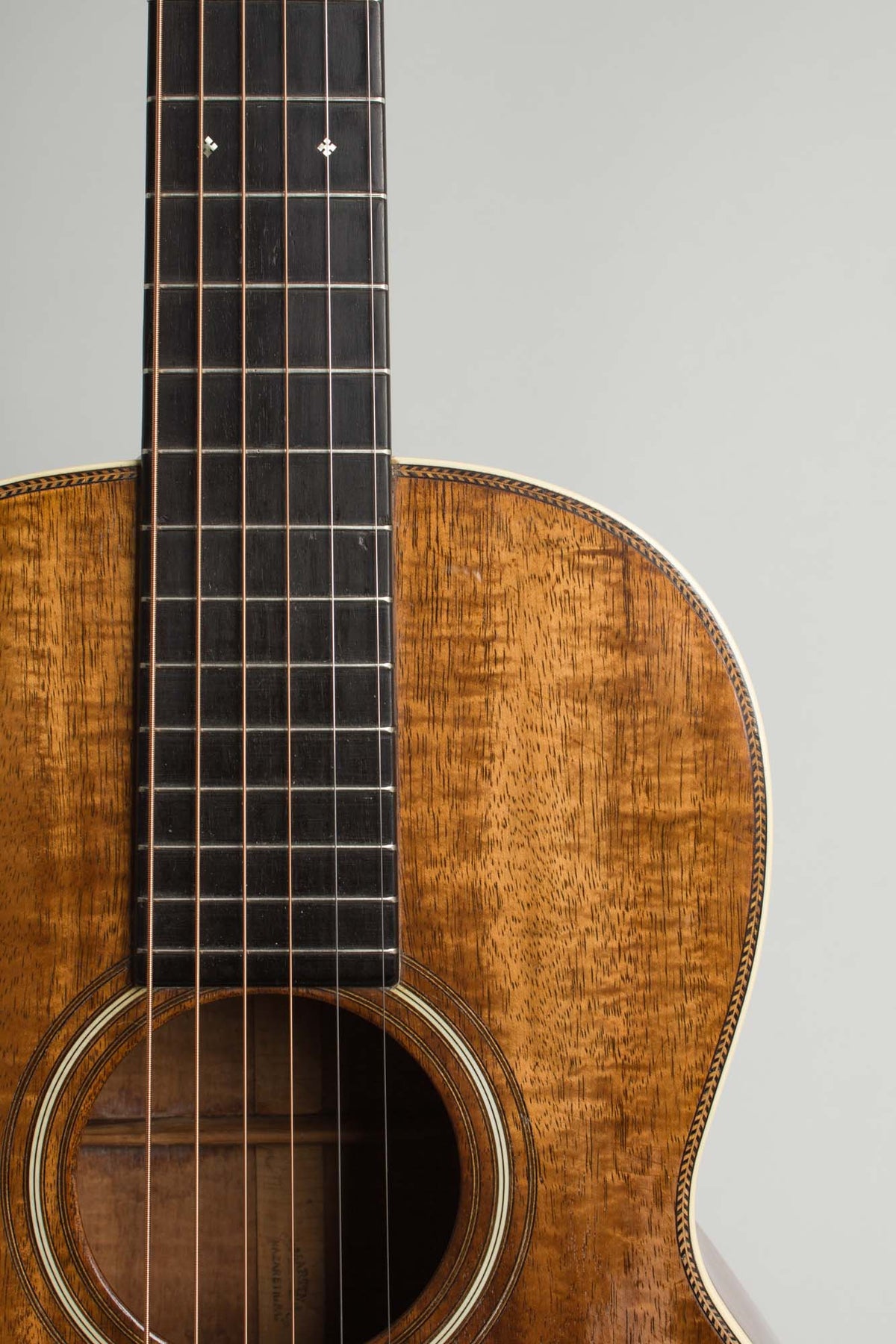
C. F. Martin 0-28K Model Flat Top Acoustic Guitar (1927), made in Nazareth, PA, serial # 34361, natural lacquer finish, koa body, mahogany neck with ebony fingerboard, black tolex hard shell case.
Starting in the mid/late 1910's Martin began fielding requests to make Hawaiian style guitars, as a craze for native musical stylings had recently taken hold of the country. After some (in retrospect) quizzical experiments with fan-bracing tops, Martin settled on retaining their trademark X-bracing, simply replacing the rosewood and spruce normally used for the body with native Hawaiian koa wood. The scalloped X-bracing pattern was the same as used on the standard Martins, just beefed up just a bit as these were intended from the start to use steel strings. While many were destined to be used as lap-style instruments, the early examples were fretted and set up for standard play with a nut elevator used to adapt them for steel playing as needed.
The 0-28K was a more deluxe model, first shipped in 1918 but not officially cataloged until 1923. This one dates to the end of 1927, one of 175 shipped out this peak production year for the model. After the later 20's Martin began to usually ship them in a dedicated Hawaiian mode, but at this point they were still finished out as standard guitars adaptable for lap-style play. As the Hawaiian bands used guitars for rhythm as well as lead, often the same group would request several identical models with differing set ups!
This guitar has the same dimensions and basic features as a standard 1927 Martin 0-28, with the exception of an entirely koa body in place of spruce and rosewood. This wood on this guitar has less cross-grain figure than some we have seen, and the koa is more similar to the lighter type used earlier in the 1920s than the harder, zebra grained wood that is more common later in the decade. The body bindings are ivoroid with the celebrated herringbone trim around the top, the classic mark of the Style 28.
The 12-fret neck is mahogany, with a fairly shallow "C" profile topped by a slotted rosewood-faced headstock and unbound ebony fingerboard inlaid with small slotted pearl diamonds. The tuners are engraved Waverly strips with ivoroid buttons. Construction is very light overall, even compared to later Hawaiian style Martins. Many of these instruments show structural damage from use as Hawaiian guitars in the old A tunings with the heavy strings of the period; the top on this one is still in good shape.
Martin's koa models were somewhat more expensive than standard models in any given style; this guitar listed for $75 (without case) in 1927, a fairly substantial sum at the time. The company imported the wood from Hawaii, usually using an intermediary on the west coast but the process must have added considerable expense. Early koa Martins like this are really a connoisseur's delight, a different and distinct flavor of the best small body flat tops ever made and especially favored for fingerpicked and, as intended, Hawaiian styles. This one has a warmer sound than some; we often find the more open grain, less cross-figured koa used on this guitar enhances this character.
Overall length is 38 1/8 in. (96.8 cm.), 13 5/8 in. (34.6 cm.) wide at lower bout, and 4 3/16 in. (10.6 cm.) in depth at side, taken at the end block. Scale length is 24 3/4 in. (629 mm.). Width of nut is 1 15/16 in. (49 mm.).
This guitar remains in very nice playing condition overall, with typical finish wear and some minor repairs. The thin lacquer finish has some general wear with dings, dents and scrapes overall and quite a bit of heavier scratching on the back. There appears to be some very light inconspicuous overfinish on parts of the top, mostly in the "pickguard" area where there was no guard. There are pick scratches below the soundhole and an area of top finish is rubbed away near the waist on the treble side, with small chips here and there around the top. The finish is worn down to the wood on much of the back of the neck with small dings and dents, some worn smooth again.
There are no grain cracks in the koa body, which is delightful for 95+ years on! The top center seam has been resealed with some finish touch up, but that's it. The ebony bridge remains original, looking slightly lowered long ago in front of the pins. It was reglued at some point with some light scarring around the edges which very common on these, as they were subjected to higher tension than many Martins when new. This bridge has been fitted with a newer slightly compensated bone saddle; helpful as it is mounted straight. The celluloid bridgepins appear original.
The interior of the guitar including the scalloped bracing and thin maple bridge plate remains original; the transverse brace on treble side has been reglued as has the second back brace on bass side. The neck has been reset, and the original bar frets recrowned; the bone nut appears original as well. The fingerboard has a few small chips around the 13th fret from the neckset procedure. The guitar retains its original deluxe three-on-a plate white button Waverly tuners that still work fine.
Overall this is a lovely, fine playing example of a 1920's deluxe koa Martin, a fancy, superbly elegant looking guitar and a great player with a very fine sound. It lives in a more modern HSC. Overall Very Good + Condition.