


Bacon William Place Jr. Artist Model Carved Top Mandolin (1921)


1
/
of
15
Couldn't load pickup availability
Item #13893
Bacon William Place Jr. Artist Model Model Carved Top Mandolin (1921), made in Groton CT, serial # 106, sunburst lacquer finish, fmale maple back and sides, spruce top; laminated maple neck with ebony fingerboard, original black hard shell case.
This is an extremely rare piece, a very early example of the top-of-the-line instrument Mandolin virtuoso William K. Place Jr. helped design for Fred Bacon's company at the beginning of the 1920s. It has a significant repair to the neck but remains an excellent player.
In 1920 Fred Bacon had recently established a new factory in Groton CT, previously having been selling banjos built for him by other manufacturers. Bacon was one of the most respected 5-string banjoists of the day so was friendly with Place, one of the world's most esteemed mandolinists. Bacon apparently wanted to expand into the mandolin market which had been very lucrative for Gibson (among others) in the 1910s. He engaged Place to help design a mandolin line for him, resulting in three models: the "Amateur", the "Professional" and this "Artist" model as the crowning achievement.
Unfortunately as the 1920s began to roar the mandolin suffered a dramatic drop in popularity, the ukulele and tenor banjo becoming the stars of the age. Bacon engaged former Fairbanks designer David Day and the "B&D" line emerged as some of the most successful orchestra banjos of the day. The 1921 Bacon mandolin line pretty much got lost in the shuffle, the Groton factory building only banjos into the 1930s. Based on observed serial numbers, perhaps something over 400 of the entire line were made. William K. Place (who was friendly with Lloyd Loar) became a Gibson endorser and got a very fine F-5 which he became most associated with. He wrote to Loar in August 1923 admitting the new Master Model F-5 had thoroughly bested "Mandolins of my own design".
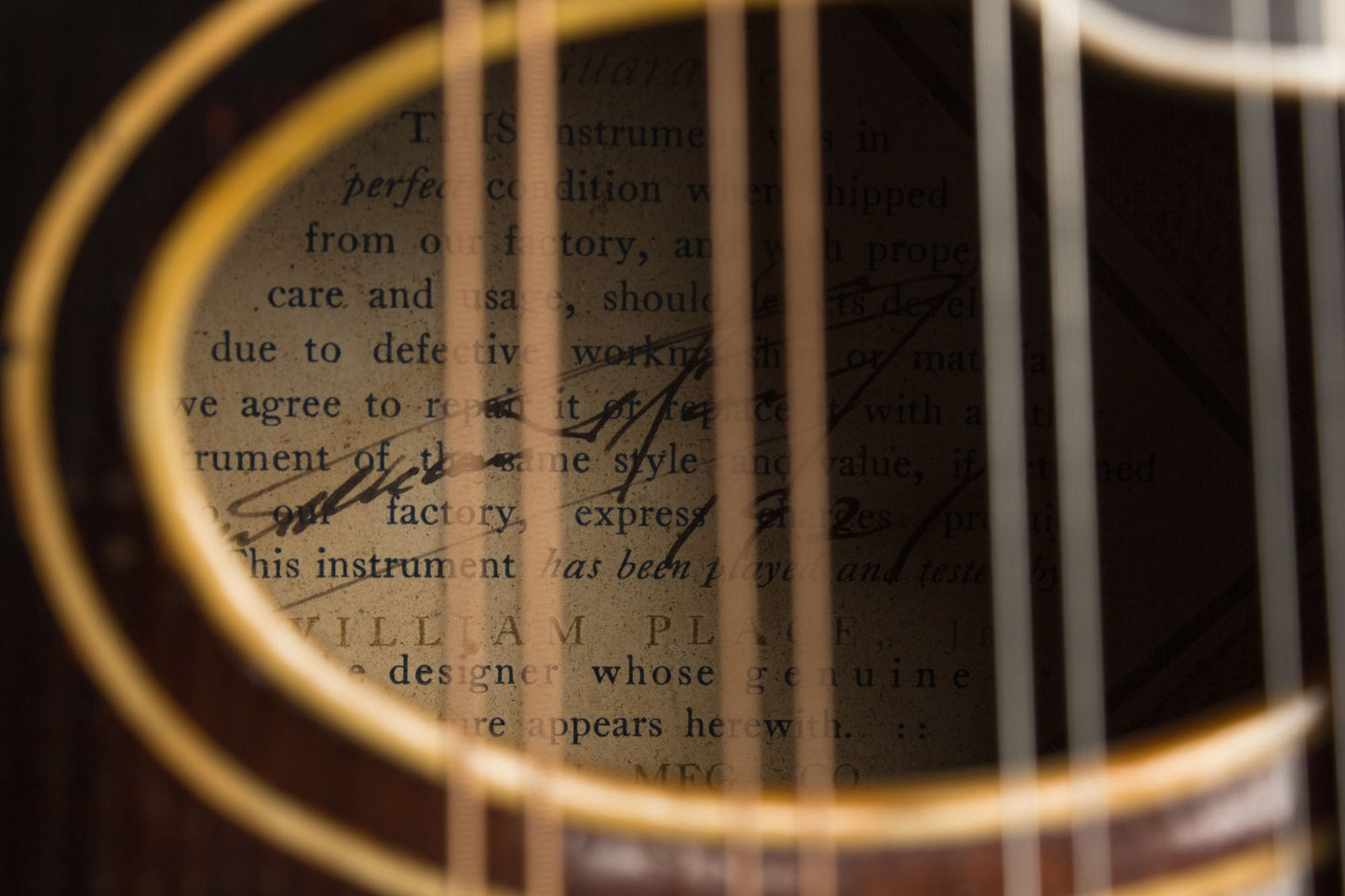
This is not only a lovely example of this very rare Artist model, but one of the first ones built, carrying serial #106. The 1921 list price was $100, less than Gibson's top-line F-4 but more than their oval hole offerings. The label bears Place's signature hand-dated to 1921, an idea Gibson quite likely poached for their Loar signed mandolins a couple of years later! The catalog description reads:
"Designed by William Place Jr. the Celebrated Virtuoso. Instruments which meet his exacting requirements. We secured the services of one of the greatest mandolin players that ever lived, authorizing him to design the instruments for us sparing neither time nor expense. We are confident that in the new William Place Jr. models we are offering instruments which will be appreciated by those who are capable of minute discrimination, who understand tonal values, and who can discern resonance and carrying power. Every mandolin is tested and played by Mr. Place and must meet with his requirements, after which he affixes his autograph. For the player, soloist, teacher and virtuoso the Artist model will prove to be an instrument that will be the companion of a lifetime."
The Artist Model has a carved top and back and an oval soundhole, one of the first non-Gibson instruments built this way. The symmetrical body is oddly shaped but attractive, vaguely reminiscent of a Chianti wine bottle! The carved spruce top is worked somewhat thinner than most Gibsons of the time. The book-matched two-piece back and sides are flame maple, the very Gibson-y "V" profile neck is a 3-piece flame maple laminate with a dark center strip. The headstock face and back are veneered with ebonized wood, with fancy pearl inlay on the face. The body edges are very artistically bound with ivoroid, which extends over the edges giving a rounded fiddle-edge effect. The dark sunburst finish on the top has very little "sun"; the back and sides have a more even blend.
Who actually built these instruments is an open question, but on close examination they do not have telltale signs of the work of Vega or Lyon & Healy, who would be the most likely suspects. It is certainly possible the Fred Bacon was able to hire at least a couple of violin builders for the task. Whoever did the work they are beautifully made, well up to the standards of the best available instruments. The sound is somewhat similar to the Lyon & Healy Style A but a bit gustier, with more power when pushed. David Grisman made enough use of one that Eastman re-created the design in their "Dawg" series as the DGM-2 Mandolin, a repro of his personal Bacon Artist. This is the first of these we have had, and it is a lovely instrument and a fascinating piece of mostly lost mandolin history and lore.
Overall length is 25 3/4 in. (65.4 cm.), 10 in. (25.4 cm.) across at the widest point, and 1 5/8 in. (4.1 cm.) in depth, measured at side of rim. Scale length is 13 3/4 in. (349 mm.). Width of nut is 1 3/16 in. (30 mm.).
This 105-year old mandolin is relatively clean overall but does have one significant repair. There is a well-sealed crack to the neck running from the underneath the nut down to the third fret area diagonally across the grain on both sides. The headstock was not detached, but a significant amount of the neck was cracked through, likely due to a fall. This has been very solidly an cleanly repaired, with the back of the neck refinished from nut to heel. This was well blended but feels a bit more satin-y in character than the rest of the finish. There is some less carefully blended finish around the heel, but overall the job was well done. While the evidence of an unfortunate incident, this repair does not affect the instrument's sound or playability in any way.
The rest of the finish remains all original with some light wear, with a number of tiny dinks to the top. There is no pickwear to speak of. The only other repair is the back center seam was resealed for about two inches off the back edge. All hardware remains original including the tuners, pickguard, elegantly carved bridge and the impossible-to find-if-missing embossed tailpiece cover. There is some light wear to much of it but nothing to serious.
This is a very nice mandolin to play, combining the sweetness of the 1917 Lyon & Healy design with a bit of the "bark" of a Gibson. Currently the action is just over 3/32" bass and just under the same on the treble side; this is a hair higher than out shop standard but sounds great and allows considerable forcing. It could be lowered by re-working the original bridge if desired, which we can do on request. This is the first of these Bacon mandolins we have had and we are much impressed by the workmanship and tone, even of the body shape initially appears a bit odd! It lives in what appears to be the original HSC, although the fit is inexact. Overall Very Good + Condition.
View full details
This is an extremely rare piece, a very early example of the top-of-the-line instrument Mandolin virtuoso William K. Place Jr. helped design for Fred Bacon's company at the beginning of the 1920s. It has a significant repair to the neck but remains an excellent player.
In 1920 Fred Bacon had recently established a new factory in Groton CT, previously having been selling banjos built for him by other manufacturers. Bacon was one of the most respected 5-string banjoists of the day so was friendly with Place, one of the world's most esteemed mandolinists. Bacon apparently wanted to expand into the mandolin market which had been very lucrative for Gibson (among others) in the 1910s. He engaged Place to help design a mandolin line for him, resulting in three models: the "Amateur", the "Professional" and this "Artist" model as the crowning achievement.
Unfortunately as the 1920s began to roar the mandolin suffered a dramatic drop in popularity, the ukulele and tenor banjo becoming the stars of the age. Bacon engaged former Fairbanks designer David Day and the "B&D" line emerged as some of the most successful orchestra banjos of the day. The 1921 Bacon mandolin line pretty much got lost in the shuffle, the Groton factory building only banjos into the 1930s. Based on observed serial numbers, perhaps something over 400 of the entire line were made. William K. Place (who was friendly with Lloyd Loar) became a Gibson endorser and got a very fine F-5 which he became most associated with. He wrote to Loar in August 1923 admitting the new Master Model F-5 had thoroughly bested "Mandolins of my own design".
This is not only a lovely example of this very rare Artist model, but one of the first ones built, carrying serial #106. The 1921 list price was $100, less than Gibson's top-line F-4 but more than their oval hole offerings. The label bears Place's signature hand-dated to 1921, an idea Gibson quite likely poached for their Loar signed mandolins a couple of years later! The catalog description reads:
"Designed by William Place Jr. the Celebrated Virtuoso. Instruments which meet his exacting requirements. We secured the services of one of the greatest mandolin players that ever lived, authorizing him to design the instruments for us sparing neither time nor expense. We are confident that in the new William Place Jr. models we are offering instruments which will be appreciated by those who are capable of minute discrimination, who understand tonal values, and who can discern resonance and carrying power. Every mandolin is tested and played by Mr. Place and must meet with his requirements, after which he affixes his autograph. For the player, soloist, teacher and virtuoso the Artist model will prove to be an instrument that will be the companion of a lifetime."
The Artist Model has a carved top and back and an oval soundhole, one of the first non-Gibson instruments built this way. The symmetrical body is oddly shaped but attractive, vaguely reminiscent of a Chianti wine bottle! The carved spruce top is worked somewhat thinner than most Gibsons of the time. The book-matched two-piece back and sides are flame maple, the very Gibson-y "V" profile neck is a 3-piece flame maple laminate with a dark center strip. The headstock face and back are veneered with ebonized wood, with fancy pearl inlay on the face. The body edges are very artistically bound with ivoroid, which extends over the edges giving a rounded fiddle-edge effect. The dark sunburst finish on the top has very little "sun"; the back and sides have a more even blend.
Who actually built these instruments is an open question, but on close examination they do not have telltale signs of the work of Vega or Lyon & Healy, who would be the most likely suspects. It is certainly possible the Fred Bacon was able to hire at least a couple of violin builders for the task. Whoever did the work they are beautifully made, well up to the standards of the best available instruments. The sound is somewhat similar to the Lyon & Healy Style A but a bit gustier, with more power when pushed. David Grisman made enough use of one that Eastman re-created the design in their "Dawg" series as the DGM-2 Mandolin, a repro of his personal Bacon Artist. This is the first of these we have had, and it is a lovely instrument and a fascinating piece of mostly lost mandolin history and lore.
Overall length is 25 3/4 in. (65.4 cm.), 10 in. (25.4 cm.) across at the widest point, and 1 5/8 in. (4.1 cm.) in depth, measured at side of rim. Scale length is 13 3/4 in. (349 mm.). Width of nut is 1 3/16 in. (30 mm.).
This 105-year old mandolin is relatively clean overall but does have one significant repair. There is a well-sealed crack to the neck running from the underneath the nut down to the third fret area diagonally across the grain on both sides. The headstock was not detached, but a significant amount of the neck was cracked through, likely due to a fall. This has been very solidly an cleanly repaired, with the back of the neck refinished from nut to heel. This was well blended but feels a bit more satin-y in character than the rest of the finish. There is some less carefully blended finish around the heel, but overall the job was well done. While the evidence of an unfortunate incident, this repair does not affect the instrument's sound or playability in any way.
The rest of the finish remains all original with some light wear, with a number of tiny dinks to the top. There is no pickwear to speak of. The only other repair is the back center seam was resealed for about two inches off the back edge. All hardware remains original including the tuners, pickguard, elegantly carved bridge and the impossible-to find-if-missing embossed tailpiece cover. There is some light wear to much of it but nothing to serious.
This is a very nice mandolin to play, combining the sweetness of the 1917 Lyon & Healy design with a bit of the "bark" of a Gibson. Currently the action is just over 3/32" bass and just under the same on the treble side; this is a hair higher than out shop standard but sounds great and allows considerable forcing. It could be lowered by re-working the original bridge if desired, which we can do on request. This is the first of these Bacon mandolins we have had and we are much impressed by the workmanship and tone, even of the body shape initially appears a bit odd! It lives in what appears to be the original HSC, although the fit is inexact. Overall Very Good + Condition.


Loading...
Just arrived!
Item #