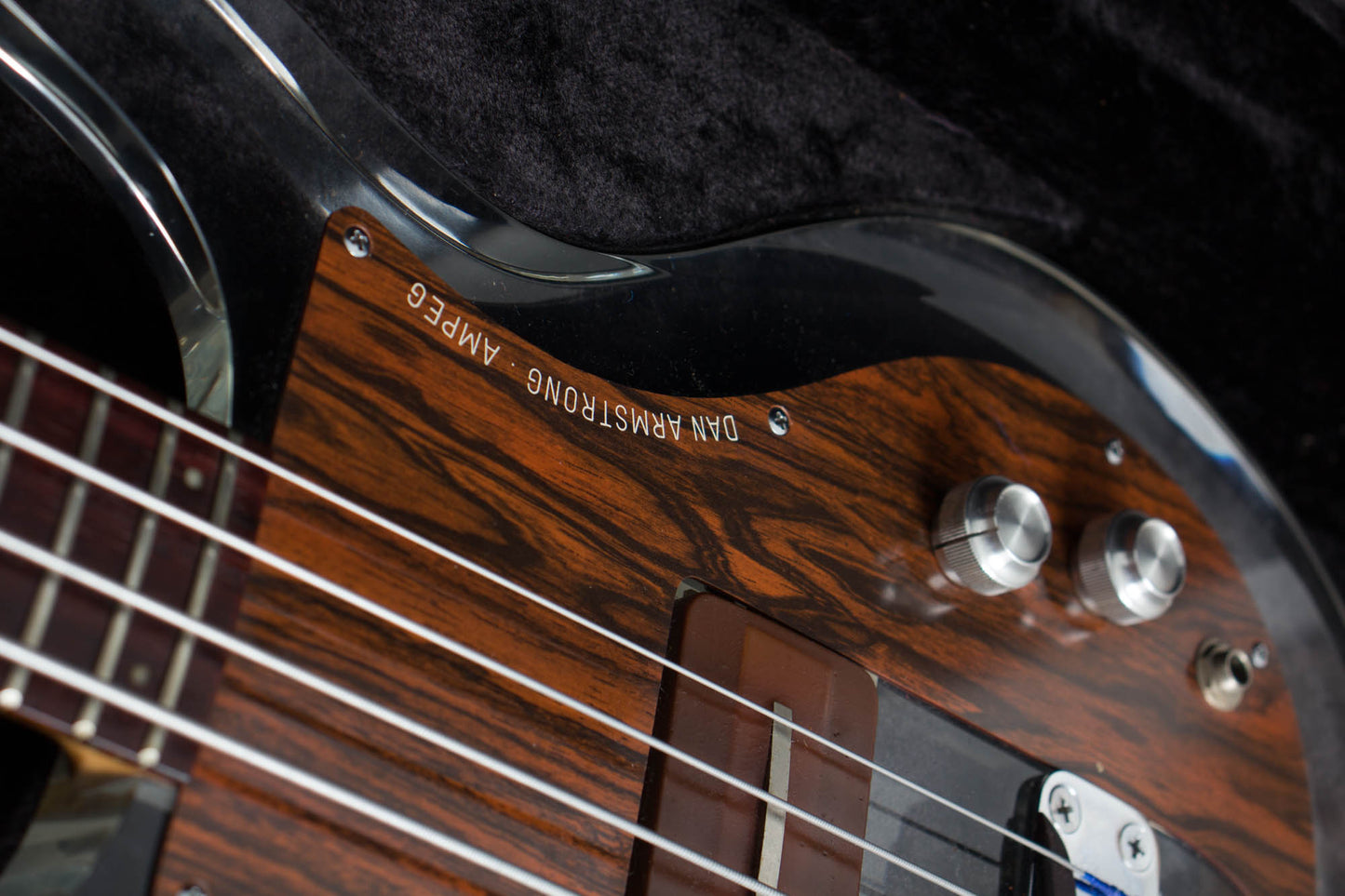
Ampeg Dan Armstrong Model Solid Body Electric Bass Guitar (1969), made in New Jersey, serial # D660A, clear acrylic finish, acrylic body, maple neck with rosewood fingerboard, original black hard shell case.
This is a fine example of one of the last great 1960s American guitar/bass ideas, the Ampeg Dan Armstrong, nicknamed the "See Through" for obvious reasons. In 1968 amplifier giant Ampeg was looking to get into the guitar and bass market, after several previous attempts had met with middling results. They consulted New York-based Dan Armstrong whose "hip" guitar shop had become a Mecca for electric players.
Armstrong agreed to design what they billed as "The Ultimate Guitar", a high quality instrument that was an original concept, not a re-tread. The resulting guitar and bass were both visually and sonically unique. In contrast to many over-designed 1960s instruments, Armstrong emphasized clean lines and simplicity -- so clean, in fact, that you can see right through it!
The most radical element is the body, cut from a block of transparent Lucite. The deep double cutaway offers access to all 24 frets, inspired by the Danelectro Longhorn. The edges were contoured to reduce weight and make it comfortable to play. The design has other kinship with Danelectros. The chrome bridgeplate was similar, but bolted solidly to the body with a similar one-piece rosewood saddle. A whimsical touch is a wood-grained Formica pickguard and headstock facing -- a visual pun on a plastic guitar!
While Armstrong's "ultimate" guitar had interchangeable pickups, the Bass was not built with this facility. Instead it has a single stacked humbucker designed with Bill Lawrence set in the middle position. This is a very powerful and aggressive sounding unit with a tone control that blends the coils offering an unusually wide range of sounds. This makes for a surprisingly versatile bass with tones range from a bright Danelectro-like twang to a deep Gibson-y thump from just the one pickup. This bass is a fairly early example, not fitted with a tone modifying switch added later.
The 30" scale neck is relatively traditional, made of maple with a rosewood fingerboard and bolted solidly to the body. The small, slightly asymmetrical headstock looks graceful and still rather modern. The truss rod is adjusted at the head, which is equipped with Grover Rotomatic machine heads. The short-scale neck has a somewhat "Gibson-y" feel despite the Fender-like materials; short-scale basses were losing favor at the time and this is about the last classic design of its type.
The Dan Armstrong/Ampeg guitar and bass set were launched when established guitar names were perceived as losing some luster. The "See Throughs" (a term Ampeg trademarked) were premiered at the June 1969 NAMM show, listing at $290.00 plus $60 for the case. They got a huge boost when the Rolling Stones took a set on their epic 1969 US Tour. The guitar became forever linked to Keith Richards, and other players soon followed "Keef's" lead. Bill Wyman used the bass for a time in the early '70s, as did Jack Bruce.
Unfortunately the "See-Throughs" had a short production life. Armstrong experienced issues with Ampeg management and refused to continue his agreement. They ceased production in 1971 with around 3,000 each of the guitar and bass produced over less than 2 years. The Ampeg/Armstrong remains unique today despite many other subsequent instruments made from different plastics. It still exudes a supreme badass cool, plays great and sounds as unique as it looks.
Overall length is 42 1/4 in. (107.3 cm.), 13 1/8 in. (33.3 cm.) width, and 1 1/8 in. (2.9 cm.) . Scale length is 30 in. (762 mm.). Width of nut is 1 5/8 in. (41 mm.).
This bass is all original and quite clean overall. It shows some light play wear, mostly scratching into the Acrylic which is most prominent on the upper back. There are a couple of feelable dings in the treble side of the neck around the 5-6th fret area. The pickup works great and has none of the flaking of the outer casing that is common with these. The frets show only some light wear. The original case is also intact with some general exterior wear. This is a superb example of this beautiful if eccentric classic, and a very cool bass to play still. Excellent - Condition.