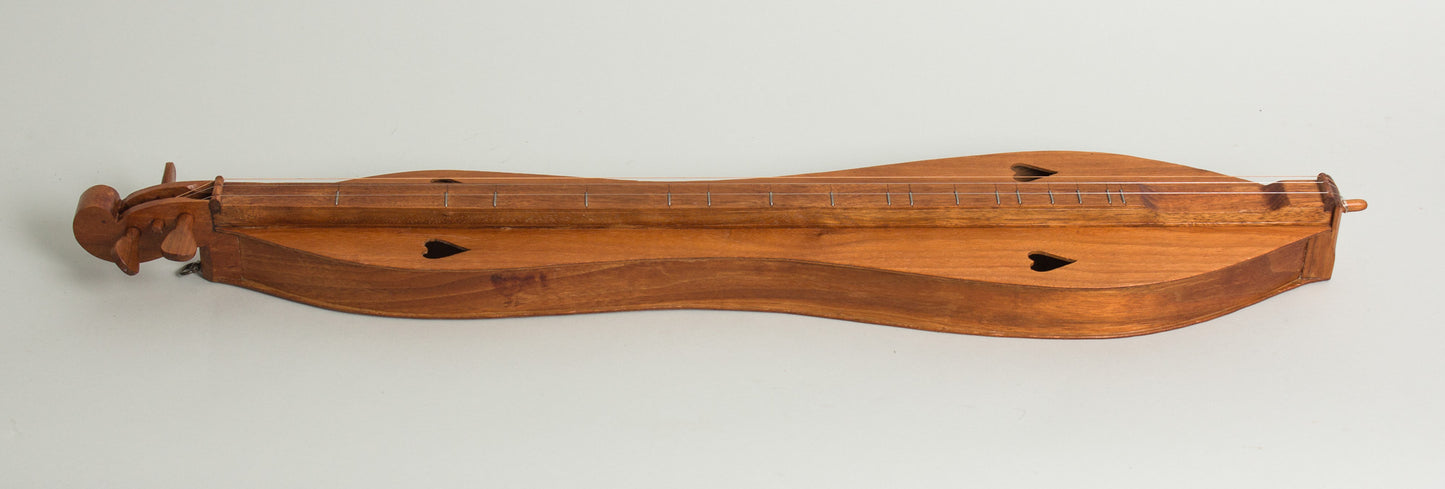
Amburgey 3-String Model Appalachian Dulcimer (1964), made in Hindman, Kentucky, serial # 605, natural finish, cherry top, back, and sides.
Here is a fine dulcimer specimen from the hands of Jethro Amburgey, born in Appalachian Kentucky in the late 1800s. Amburgey was a prolific builder responsible for building well over a thousand dulcimers in his time, some of which are featured in prominent national collections such as the Smithsonian and National Museum of American History. Jethro was a student of notable early dulcimer maker Ed Thomas. Living as a high school woodworking teacher himself, he also went on to teach his son Morris the craft of dulcimer making as well before passing away in 1971.
This is nicely constructed example of a 3-string Appalachian dulcimer with a more unusual half-fret fingerboard; only one string can be properly fretted, and the middle string can either be played as a drone or fretted (with a small amount of additional effort). Outside of that, the dulcimer has hand-carved cherry friction tuning pegs in the quite squat scroll headstock, a sort of dowel-like protrusion for a tailpiece to hold loop end strings, and the ever-charming heart shaped soundholes.
Length is 32 1/2 in. (82.6 cm.), 5 7/8 in. (14.9 cm.) wide at lower bout, and 2 5/8 in. (6.7 cm.) in depth at deepest point.
This is an overall well-kept example of a higher quality dulcimer with little more than a few scrapes and scuffs, primarily on the back, from use through the years. There is one very small sealed crack about an inch long on the lower treble side bout that is sturdy and hardly noticeable. The narrow 3-string peghead is in perfect working order with the three original hand-carved tuning pegs. The original partial frets are in good shape with only trace shows of wear. The whole unit held close emits a faint woody aroma and plays just fine.
The label inside bearing Amburgey's name as well as the date and serial number is clearly visible inside one of the heart soundholes. It does not come with a bag and almost certainly would not have when leaving the shop in 1964. Overall Excellent - Condition.